15 Contact Center Automation Trends Shaping Customer Experience in 2026

15 Contact Center Automation Trends Shaping Customer Experience in 2026



The contact center landscape is undergoing a fundamental transformation. What was once a cost center focused on handling customer complaints has evolved into a strategic hub for customer experience and brand loyalty. According to Gartner, 85% of customer service leaders now use conversational AI, signaling that automation is no longer optional but essential for competitive organizations
As customer expectations continue to rise and technology advances at an unprecedented pace, businesses must stay ahead of the curve. In this comprehensive guide, we explore the 15 contact center automation trends that are reshaping how organizations interact their customers in 2026 and beyond.
Need for Contact Center Automation
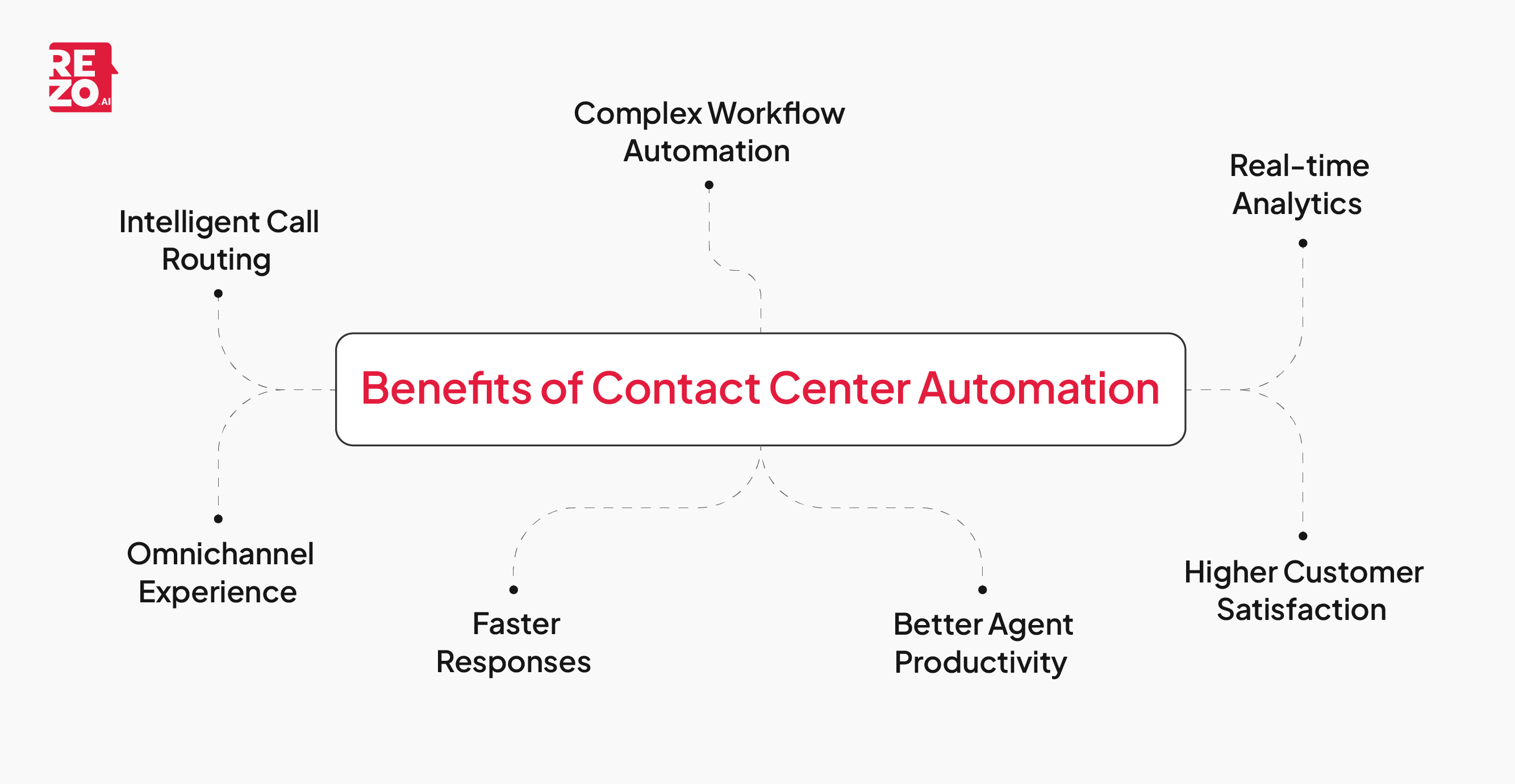
Call centers and contact centers have long struggled with operational efficiency, as customer service teams often fail to deliver fast and accurate resolutions to customer queries. This leads to higher AHT and lower CSAT. With contact center automation tools, contact center operations can become significantly more efficient, resulting in increased cost savings, higher customer satisfaction, and improved service quality.
Top 15 Contact Center Automation Solutions and Trends
1. Generative AI
Generative AI has rapidly transitioned from an emerging technology to an essential capability in contact centers. According to Industry Reports, 80% of customer service and support organizations will be using generative AI to boost agent productivity and enhance customer experience.
This technology is transforming how contact centers operate in several ways. Agents can now generate accurate, contextual responses in seconds rather than searching through knowledge bases manually. Generative AI excels at summarizing lengthy customer histories, drafting email responses, and creating personalized solutions on the fly.
The impact extends beyond customer-facing interactions. Generative AI automates documentation, creates training materials, and helps build comprehensive knowledge repositories.
2. Agentic AI and Multi-Agent Orchestration
Agentic AI represents a paradigm shift from traditional chatbots and virtual assistants. Unlike rule-based systems that follow predefined scripts, agentic AI powered agents can reason, plan, and execute more complex tasks and complex customer requests autonomously. Industry analysts predict that AI automation rates will increase fivefold by 2026.
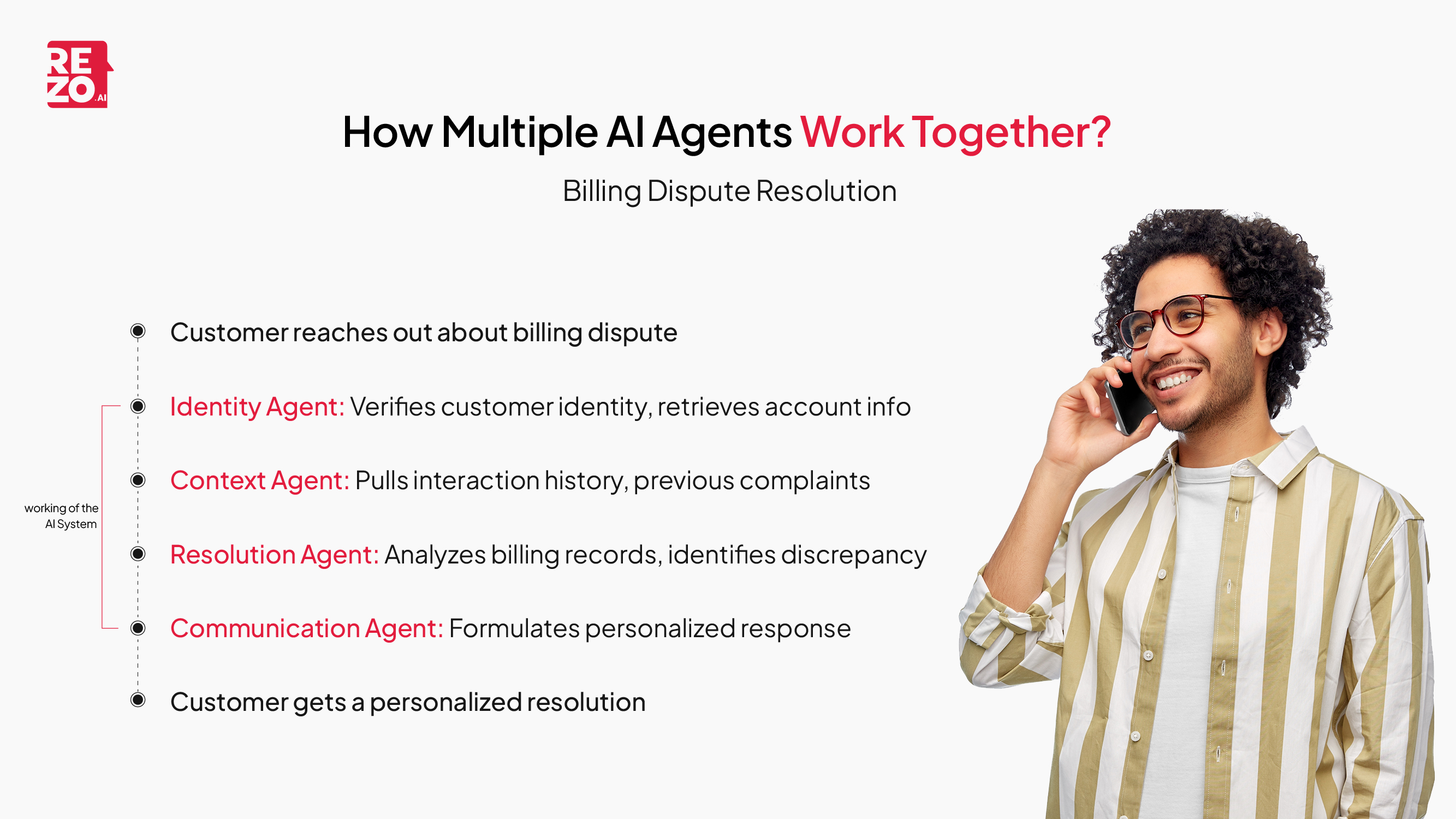
What makes agentic AI particularly powerful is multi-agent orchestration. Instead of a single AI handling all tasks, multiple specialized AI agents work together, sharing context, streamlining workflows, dividing responsibilities, and coordinating across systems. One agent might handle initial customer identification while another retrieves account information and a third formulates the response.
This collaborative approach enables AI to solve more complex customer issues end to end without human intervention. The technology is moving AI from being a simple tool to becoming a genuine coworker in the contact center environment that can manage customer demand and perform time consuming tasks with ease. AI agents also significantly reduce contact center costs by increasing customer satisfaction and improving customer retention.
3. AI Voice Agents
Voice remains a critical channel for customer service, and AI voice agents are becoming increasingly sophisticated. These systems leverage Machine Learning and Natural Language Processing (NLP) for understanding customer intent, Automatic Speech Recognition (ASR) for real-time transcription, and Text-to-Speech (TTS) for natural-sounding responses.
Modern AI voice agents can handle complex customer inquiries, multi-turn conversations that feel natural to customers. They understand context, remember previous statements in the conversation, and can navigate nuanced requests. The technology has advanced far beyond simple interactive voice responses (IVR) menus to create personalized customer service.
For one of our clients at Rezo AI, we deployed an AI-powered Voice Bot that automated 66% of inbound interactions, operated 24/7, and integrated seamlessly with their existing CRM systems. This automation strategy improved customer satisfaction scores, reduced average handle time, and boosted overall agent performance
Read the Full Case Study Here:- Livguard Optimized its Contact Center Efficiency.
4. Real Time Agent Assistance
Rather than replacing human agents, automated call centers are positioning AI as a contact center agent’s best friend and most-used tool. These virtual agents focus on augmenting human capabilities rather than automating customer interactions entirely.
AI agents assist agents in multiple ways. They summarize customer history and previous interactions instantly, analyse customer data, give insights on customer sentiment, automate time-consuming post-call documentation, provide real-time suggestions during conversations, and surface relevant knowledge base articles without manual searching. This support helps agents handle routine inquiries faster and more accurately.
The impact on agent wellbeing is significant. Studies show that 74% of call center agents are at risk of burnout, and AI assistance helps reduce this burden by eliminating repetitive tasks and providing guidance during difficult interactions thus increasing job satisfaction, which in turn also increases contact center efficiency.
5. Omnichannel Integration
Customers today expect seamless experiences across all communication channels. Omnichannel integration unifies voice, chat, email, SMS, and social media into a single platform, ensuring consistent service regardless of how customers choose to connect.
The key to successful omnichannel integration is context preservation. When a customer starts a conversation on chat and later calls in, the agent should have full visibility into the previous interaction. AI-powered routing ensures customers reach the right resource while carrying their history with them.
This unified approach eliminates the frustration of customers having to repeat themselves across channels. It also provides organizations with a complete view of the customer journey, enabling better service and more informed decision-making, providing for an effortless customer experience.
6. Smart Call Routing
Traditional call routing relied on simple rules like round-robin distribution or basic skill matching. AI powered systems for smart call routing take a fundamentally different approach, analyzing customer intent, interaction history, and agent capabilities to make intelligent routing decisions that improves customer service.
AI-powered routing considers multiple factors simultaneously. It evaluates the nature of the inquiry, the customer’s value and history, the complexity of the issue, and which available agent has the best track record with similar cases. This matching process happens in milliseconds, creating better outcomes for both customers and agents.
The benefits extend beyond simple efficiency. By matching customers with the most suitable agents, organizations see improved first-call resolution rates and higher customer satisfaction.
7. Lead Scoring and Qualification
Contact centers increasingly serve as revenue-generating hubs, not just support functions. AI-powered lead scoring analyzes customer behavior, interaction patterns, and engagement signals to automatically prioritize high-value prospects.
During live conversations, AI can qualify leads in real-time by analyzing language patterns, questions asked, and expressed needs. This information flows directly into CRM systems, ensuring sales teams have the context they need for effective follow-up.
AI agents use predictive analytics to identify cross-sell and upsell opportunities during support interactions. When a customer calls about one product, AI can detect signals that suggest interest in complementary offerings.
8. Mobile-First Customer Experience
With mobile devices dominating how customers interact with businesses, contact centers must prioritize customer service processes for mobile-first experiences. This means designing support interactions that work seamlessly on smartphones, from in-app support to click-to-call functionality.
Mobile-first strategies include SMS support, messaging app integration with platforms like WhatsApp and Messenger, and responsive self-service portals. Customers can start a support interaction on their phone, switch to another device, and continue without losing context.
Visual IVR represents another mobile innovation, allowing customers to navigate support options through their smartphone screen rather than listening to lengthy voice menus. This approach reduces frustration and speeds resolution times providing great customer service.
9. Proactive and Predictive Customer Service
Traditional contact centers operate reactively, waiting for customers to reach out with problems. The next frontier is predictive service that anticipates customer needs before they even contact support.
AI agent analyzes patterns in customer behavior, product usage, and historical data to forecast potential issues. If a customer’s usage pattern suggests they might encounter a problem, the system can trigger proactive outreach with a solution before frustration sets in.
Examples include alerting customers about unusual account activity, notifying them of service disruptions that might affect them, or reaching out when a subscription is about to expire. This shift from reactive to proactive service transforms the customer relationship from transactional to consultative in turn increasing customer effort score.

10. Hyper-Personalization at Scale
Personalization has moved from competitive advantage to baseline expectation. Research shows that consumers expect personalized interactions, and become frustrated when they do not receive them.
Contact center automation enables hyper-personalization by creating detailed, dynamic customer profiles that update with every interaction. Agents see not just basic account information but preferences, past issues, communication style preferences, and predicted needs.
AI tailors responses, recommendations, and solutions in real-time based on this rich context. A returning customer receives a different experience than a first-time caller, and a technical expert receives different explanations than a novice user.
11. Real-Time Analytics and Sentiment Analysis
Real-time analytics transform how agents handle live interactions. Sentiment analysis monitors customer emotions throughout conversations, alerting agents to frustration or satisfaction signals as they occur.
With call center automation solutions, agents can adjust their approach mid-conversation based on AI-generated insights. If sentiment turns negative, the system might suggest specific phrases or escalation options. If the customer seems satisfied, it might recommend relevant add-on services.
The adoption of real-time analytics has grown 5-10% annually and continues to accelerate. Beyond individual interactions, this data feeds into broader operational improvements, identifying training needs and process bottlenecks.
12. AI-Powered Quality Assurance
Traditional quality assurance involves supervisors manually reviewing a small sample of calls, typically 1-3% of total interactions. AI-powered QA transforms this process by automatically analyzing every customer conversation across all channels.
Unified interaction data from voice, chat, email, and social channels feeds into AI systems that evaluate performance against defined criteria. Customer service automation identifies coaching opportunities, compliance issues, and best practices without human reviewers spending hours listening to recordings.
This comprehensive approach ensures consistent quality standards across all interactions, not just the random sample that traditional methods capture. Agents receive faster, more specific feedback, accelerating their development.
13. Robotic Process Automation (RPA)
Robotic Process Automation handles routine tasks that consume agent time without adding customer value. RPA bots can update multiple systems simultaneously, process forms, verify information, and handle routine administrative work.
What makes RPA particularly valuable is its ability to integrate with existing systems without requiring major infrastructure changes. Bots interact with legacy applications the same way humans do, making implementation faster and less disruptive than full system replacements for customer service providers.
Call center automation software scales easily to handle volume fluctuations and can be tailored to automate quality assurance processes or monitor compliance with service standards.
14. Self-Service and Knowledge Management
Customer preferences have shifted dramatically toward self-service options. Research indicates that 61% of customers prefer self-service for resolving simple inquiries rather than waiting for an agent
AI-powered knowledge bases go beyond simple FAQ pages. They understand natural language questions, provide contextual answers, and offer interactive troubleshooting guides that walk customers through solutions step by step. When AI agents cannot resolve an issue, the system seamlessly escalates to a human agent with full context.
Effective self-service reduces agent workload while improving customer satisfaction for straightforward issues. The key is ensuring the technology handles simple requests effectively while routing complex issues to human agents appropriately.
15. The Evolving Role of Human Agents
As automation handles more routine interactions, the role of human agents is fundamentally changing. Rather than processing high volumes of simple requests, human agents increasingly focus on complex, emotionally nuanced cases that require human judgment and empathy.
This shift is reflected in customer preferences. Research shows that53% of consumers still prefer speaking to a live human agent for complex issues, even as they embrace automation for simpler queries. The human touch remains essential for situations requiring creativity, emotional intelligence, or complex problem-solving.
Agents are also becoming AI supervisors and coaches, monitoring automated systems, handling escalations, and training AI models through their feedback. Contact centers are transforming into “experience centers” where human agents deliver high-value interactions while AI handles routine work.

Conclusion
The 15 trends outlined in this article represent a fundamental shift in how contact centers operate. From generative AI and agentic systems to smart routing and hyper-personalization, automation is transforming every aspect of customer service.
However, successful implementation requires balance. Organizations that rushed AI deployment without proper planning have experienced negative consequences, with 44% reporting issues from hasty implementation. The most effective approach combines automation with human oversight, using AI to enhance rather than replace human capabilities and continuous improvements based on existing results. It is also important to identify key performance indicators for the AI systems and measure them.
As contact centers evolve into experience centers, the organizations that thrive will be those that strategically embrace these trends while maintaining the human connection that customers value. The future belongs to contact centers that leverage automation intelligently while never losing sight of the customer experience at the heart of their mission.
Frequently Asked Questions
What are the call center automation trends for 2026?
Call center automation trends include the integration of AI for both chatbots and agent assistance. They also focus on delivering hyper-personalization and leveraging predictive analytics for more proactive customer support. Additionally, these trends emphasize providing an omnichannel customer experience.
What is the future of call centers?
The future of customer service operations in call centers includes the integration of AI-powered systems that can manage customer queries, as well as inbound and outbound calls, to deliver an efficient, personalized, and unified customer experience. AI systems can handle repetitive tasks, allowing human agents to focus on more complex issues. This approach reduces operational costs, improves service quality, and enhances overall customer satisfaction.
Frequently Asked Questions (FAQs)


Take the leap towards innovation with Rezo.ai
Get started now