Omnichannel Customer Support: The Complete Guide to Delivering Seamless Customer Experiences

Omnichannel Customer Support: The Complete Guide to Delivering Seamless Customer Experiences


In today’s hyperconnected world, customers interact with businesses through multiple channels, from social media and live chat to email and phone calls. They expect these interactions to be seamless, consistent, and personalized regardless of how they choose to reach out. This expectation has given rise to omnichannel customer experience, and it has become essential for businesses seeking to meet modern customer demands and stay competitive.
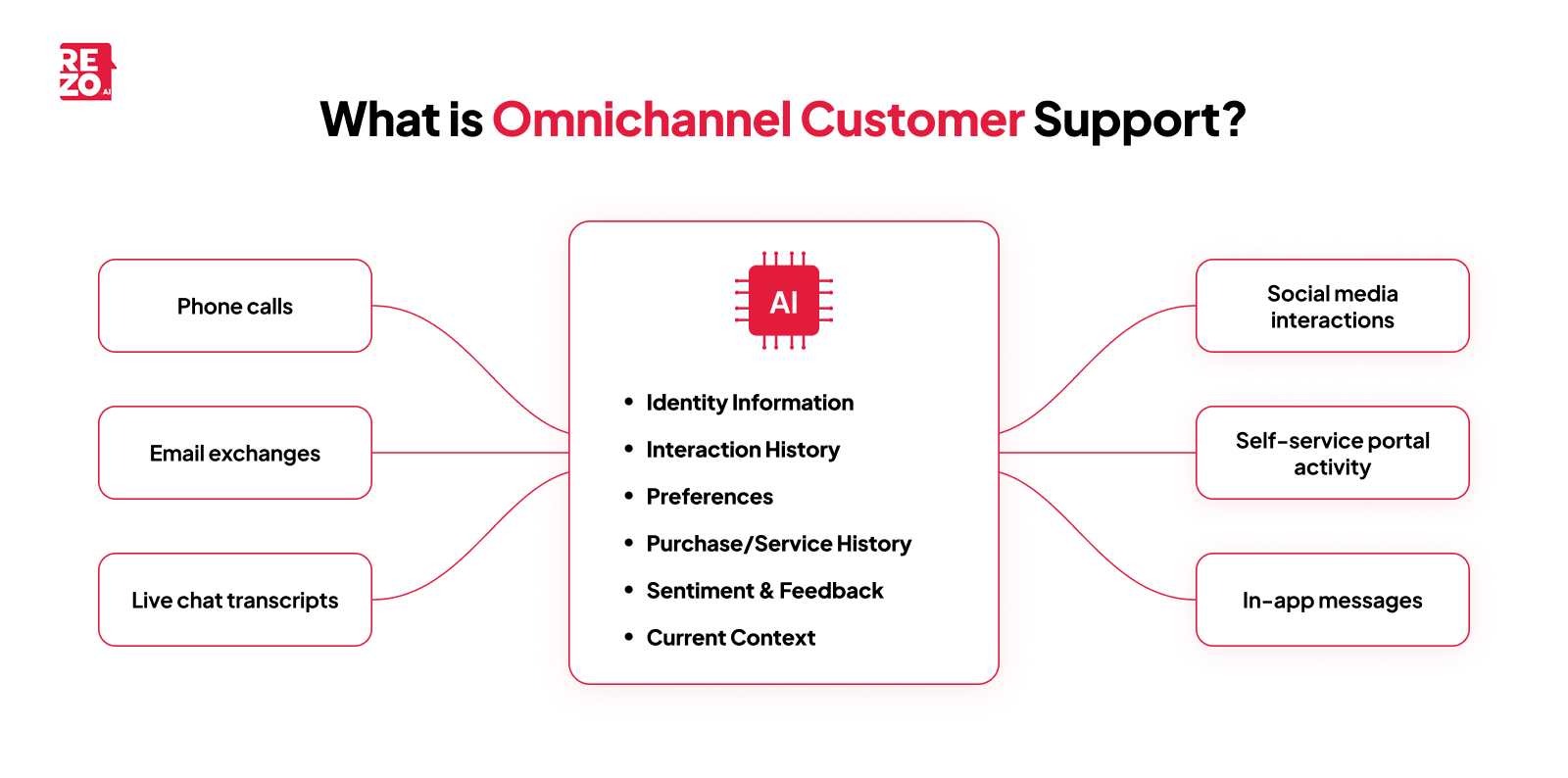
What is Omnichannel Customer Support?
Omnichannel customer support is a customer experience strategy that creates connected and consistent interactions across all communication channels. Unlike multichannel support, where each channel operates in isolation, omnichannel support synchronizes all touchpoints to provide agents with a complete view of customer interactions regardless of where or how the customer reached out.
The key distinction lies in integration. While multichannel support simply offers multiple ways for customers to contact a business, omnichannel customer service strategy ensures that the context and history of previous interactions carry over seamlessly from one channel to another throughout the entire customer journey. This means a customer can start a conversation on social media, continue it via email, and resolve it through a phone call without ever having to repeat themselves.
Industry report reveals a troubling reality: only 13% of companies report that customer data, history, and context carry over fully across interactions and channels. This gap between customer expectations and actual service delivery represents both a challenge and an opportunity for forward-thinking businesses.
Omnichannel vs. Multichannel: Understanding the Difference
Before diving deeper, it is important to clarify a common point of confusion. Many businesses use the terms “multichannel” and “omnichannel” interchangeably, but they represent fundamentally different approaches to customer service.
Multichannel customer support means offering customers multiple communication channels to reach your business, such as phone, email, chat, and social media. However, these channels typically operate independently. A customer service agent handling a phone call has no visibility into the customer’s previous chat conversation or email exchange.
Omnichannel customer service takes this further by connecting all channels into a unified system. Every interaction, regardless of channel, feeds into a central platform that provides agents with complete customer context. According to Salesforce, 59% of customers say tailored engagement based on past interactions is very important to winning their business. This level of personalization is only possible with true omnichannel integration.
The practical difference is significant. Research shows that 56% of customers say they have to repeat themselves during support interactions, a frustration that stems directly from disconnected multichannel systems. An omnichannel customer service platform eliminates this pain point by ensuring context travels with the customer.
Why Omnichannel Customer Support Matters in 2026?
The importance of omnichannel customer support cannot be overstated. According to Gartner, 93% of customers reported higher customer satisfaction (CSAT) when they were able to seamlessly transition from one service channel to another providing a consistent experience. Conversely, customers perceive 62% of channel transitions as “high effort,” highlighting the gap between expectation and reality.
Research found that 70% of consumers expect consistent interactions across all channels, while 73% believe companies should inherently understand their expectations. Furthermore, 62% of customers expect businesses to proactively anticipate their needs. These changes in customer behavior have fundamentally shifted how businesses must approach customer service.
The stakes are high. PwC research indicates that 32% of customers will walk away after having a single bad experience, and 86% of buyers are willing to pay more for a better customer experience. In an era where customer loyalty is increasingly difficult to earn, a successful omnichannel strategy has become a critical differentiator.
The Business Case for Omnichannel Support
Companies that invest in strong omnichannel strategies to enhance customer interactions see remarkable results. Research shows that companies with extremely strong omnichannel marketing strategy retain on average 89% of their customers, compared to just 33% for companies with weak omnichannel engagement.
Latest reports demonstrates that customer satisfaction reaches 67% with smooth omnichannel approach, compared to just 28% for disconnected multi channel customer service. The same research found that companies providing an omnichannel platform transformations see a 5-15% increase in total revenue.
According to a study conducted by Forrester, 46% of respondents noted a rise in customer lifetime value with omnichannel customer engagement, while 36% experienced improved operational efficiency. The research also found that existing customers who receive high-quality personalized experiences on multiple platforms are 3.6 times more likely to make additional purchases.
Further industry trends reveals that companies with strong omnichannel engagement see a 9.5% year-over-year increase in annual revenue, compared to 3.4% for weak omnichannel companies. Additionally, strong performers experience a 7.5% year-over-year decrease in cost per contact.
Key Components of Effective Omnichannel Support
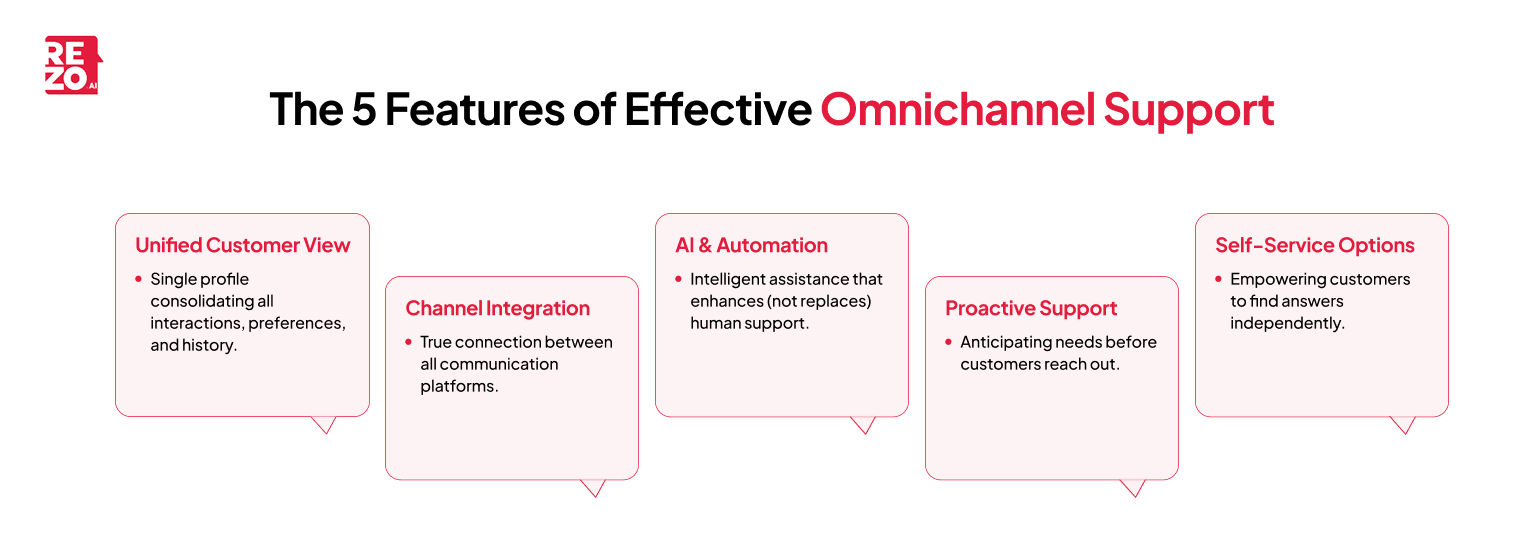
Unified Customer View
The foundation of omnichannel support is a unified customer profile that consolidates all interactions, preferences, and history into a centralized database. This enables support agents to provide personalized support without asking customers to repeat information on their preferred channels. According to research, 77% of strong omnichannel companies store customer data across channels, compared to just 48% of weak omnichannel companies.
Channel Integration
Effective omnichannel support requires true integration between different channels. This means that a conversation started on one platform can continue seamlessly on another following all customer touchpoints. Companies utilizing an integrated omnichannel solution with centralize customer data experience a 31% reduction in first-resolution times and a 39% decrease in customer wait times compared to those operating in silos, thus increasing customer satisfaction.
AI and Automation
Artificial intelligence plays an increasingly important role in omnichannel support. According to industry leaders, AI will be a primary driver of business differentiation by 2025, with companies that implement AI in their customer experience strategies seeing a substantially improved customer satisfaction.
Research from the National Bureau of Economic Research shows that when customer service teams are given access to AI agents, their productivity increases by an average of 14%. However, industry study also found that 64% of customers would rather companies and support teams avoid AI altogether if it compromises service quality, emphasizing the need for thoughtful implementation.
Proactive Support
Modern omnichannel strategies increasingly incorporate proactive support. According to Gartner, 87% of customers preference is towards proactive outreach, whether it involves warnings about delays, payment reminders, or service fixes before failure occurs. The research suggests that proactive service interactions will outnumber reactive ones by the end of 2025.
Self-Service Options
Self-service has become a critical component of omnichannel support. Research shows that 67% of customers prefer self-service options over speaking to a live agent. Integrating robust self-service capabilities, such as knowledge bases, chatbots, and FAQ sections, into the omnichannel strategy allows customers to find answers quickly while freeing agents to handle more complex issues.
Best Practices for Implementing Omnichannel Support
Start with Customer Journey Mapping
Understanding how customers interact with your business across different touchpoints is essential. Identify pain points, common channel transitions, and opportunities for improvement for a seamless customer journey. McKinsey research found that 71% of customers expect companies to deliver personalized experiences, making journey mapping crucial for meeting these expectations.
Invest in the Right Technology
Selecting the right technology stack is critical for omnichannel success. Look for platforms that offer true integration rather than simply aggregating multiple channels. Key features to evaluate include unified inbox capabilities, CRM integration, AI-driven automation, SLA management, and workflow customization.
Train Your Team
According to a Industry case study, 85% of companies identified as top performers in omnichannel strategy conduct regular training of customer care agents in handling omnichannel communications. Human agents need to understand how to access and leverage customer information across multiple digital channels and how to provide consistent resolution to customer inquiries regardless of the communication method.
Maintain Consistency
Consistency is the hallmark of effective omnichannel support. This includes consistent messaging, tone, service levels, and resolution processes across all channels. PwC research shows that 65% of consumer find a positive experience with a brand to be more influential than great advertising, underscoring the importance of delivering consistent quality.
Measure and Optimize
Implement comprehensive analytics to track performance across all channels. Monitor metrics such as customer satisfaction scores, first contact resolution rates, customer feedback, average handling time, and channel transition success rates. Use these insights to continuously refine and improve your omnichannel strategy.

The Future of Omnichannel Customer Support
The omnichannel landscape continues to evolve rapidly. Gartner predicts that by 2028, 30% of Fortune 500 companies will consolidate customer service into a single, AI-powered channel. The omnichannel messaging software market is predicted to grow from USD 7.8 billion in 2025 to USD 39.1 billion by 2035, reflecting the increasing importance of these solutions.
Emerging trends include greater use of Agentic AI, predictive analytics for anticipating customer needs, and deeper integration of social commerce into support workflows. Companies that stay ahead of these trends while maintaining focus on the fundamentals of seamless, personalized service will be best positioned for success.
HubSpot’s 2024 State of Customer Service Report found that 90% of surveyed customers believe their support requests should be resolved in 10 minutes or less. This expectation for speed, combined with the demand for personalization, and round the clock support, makes omnichannel customer service not just a competitive advantage but a necessity for survival in the modern marketplace.
Additionally, Forbes reports that customers would pay an average of 19% more for “always immediate service.” This willingness to pay a premium for exceptional support underscores the value that customers place on seamless, efficient omnichannel experiences.

Conclusion
Omnichannel customer support has evolved from a nice-to-have feature to a business imperative. With customers expecting seamless experiences across all support channels and research shows that 50% of customers will switch to a competitor after just one bad support experience, the pressure to deliver exceptional omnichannel customer service has never been greater.
The evidence is clear: companies with strong omnichannel strategies outperform their competitors in customer retention, satisfaction, and revenue growth. According to an IBM research, organizations that prioritize customer experience see three times as much revenue growth as their peers.
For businesses looking to thrive in an increasingly competitive landscape, investing in omnichannel customer support is not optional. It is the foundation for building lasting customer relationships, driving loyalty, and achieving sustainable growth. The question is no longer whether to implement omnichannel support, but how quickly and effectively you can make it a reality for your customers.
Frequently Asked Questions
What is omnichannel customer service in BPO?
Omnichannel customer service in BPO leverages customer data to provide consistent and context-aware support across all channels operating independently. Whether it is phone support, email support, or chat support, agents follow an omnichannel approach that retains customer history across every channel.
What is an omnichannel call center?
An omnichannel call center enables customers to reach a brand through different platforms and receive context-aware, consistent responses across all channels.
Do AI agents help boost agent productivity?
Yes. AI agents can help deliver omnichannel customer support, which in turn enables human agents to perform more efficiently.
Frequently Asked Questions (FAQs)


Take the leap towards innovation with Rezo.ai
Get started now

.jpg)