Conversational AI for Healthcare: 5 Important Use Cases

Conversational AI for Healthcare: 5 Important Use Cases
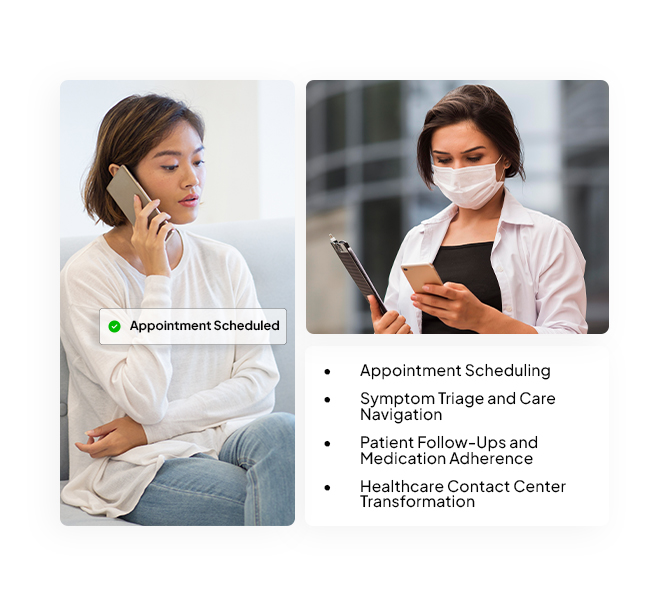


Picture this. A patient calls their healthcare provider to reschedule a routine appointment. They wait on hold for 12 minutes, get transferred twice, repeat their patient information each time, and eventually hang up, frustrated. Meanwhile, the contact center agent juggling dozens of similar calls barely has time to breathe between interactions.
This scenario plays out millions of times every day. Over 230 million people already turn to AI chatbots for health-related concerns each year. Yet only19% of U.S. medical practices use healthcare chatbots or virtual assistants for patient communication. That gap between patient expectations and care delivery is not just inconvenient. It is costly, unsustainable, and increasingly avoidable.
This article is a practical walkthrough of conversational AI in healthcare: why the industry needs it now, what it actually does, and how your organization can implement conversational AI solutions with confidence.
Why Healthcare Needs Conversational AI Right Now?
The conversation around artificial intelligence in healthcare has shifted from "interesting experiment" to "operational necessity." Three forces are converging to make 2026 the inflection point.
The Staff Burnout Crisis Is Unsustainable
Healthcare professionals spend 60 or more minutes every day on routine tasks like scheduling, follow-ups, and documentation. In contact centers, agents field a relentless stream of repetitive tasks, from appointment changes and insurance verification to prescription refills status updates. The result is high turnover, fatigue, and declining morale.
This is not just a staffing issue. It is a patient care quality issue. Fatigued teams make more errors and deliver less empathetic interactions at the very moments when patient needs require empathy most. According to PwC, AI technology is now a system-wide strategic priority in four out of five large hospital groups, precisely because the human cost of inaction has become too high.
Patients Expect More (And They Are Already Using AI)
Consumer expectations have been reshaped by banking, e-commerce, and travel. Patients now expect immediate access, instant responses, and digital-first communication. Healthcare systems, by comparison, often still run on phone trees and scheduling limited to clinic hours.
Patients are not waiting for their healthcare providers to catch up. The gap between what patients expect and what most healthcare organizations deliver is widening, and the rise of AI in customer service across other industries is raising the bar further.
The Technology Has Finally Caught Up
For years, conversational AI technology was not quite ready. That has changed. Natural language processing, large language models, and integration capabilities across EHR, CRM, and telephony platforms have matured to production-grade reliability.
The market reflects this confidence. The conversational AI in healthcare market was valued at $11.58 billion in 2024 and is projected to reach $41.39 billion by 2030, growing at a CAGR of 23.7%.Healthcare AI automation is no longer a question of "if." It is a question of how fast the healthcare industry can move.
What Conversational AI Actually Does in Healthcare
Let us move from the "why" to the "what." If you are evaluating conversational AI for your healthcare organization, here are the use cases that deliver the most tangible impact.
First, What Makes It Different from a Basic Chatbot?
A healthcare chatbot typically follows rigid, pre-scripted decision trees. Ask it something outside its script, and it fails. Conversational AI systems are fundamentally different. These advanced conversational AI tools use natural language processing, machine learning, and contextual understanding to conduct human-like, multi-turn conversations across voice and chat channels. By understanding context and intent, they retain information across interactions and handle complex, branching dialogues.
In healthcare, this distinction matters because patient questions are rarely simple. A patient asking about a medication refill may also need to update insurance information and schedule a follow-up. Virtual assistants powered by conversational AI handle that entire healthcare journey in a single, seamless interaction, empowering patients to resolve multiple needs at once.
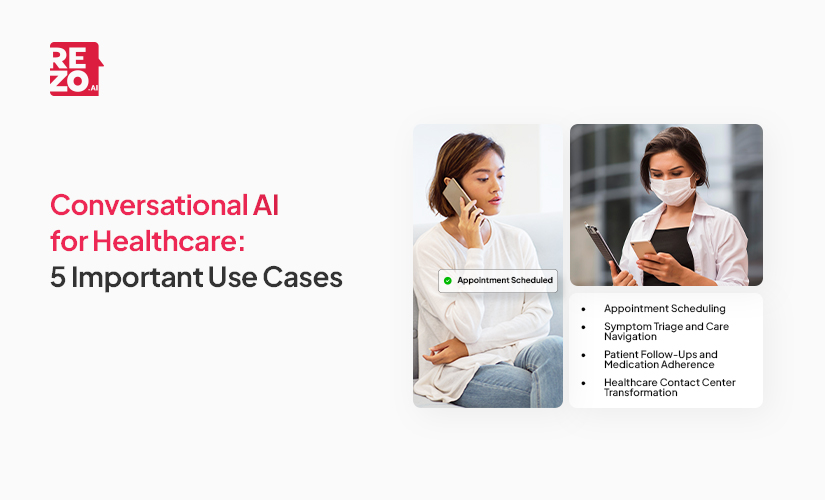
Appointment Scheduling and No-Show Reduction
This is the highest-volume, lowest-risk starting point for most healthcare systems. Conversational AI tools handle appointment booking, rescheduling, and reminders via voice and digital channels, available around the clock. Patients do not need to call during clinic hours or navigate phone menus to gain timely access to care.
The impact can be dramatic. For organizations losing revenue and care continuity to no-shows, conversational AI for healthcare appointment scheduling is one of the fastest paths to measurable improvement in patient satisfaction.
Symptom Triage and Care Navigation
Patients describe their symptoms in natural language. The AI systems assess urgency and route them to the appropriate level of care, whether that is the emergency room, urgent care, a telehealth visit, or simple self care guidance. This clinical triage capability reduces unnecessary ER visits and helps guide patients to the right provider faster, avoiding an unnecessary in person visit.
The key here is the "human-in-the-loop" model. AI assists with clinical decision support, but clinical judgment always remains with medical professionals. Every workflow includes clear escalation paths to a clinician when the AI's confidence drops below a defined threshold. Patient triage automation is not about replacing doctors. It is about giving patients faster answers and giving clinicians better-prepared encounters, improving patient safety along the way.
Patient Follow-Ups and Medication Adherence
Post-discharge check-ins, medication reminders, and chronic disease management are critical for patient outcomes but incredibly resource-intensive. Conversational AI solutions deliver these through automated, personalized conversations that feel human, not robotic, driving long term outcomes through consistent patient support.
What makes this especially powerful is proactive outreach. Instead of waiting for patients to call in with problems, AI initiates post visit follow ups, identifies risks early, and escalates to care teams when needed. This reduces readmissions and improves medication adherence to treatment plans. Multilingual support built into these conversational AI platforms also ensures equitable patient access for diverse patient populations, a critical consideration essential for reducing health disparities in AI-driven care coordination.
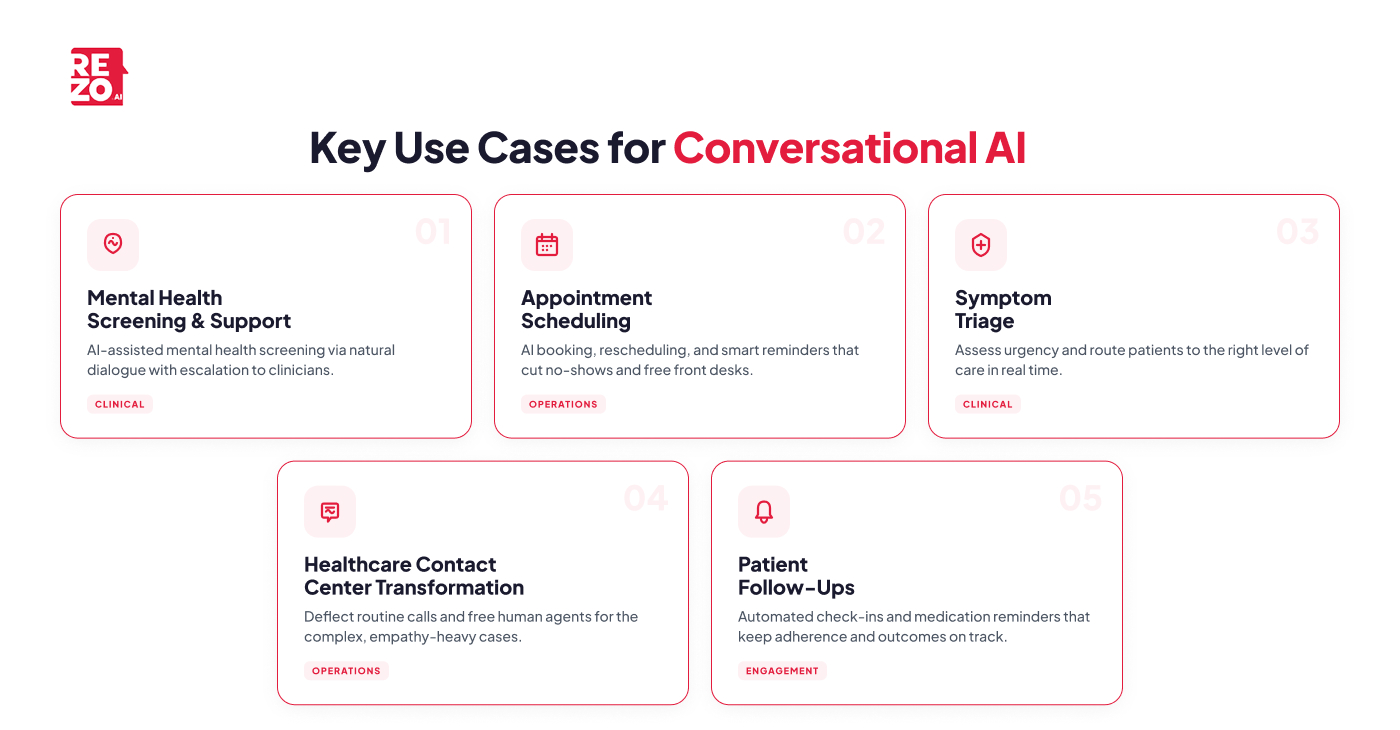
Healthcare Contact Center Transformation
While the healthcare sector focuses on patient-facing chatbots, the contact center is the operational backbone of healthcare communication. It is where the volume lives and where conversational AI in healthcare delivers some of its most significant operational impact.
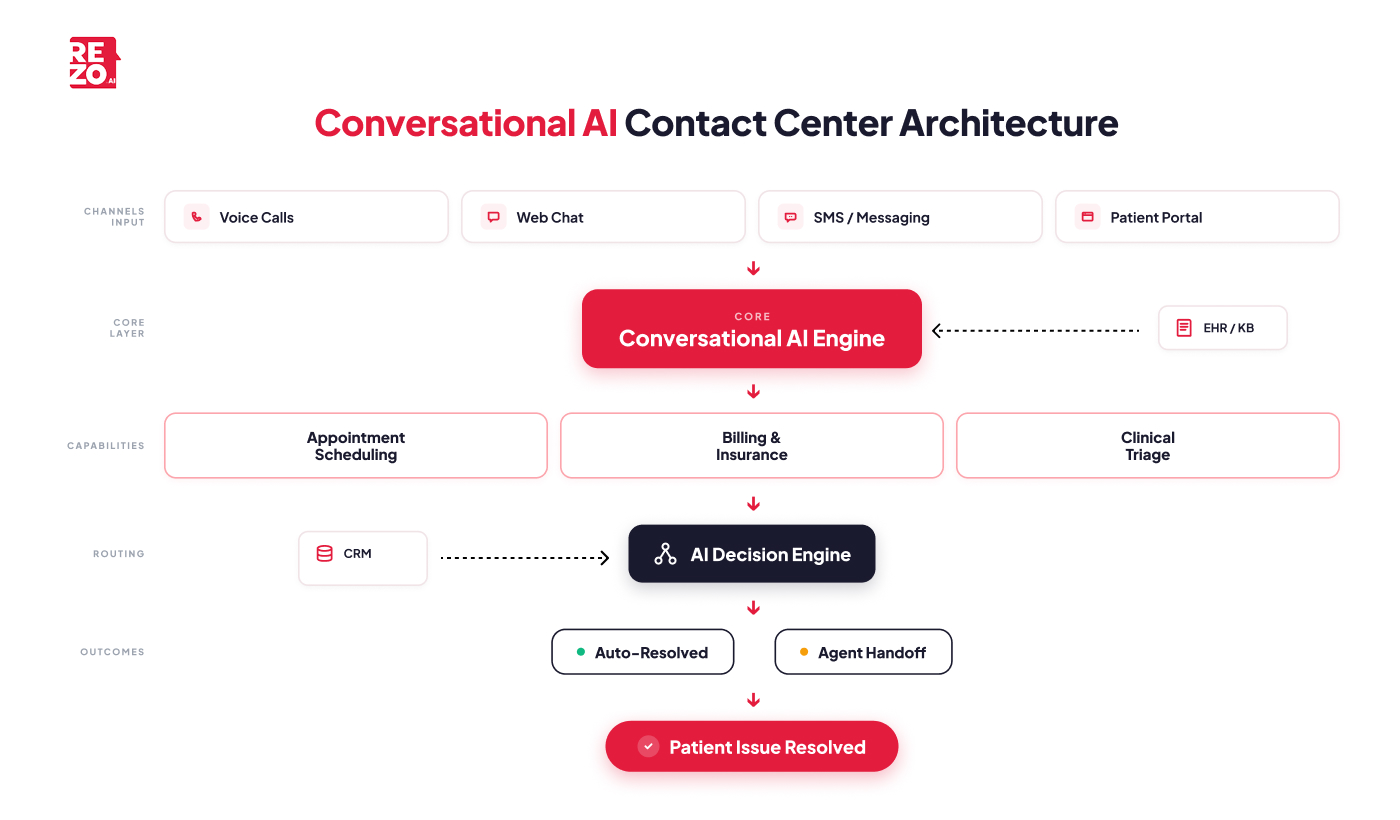
Healthcare contact center AI systems can deflect a majority of routine queries and calls, including billing systems inquiries, appointment changes, insurance verification, and prescription refills status requests. That frees human agents and healthcare staff for the complex, empathetic interactions that actually require a human touch. With voice AI and chat AI working together across channels, patients experience a seamless journey regardless of how they reach out.
Layering speech analytics on top of conversational AI adds another dimension: identifying patient sentiment, flagging compliance risks, and surfacing quality improvement opportunities in real time. Healthcare organizations deploying these conversational AI tools report higher patient engagement rates that improve patient engagement across the board.
Mental Health Screening and Support
This is perhaps the most surprising and promising application. AI-powered conversational AI tools can conduct validated mental health screenings, including PHQ-9 and GAD-7 assessments, through natural dialogue rather than sterile clinical questionnaires.
Rogers Behavioral Health has demonstrated 93% accuracy in mental health screening with AI-assisted tools. And here is something that challenges assumptions: research published in JAMA Network found that patients rated AI responses as more empathetic than physician responses in certain contexts. Patients are often more candid with AI assistants about sensitive topics like depression and anxiety, partly because they feel less judged. Conversational AI for mental health support is not replacing therapists. It is opening doors that many patients would never walk through on their own.
How to Implement Conversational AI in Healthcare
Understanding the value is one thing. Actually deploying conversational AI in healthcare is another. Here is a practical, staged roadmap that healthcare decision-makers can follow.
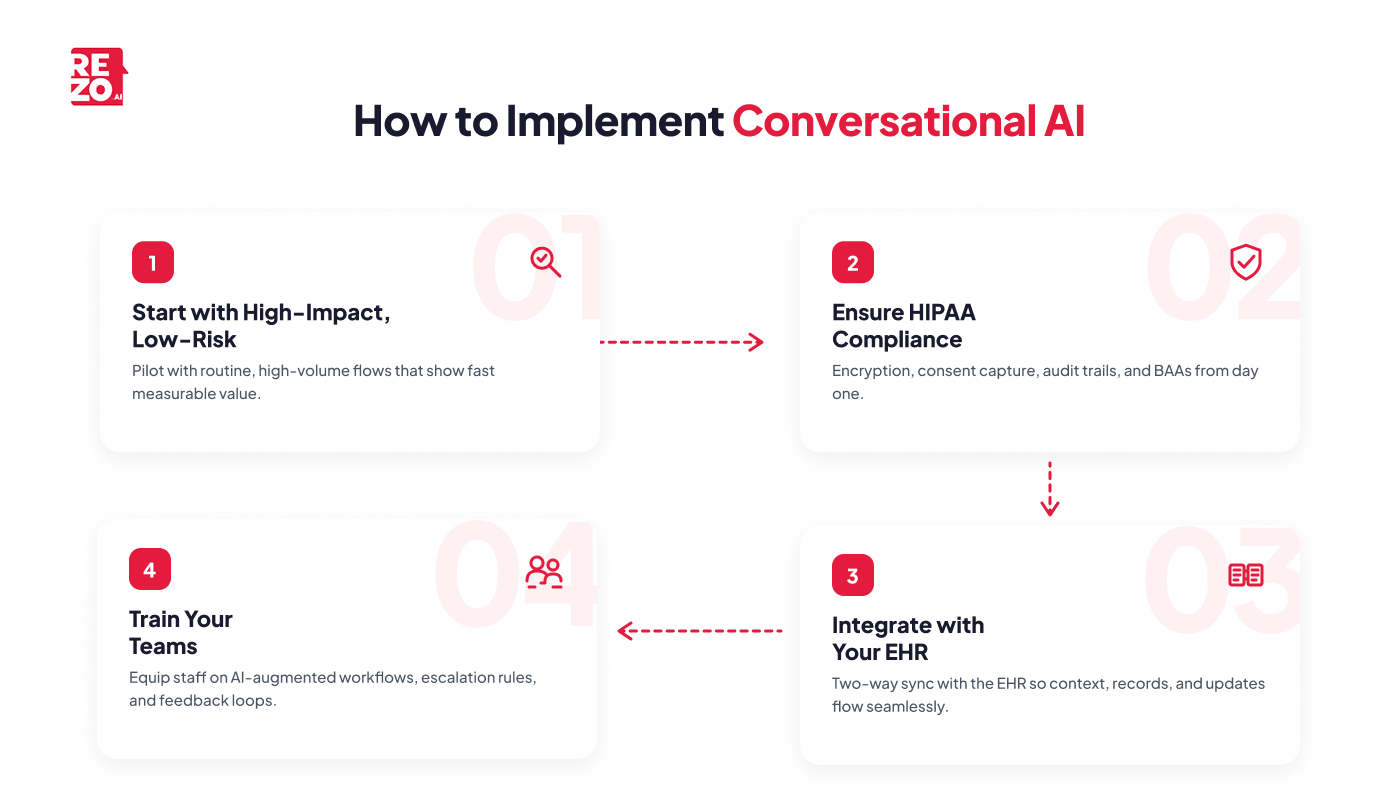
Start with High-Impact, Low-Risk Use Cases
Do not try to transform everything at once. Begin with appointment scheduling and reminders. It is the use case with the clearest impact, the lowest clinical risk, and the fastest time to value. Quick wins build internal buy-in and demonstrate operational efficiency to skeptics across your organization.
This phased approach aligns with what healthcare AI research reveals: Early adopters are prioritizing multi-agent AI solutions, but they are starting small and scaling to interconnected AI agents over time. The healthcare organizations that succeed are the ones that resist the urge to boil the ocean on day one.
Ensure HIPAA Compliance from Day One
Any conversational AI handling patient data must be HIPAA compliant. Under the Health Insurance Portability and Accountability Act, this is non-negotiable, and data privacy must be built into the foundation, not bolted on later.
HIPAA compliance essentials for AI deployment:
- End-to-end encryption for all patient data in transit and at rest
- Role-based access controls limiting who can view patient interactions
- Comprehensive audit trails for every AI-patient conversation
- A signed Business Associate Agreement (BAA) with your AI vendor
- On-premise or hybrid deployment options for strict data residency requirements
- Ongoing monitoring and regular compliance audits
Integrate with Your EHR and Existing Healthcare Systems
Conversational AI in healthcare delivers the most value when it connects to the systems your teams already use: electronic health records, CRM, scheduling, billing systems, and telephony platforms. Bidirectional EHR integration means the AI can read health records (with proper authorization) and write back updates, closing the information loop and providing relevant details to clinician workflows.
When evaluating vendors, look for API-first architecture and compatibility with interoperability standards like HL7 and FHIR. Conversational AI EHR integration is what separates a helpful tool from a truly transformative system that eliminates manual data entry and keeps clinical workflows running smoothly across the healthcare sector.
Train Your Teams and Design Escalation Paths
Technology adoption fails without people. Your clinical and contact center healthcare staff need to understand what the AI does, when it escalates, and how to handle AI-assisted interactions effectively. Healthcare conversational AI works best when healthcare professionals and AI technology operate as a unified team.
Design clear escalation protocols. When a conversation exceeds the AI's confidence threshold, it must seamlessly hand off to a human agent or clinician with full context and all relevant details. No patient should ever have to repeat their patient questions after an AI handoff.
McKinsey's State of AI research identifies the healthcare industry as one of the top sectors for AI agent adoption, and the organizations leading that adoption are investing as much in change management and staff training as they are in the AI technology itself.
What the Future Holds: From Chatbots to Agentic AI
The next evolution is already taking shape. The healthcare sector is shifting from reactive chatbots to proactive, agentic AI agents that can execute multi-step workflows autonomously. Imagine conversational artificial intelligence that detects a missed medication, checks the patient's schedule, books a telehealth follow-up, and notifies the care team, all in one seamless flow without any human intervention for the routine tasks.
Multi-agent AI architectures are emerging where specialized AI assistants (a scheduling agent, a triage agent, a billing agent) collaborate to resolve complex patient needs and provide accurate care coordination.
The future of conversational AI in healthcare is not about replacing healthcare workers. It is about giving them an AI-powered team that handles the operational load so they can focus on what they do best: delivering patient care with empathy and expertise.
The Time to Start Is Now
The AI technology is mature. Patients are ready. Healthcare staff need relief. The question for healthcare leaders is no longer "should we adopt conversational AI?" but "how quickly can we start?"
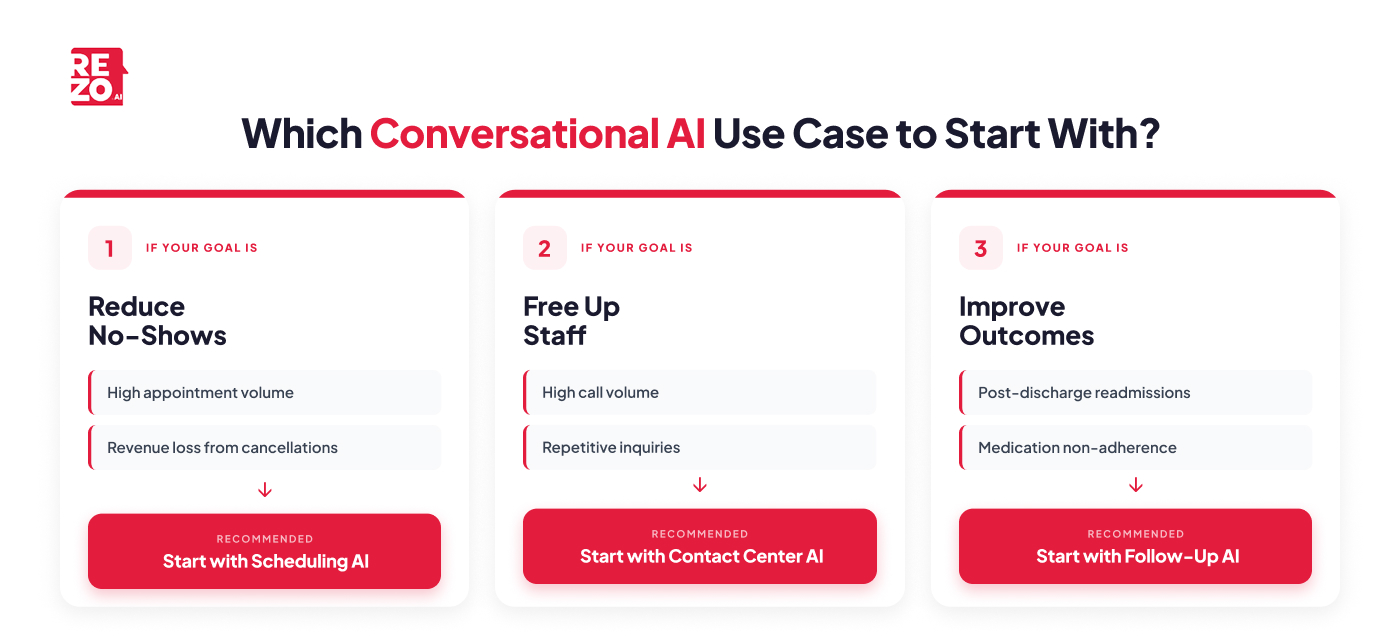
You do not need to overhaul your entire operation overnight. Start with a single, high-impact use case, whether that is appointment scheduling, contact center call deflection, or patient follow-ups. Prove the value, build internal confidence, and scale from there.
Remember that patient from the opening scenario, the one who waited on hold for 12 minutes, got transferred twice, and hung up frustrated? With conversational AI systems, they would have rescheduled their appointment in 30 seconds through digital channels. No hold time. No transfers. No frustration. That is not a futuristic vision. It is what leading healthcare providers are delivering today through machine learning and generative AI powered conversational AI platforms.
Healthcare organizations that embrace conversational AI for healthcare now will not just improve their operations. They will fundamentally transform the patient experience and set a new standard for what healthcare communication looks like across the entire healthcare journey.
Frequently Asked Questions
How much does conversational AI cost for healthcare organizations?
Pricing typically ranges from $0.002 to $0.12 per minute of interaction, plus EHR integration fees. Despite upfront investment, a Microsoft-IDC study found healthcare systems report over $3 ROI for every $1 spent on conversational AI solutions, with benefits often realized within a year.
Can conversational AI replace doctors and nurses?
No. The American Medical Association defines artificial intelligence as "augmented intelligence," designed to assist, not replace, healthcare professionals. Conversational AI handles administrative tasks like scheduling and documentation, freeing medical professionals to focus on complex patient care that requires human judgment and compassion. These AI systems provide accurate clinical decision support while keeping healthcare professionals at the center of every care delivery decision.
Frequently Asked Questions (FAQs)


Take the leap towards innovation with Rezo.ai
Get started now