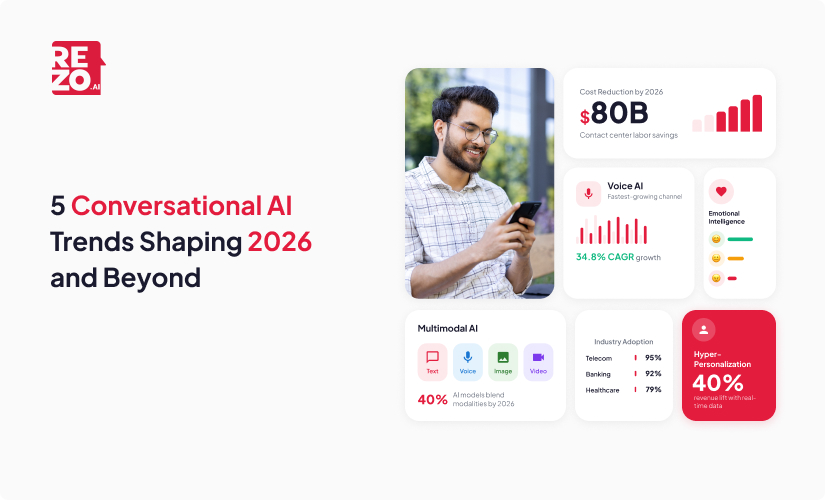
5 Conversational AI Trends Shaping 2026 and Beyond

5 Conversational AI Trends Shaping 2026 and Beyond
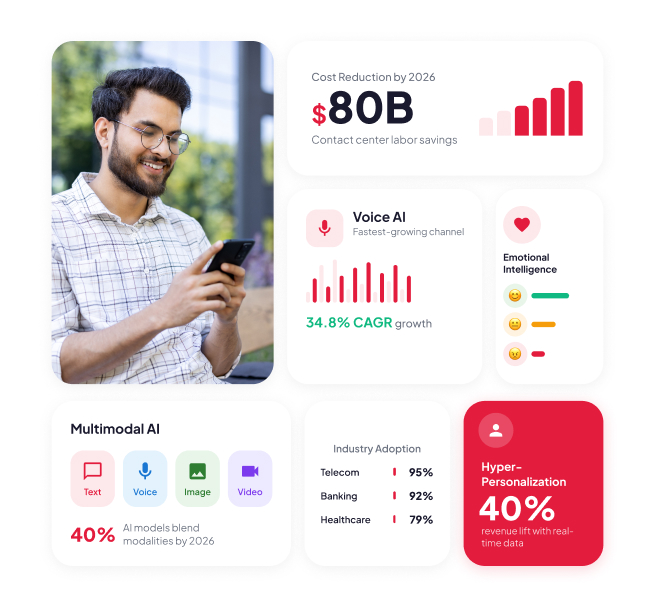


Here is a number worth sitting with: conversational AI will reduce contact center agent labor costs by $80 billion by 2026. That is not a distant forecast anymore. It is this year. And if your contact center is still treating artificial intelligence as an experiment, the gap between you and your competitors is widening fast.
The conversational AI trends shaping 2026 are not just about shinier conversational AI chatbots or fancier voice assistants. They signal a fundamental shift in how enterprises handle customer interactions at scale. Today, 78% of companies have already integrated conversational AI into at least one key operational area, reflecting the technology's maturity and business readiness. The question is no longer "should we adopt?" but "how fast can we scale?"
This article breaks down the conversational AI trends that matter most for CX leaders, contact center managers, and technology decision-makers, along with a practical playbook to act on them.
Why 2026 Is the Tipping Point for Conversational AI?
Three forces have converged to make this moment different from every artificial intelligence hype cycle before it: mature large language models, enterprise-grade infrastructure, and permanently elevated customer expectations.
The numbers tell the story. According to Gartner by 2026, 40% of enterprise applications will feature task-specific conversational AI agents, up from less than 5% in 2025. That is an eightfold jump in a single year. Industry adoption is accelerating unevenly, too. Telecom leads at 95%, with 52% of telecom companies already using artificial intelligence to boost productivity and deliver 24/7 service. Banking follows at 92% and healthcare at 79%.
What has changed is the shift from experimental pilots to scaled deployments. Businesses are no longer asking "does conversational AI work?" They are asking "how do we roll it out across every channel and language we operate in?" Customers, meanwhile, now expect instant, contextual, always-on support. Anything less feels outdated. Companies that delay adopting conversational AI risk falling behind as consumer expectations for speed and personalized interactions continue to rise.
So what exactly is changing? Let's break it down.
What Are the Conversational AI Trends Reshaping Customer Experience?
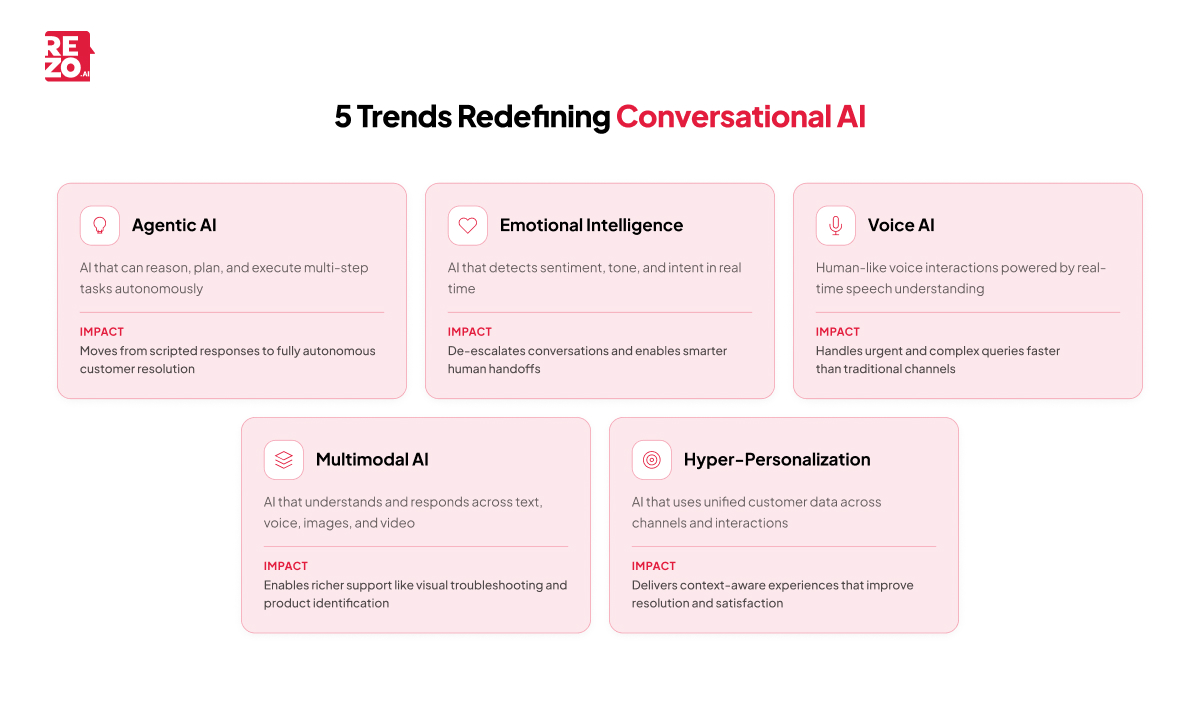
The conversational AI trends worth paying attention to in 2026 share a common thread: they all move conversational AI technology closer to genuinely human conversation. Modern conversational AI systems are rapidly shifting from passive customer service chatbots to agentic, multimodal systems that understand context, human emotions, and execute complex processes autonomously. Here are the shifts redefining how enterprises connect with their customers.
From Chatbots to Agentic AI: What's Really Changed?
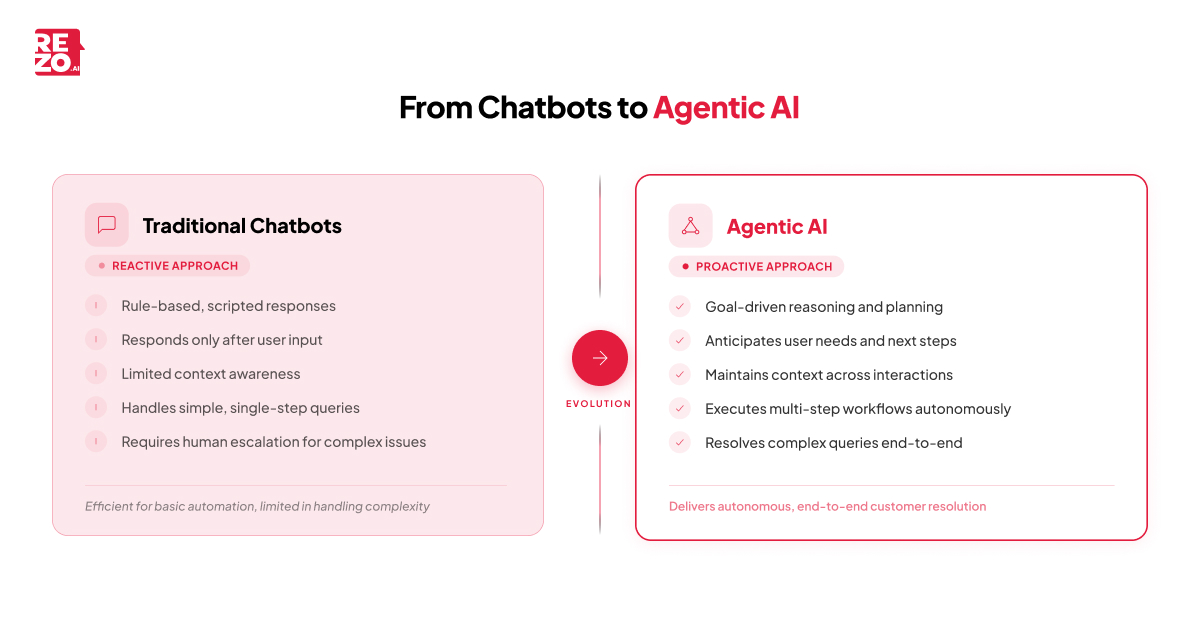
Agentic AI represents the most significant leap in conversational AI since natural language understanding arrived. Unlike traditional conversational AI chatbots that follow scripted decision trees or even intent-based bots that recognize user intent, agentic AI can reason, plan, use conversational AI tools, and complete multi-step tasks without constant human oversight. Natural language understanding, a subprocess of natural language processing, allows these AI systems to grasp the context, sentiment analysis cues, and intent behind user input, making conversations feel far more natural.
Think about what this means in practice. A customer calls their insurance provider about a claim. A conversational AI system handles the entire workflow: it collects the incident details, verifies the policy, requests and analyzes supporting documents, initiates the claim, and sends status updates. These conversational AI agents act as autonomous coworkers, executing tasks like updating systems, booking appointments, or resolving customer issues, all across voice and chat, without a single handoff.
For contact centers, this is transformative. Escalation rates drop because conversational AI can resolve complex interactions independently. Human agents are freed to focus on the interactions that genuinely require empathy, judgment, and creative problem-solving. The result is not fewer agents but more effective ones. As per Deloitte by 2027, 50% of companies using generative AI are expected to implement agentic pilots that automate complex processes and workflows without human intervention, further demonstrating the business value of this approach.
How Emotional Intelligence Is Redefining Customer Conversations
Conversational AI is moving beyond understanding what customers say to sensing how they feel. Through sentiment analysis, tone detection, and adaptive response generation, today's conversational AI systems can recognize frustration in a caller's voice, adjust their tone accordingly, and de-escalate situations before they spiral. Advanced artificial intelligence can now understand tone, user intent, and sentiment, allowing for more empathetic interactions that closely mirror human conversation. This emotional intelligence is what makes conversational AI truly effective in sensitive scenarios.
This matters enormously in industries like banking and healthcare, where emotional context shapes every customer interaction. A customer calling about a denied loan application needs a fundamentally different conversational experience than someone checking an account balance. Emotionally aware AI utilizes emotional and sentimental awareness to detect cues like urgency or frustration, improving the human-like nature of interactions and driving measurable gains in customer satisfaction.
Personalization and handling complex interactions are among the key vectors of progress in conversational AI technology. Emotionally aware AI also enables smarter human-AI collaboration: when the conversational AI system detects a highly distressed customer, it can identify issues beyond its scope and redirect customers to live contact center staff in real time, ensuring the right support arrives at the right moment. This allows human agents to focus solely on more complex customer interactions that require genuine empathy and judgment.
Why Voice AI Is the Fastest-Growing Channel
While much of the conversational AI conversation focuses on chat, voice assistants and voice AI are quietly becoming the fastest-growing channel, expanding at a 34.8% CAGR. And for good reason. Customers still reach for the phone when issues are complex, urgent, or emotionally charged.
The difference now is that conversational AI voice assistants actually work. Advances in automatic speech recognition, natural-sounding text-to-speech powered by natural language generation, and low-latency processing have made voice bots viable for real production environments. Machine learning and deep learning algorithms continuously refine how these AI systems process human language, improving accuracy with every interaction. Picture a voice assistant that handles appointment rescheduling for an automotive service center or processes payment reminders for a consumer durables brand, fluently, naturally, and without the robotic tone that used to drive callers away.
The trend is not voice assistants versus chat. It is AI-powered voice that complements chat to create a truly seamless omnichannel customer experience. Key conversational AI trends include proactive voice assistants, seamless omnichannel continuity, and low-code development that makes implementing conversational AI solutions accessible to a wider range of businesses.
What Does Multimodal AI Mean for Customer Experience?
Multimodal conversational AI combines text, voice, images, and video within a single interaction. This is not a futuristic concept; it is happening now. By 2026, 40% of artificial intelligence models are expected to blend different data modalities, enhancing the effectiveness of conversational AI systems across every channel.
Imagine a customer photographs a damaged appliance and sends the image through a conversational interface. The conversational AI analyzes the photo, identifies the product and the damage, initiates the return process, and confirms the pickup schedule, all in one continuous flow. Multimodal conversational AI systems combine voice, text, video, and image, allowing for a more intuitive user experience that responds to diverse forms of user input. For e-commerce, consumer durables, and automotive companies dealing with visual inspections and product identification, multimodal conversational AI dramatically improves self-service resolution rates while reducing operational costs.
Modern conversational AI is also moving toward Zero UI, where traditional interfaces are replaced by natural language, conversational discovery. This evolution makes conversational AI applications more accessible, allowing users to interact with technology using natural language voice commands, which is particularly beneficial for those uncomfortable with traditional conversational interfaces.
How Hyper-Personalization Is Moving Beyond "Hello, [First Name]"
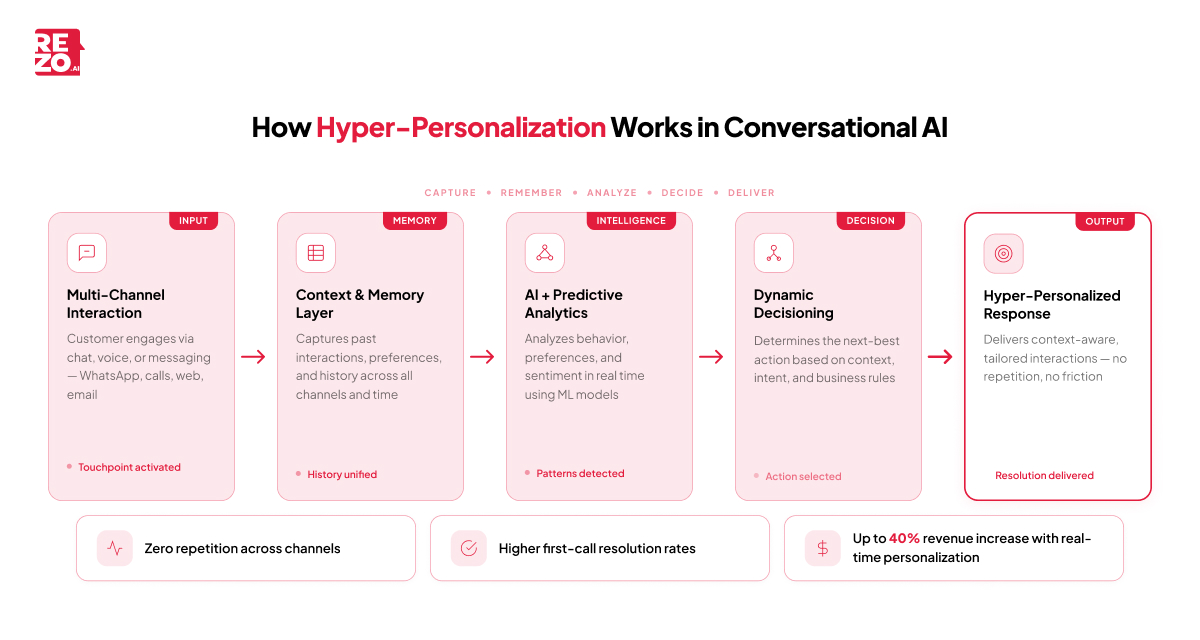
True hyper-personalization in conversational AI goes far beyond inserting a customer's name into a greeting. It means conversational AI that remembers context across past interactions, channels, and time. A customer who started a conversation on WhatsApp last Tuesday should not have to repeat themselves when they call on Thursday. Conversational AI systems use predictive analytics and machine learning to enhance decision-making and forecast future user behavior, customer preferences, and trends, all based on valuable insights drawn from past interactions.
This level of contextual memory, driven by real-time behavioral signals and not just static CRM data, is what separates good conversational AI experiences from forgettable ones. The impact on first-call resolution and customer satisfaction is significant. Companies leveraging hyper-personalization report up to a 40% lift in revenue by using real-time data for personalized interactions tailored to individual customer preferences. Conversational AI can also analyze customer sentiment and suggest next steps for sales representatives based on past behavior.
It is no surprise that a majority of CX leaders plan to increase their artificial intelligence investment. They understand that personalization at scale is no longer optional; it is what customers measure you against. The benefits of conversational ai in this area extend beyond customer satisfaction to measurable improvements in customer engagement, user engagement, and long-term loyalty.
How Should Enterprises Prepare? A Practical Implementation Playbook
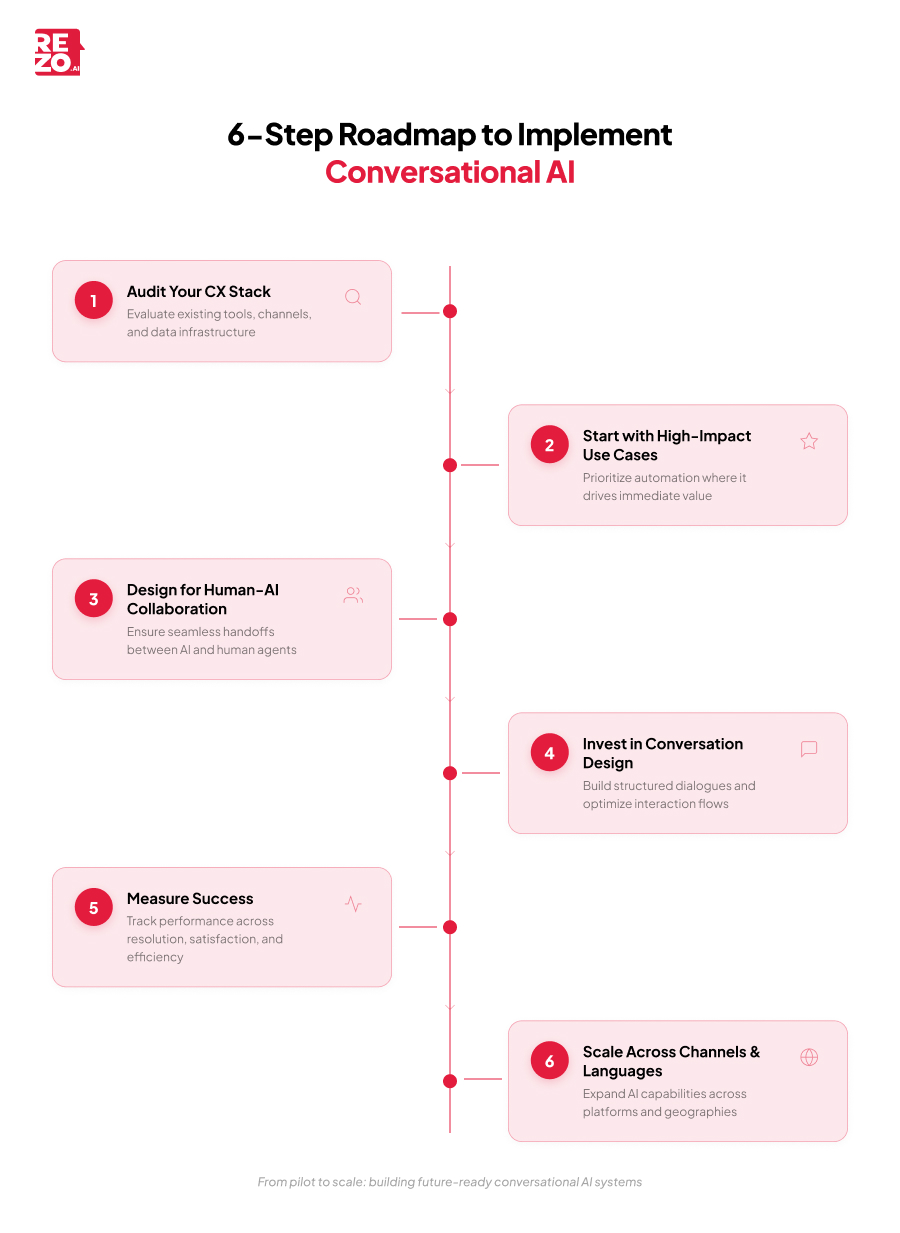
Understanding conversational AI trends is one thing. Acting on them is another. Today, 71% of business professionals have already invested in conversational AI chatbots for CX support, but many struggle to move beyond initial pilots. Implementing conversational AI successfully requires a structured approach that uses data to prioritize key transactions. Your roadmap does not have to be complicated. Here is a phased approach for adopting conversational AI that works.
Step 1: Audit Your Current CX Stack.
Map every customer touchpoint across voice assistants and chat. Identify high-volume, low-complexity routine tasks that are ripe for automation. Assess your integration readiness, because conversational AI solutions that cannot connect to your CRM, ticketing system, or knowledge base will underperform. Integrating conversational AI tools into customer relationship management systems allows AI systems to draw from customer history and provide tailored AI solutions unique to each customer.
Step 2: Start with High-Impact Use Cases.
Resist the temptation to automate everything at once. Begin with conversational AI applications where artificial intelligence delivers immediate, measurable business value: appointment scheduling, order tracking, payment reminders, answering questions about FAQs, or status updates. Conversational AI can also enhance lead qualification and sales by engaging with prospects and handling initial user queries. Early wins build organizational confidence and demonstrate the benefits of conversational AI to stakeholders.
Step 3: Design for Human-AI Collaboration.
Build clear escalation paths from day one. Conversational AI handles routine tasks and customer queries; human agents handle complex, emotional, or compliance-sensitive interactions. The conversational AI technology can identify issues beyond its scope and redirect customers to live staff in real time. This is not about replacing your team. It is about making every agent more effective by removing repetitive tasks from their plate, improving operational efficiency across the board.
Step 4: Invest in Conversation Design and Dialogue Management.
The quality of your conversational AI interactions depends on thoughtful conversation design and dialogue management. Many organizations that build virtual assistants invest in upfront research and design to understand the customer journey and context. Map customer journeys, anticipate edge cases, and build feedback loops that allow the conversational AI system to improve continuously. Continuous iteration, or bot tuning, is a critical practice for maintaining the right balance of intents and their training data.
Step 5: Measure What Matters.
Track first-call resolution, average handle time, customer satisfaction scores, and containment rate. Conversational AI can adapt and learn from past interactions, refining customer support metrics such as response time and customer satisfaction. Embed these metrics within your existing KPI frameworks rather than treating conversational AI performance as a separate reporting exercise. The valuable insights gathered from these ai systems can inform broader business processes and strategy.
Step 6: Scale Across Channels and Multiple Languages.
Once a conversational AI use case is proven on one channel, extend it across voice assistants, chat, WhatsApp, and email. For enterprises operating across geographies, multilingual capability supporting multiple languages is not a nice-to-have. It is essential. Conversational AI provides 24/7 customer support, ensuring that customer queries receive attention at any time, regardless of high volume or peak call times. This round-the-clock availability significantly reduces operational costs while maintaining high customer experience standards.
What's Next for Conversational AI Beyond 2026?
The future of conversational AI points toward ai systems that do not just respond but anticipate. Proactive and predictive conversational AI will notify a customer about a delayed shipment before they even think to check, offering alternatives and next steps without being asked. Conversational AI continues to evolve, leveraging insights from past behavior to predict user needs and preferences, allowing for proactive customer engagement that transforms how businesses connect with their audiences.
Multi-agent orchestration is another frontier. Think of it as a team of specialized virtual assistants and AI assistants collaborating to resolve a complex interaction, much like a human team would. Organizations can overcome the challenge of disjointed multiple bots with the introduction of a master virtual assistant that uses dialogue management to handle a range of routine tasks for the customer. The concept is already moving from research into early production environments.
Meanwhile, AI governance and compliance are becoming non-negotiable. Regulatory frameworks like the EU AI Act are shaping how conversational AI gets deployed. The path to full-scale deployment of conversational AI is often accompanied by challenges such as data security, privacy, and ensuring fairness in ai algorithms. Enterprises that build ethical, transparent artificial intelligence practices and formalize AI ethics governance today will hold a significant competitive advantage tomorrow.
And the human agent? Their role evolves, not disappears. Agents are becoming AI supervisors, conversation designers, and escalation specialists who work alongside ai assistants and virtual agents daily. The prediction that traditional search engine volume will drop 25% by 2026 due to conversational AI chatbots and virtual agents underscores a broader truth: conversational interfaces are becoming the primary way people interact with information and services. Modern conversational AI makes conversational ai the default channel for how businesses answer questions and resolve customer needs.
The Bottom Line
The conversational AI trends defining 2026 are not about conversational AI technology for technology's sake. They are about delivering fundamentally better customer experiences, faster resolutions, more personalized interactions, and smarter use of your team's expertise. Businesses integrating conversational AI solutions into their contact centers achieve substantial cost savings, reduce operational costs, and enhance customer engagement across every touchpoint.
The organizations that will lead are not the ones waiting for conversational artificial intelligence to mature further. They are the ones building their conversational AI capabilities today, one use case at a time, with human-AI collaboration at the center of every decision. To successfully implement conversational AI, businesses need a sophisticated, scalable solution that enhances customer engagement and streamlines operations.
The window to move from observer to leader is open. The question is whether you will step through it.
Ready to future-proof your customer experience? Talk to our team about building your conversational AI roadmap.
Frequently Asked Questions
How big is the conversational AI market in 2026?
The global conversational AI market is projected to reach approximately $17.97 billion in 2026, growing at a CAGR of over 23%. The conversational AI market is also expected to reach USD 32.6 billion by 2030, indicating significant long-term growth and investment in conversational AI technology. North America leads with a 35% market share, driven by rising enterprise adoption of conversational AI solutions across customer service, healthcare, and banking sectors.
What is the difference between conversational AI and generative AI?
Conversational AI, also known as conversational artificial intelligence, facilitates real-time dialogue between humans and machines using natural language processing (NLP) and intent recognition. Natural language processing NLP uses tokenization to break down text, sentiment analysis to understand emotion, and natural language generation to create human-like responses. Generative AI creates new content like text, images, and code. Modern conversational AI platforms combine both, using generative AI capabilities and new generative ai capabilities to make conversational AI responses more dynamic, contextual, and human-like. Generative AI, which utilizes large language models, enhances conversational AI by providing sophisticated natural language understanding and context retention.
What industries benefit the most from conversational AI?
Telecom (95% adoption), banking (92%), and healthcare (79%) lead conversational AI adoption. Retail, insurance, and automotive are fast-growing sectors actively adopting conversational AI for customer engagement and operational efficiency. Industries with high-volume, repetitive customer interactions see the strongest returns from AI-powered voice assistants and chat automation. In retail, conversational AI allows customers to manage their entire shopping experience online without human interaction. Conversational AI applications also streamline HR and business processes such as employee onboarding, while integrating conversational AI into sales helps with lead qualification and understanding customer preferences through natural language interactions. The power of combining conversational AI with emerging technologies continues to unlock new ai solutions across every industry.
Frequently Asked Questions (FAQs)


Take the leap towards innovation with Rezo.ai
Get started now