Best Conversational AI Platforms of 2026
Best Conversational AI Platforms of 2026


Conversational AI has evolved far beyond the era of rule-based chatbots and scripted responses. As a type of artificial intelligence made possible by natural language processing (NLP) and machine learning, conversational AI enables systems to understand and process human language in real time. In 2026, it represents a new generation of AI technologies capable of understanding context, managing multi-modal interactions, and engaging with customers across voice channels, web chat, and messaging channels. As a result, conversational AI is no longer just a support tool but a core driver of customer experience, operational efficiency, and business outcomes.
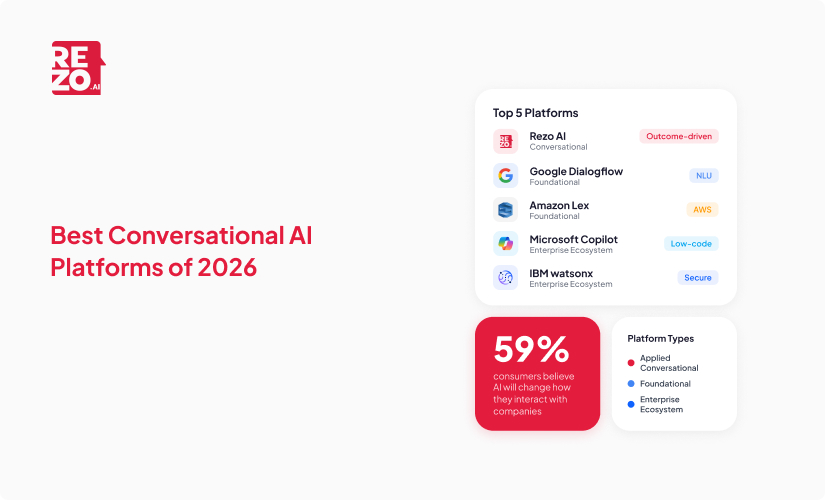
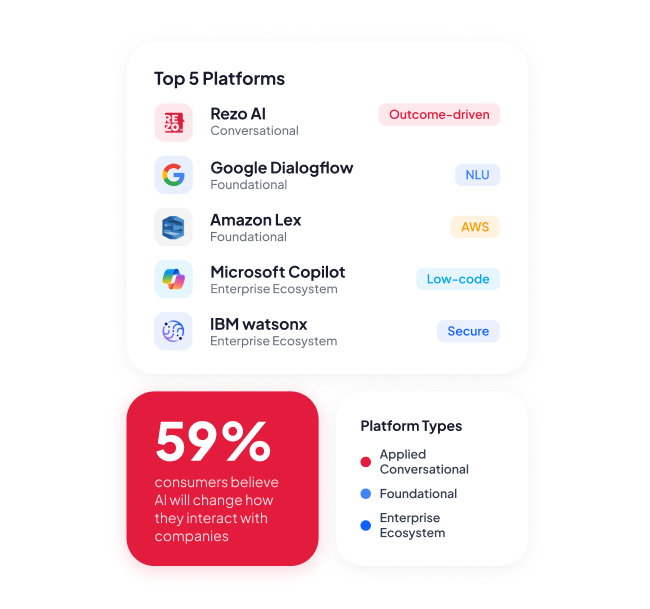
According to a Zendesk report, 59% of consumers believe AI will change how they interact with companies in the next two years. At the same time, businesses are no longer experimenting with conversational AI, they are investing in it at enterprise scale. A growing number of organizations are embedding AI agents and virtual agents across customer touchpoints, with many expecting conversational AI solutions to play a role in nearly every interaction in the near future.
In this article, we examine the different types of conversational AI platforms available, what sets apart the best conversational AI solutions, and how businesses can choose the right ai platform based on their specific needs and objectives.
Key Trends Shaping Conversational AI in 2026
Conversational AI is evolving rapidly, driven by advancements in large language models, machine learning, and rising customer expectations. Today, the focus is no longer just on enabling customer conversations but on building intelligent agents and AI powered virtual assistants that drive measurable business outcomes and customer satisfaction.
Below are the key trends shaping conversational AI platforms and products in 2026:
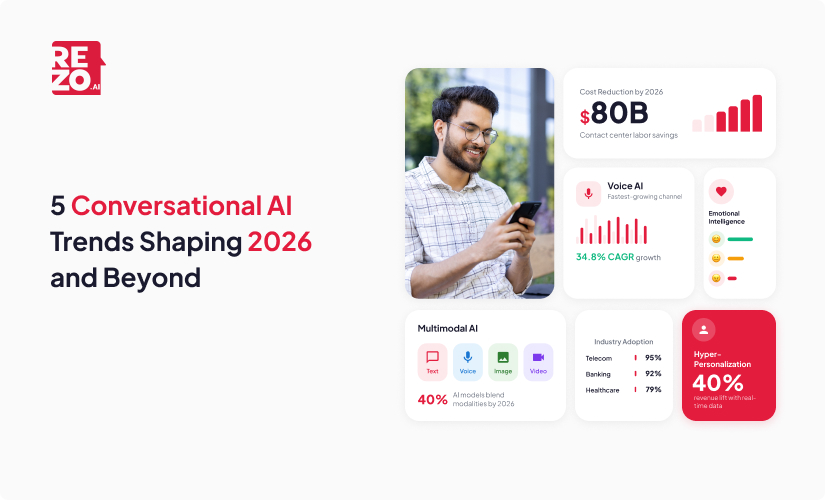
- Emotional Intelligence in AI Conversations: Conversational AI systems are increasingly able to detect sentiment and emotional context through natural language understanding, enabling more empathetic and human-like conversations. Sentiment analysis allows for prioritized human escalation when necessary.
- Advancement of Voice AI: Improvements in speech recognition and natural language processing are making voice agents and voice interactions more accurate and scalable, turning voice into a key channel for customer engagement. AI powered conversational AI agents can now handle phone calls and service requests with near-human response quality.
- Rise of Multimodal AI: Conversational AI is expanding beyond text to support multiple input formats like voice and chat, enabling seamless conversational interactions across channels. These AI technologies allow virtual agents to process human language across different modalities.
- Hyper-Personalization at Scale: AI platforms are leveraging customer data, machine learning algorithms, and past interactions to deliver hyper-personalized conversations, improving engagement and conversion rates. Conversational AI can provide personalized recommendations by accessing customer history in real time.
You can learn more about the trends shaping conversational AI here: Conversational AI Trends of 2026
Types of Conversational AI Platforms
Not all conversational AI platforms are designed the same way. As the space has matured, different types of platforms and approaches have emerged based on how these conversational AI solutions are built and deployed. Some platforms focus more on the infrastructure to build conversational experiences from scratch, while others are designed to integrate within existing enterprise environments, delivering ready-to-use conversational AI solutions specific for business use cases.
- Foundational Conversational Platforms: These platforms provide the core infrastructure required to build conversational AI systems from scratch. They focus on capabilities such as natural language understanding, intent recognition, and conversation design, offering flexibility and control for business users and support teams to create production-ready agents.
- Enterprise AI Ecosystems Platforms: They are part of a larger enterprise ecosystem designed to integrate conversational AI into existing enterprise functions, tools, and workflows. They emphasize connectivity with connected systems, enterprise scale, and alignment with broader enterprise systems.
- Applied Conversational Platforms: These conversational AI platforms are built to deliver ready-to-deploy AI agents for specific business functions such as customer support, sales, and customer engagement. They focus on faster deployments, seamless self-service, and driving.
.jpg)
Top 5 Conversational AI Platforms
With a wide range of conversational AI platforms available today, choosing the best conversational AI solution depends on a company's specific needs, technical capabilities, and business objectives. As discussed earlier, these AI platforms differ not just in features but in how they are designed and deployed.
Some platforms offer the flexibility to build highly customizable conversational experiences from the ground up, while others focus on seamless integration within the enterprise ecosystem, delivering ready-to-use conversational AI solutions for faster time to value.
Below are some of the leading conversational AI platforms in 2026:
Rezo AI
Rezo AI is a conversational AI platform designed to help businesses automate and enhance customer engagement across support, sales, and engagement. It enables organizations to deploy AI powered conversational AI agents across voice, web chat, and messaging platforms, while maintaining context and consistency for a true omnichannel experience.
The platform is built to deliver measurable business outcomes. It goes beyond basic query handling to support end-to-end automation, enabling AI agents to complete tasks, automate workflows, and handle service requests autonomously. This allows businesses to not only respond to customer queries but also maintain streamlined workflows, improve resolution times, and drive overall higher engagement and conversions.
Key Features:
- AI powered automation for entire customer journey (sales, engagement, support, and more)
- Omnichannel capabilities across voice channels, web chat, and messaging platforms
- Context-aware conversational AI agents for more accurate, relevant, and personalized responses
- Advanced analytics and reporting for customer insights and agent performance tracking
- Real-time agent assist tools to enhance productivity and support human agents
- Scalable infrastructure to manage high volumes of interactions at enterprise scale
The conversational AI platform is positioned to help organizations move from reactive support systems to more proactive, automated, and outcome-driven customer engagement.
.jpg)
Google Cloud Dialogflow
Google Cloud Dialogflow is a conversational AI platform by Google that enables developers to build and deploy chat and voice-based conversational interfaces. It is known for its strong natural language understanding (NLU) capabilities, allowing businesses to create structured and context-aware conversational experiences powered by Google Cloud AI technologies.
The AI platform offers tools for intent recognition, entity extraction, and conversation design, along with seamless integration with Google Cloud services and backend systems.
Key Features:
- Advanced NLU for intent and entity recognition
- Support for text, voice, and multilingual support across multiple languages
- Deep integration with Google Cloud ecosystem
- Scalable infrastructure for large deployments
Overall, Dialogflow is widely used for building customizable and scalable conversational AI applications and virtual agents.
IBM watsonx Assistant
IBM watsonx Assistant is an enterprise-grade conversational AI platform designed to build and deploy virtual assistants and conversational AI agents across customer service and internal support use cases. It focuses on delivering reliable, secure, and context-aware interactions at scale with enterprise-grade security and data encryption.
The conversational AI platform offers capabilities for intent recognition, dialog management, and integration with enterprise systems, making it suitable for organizations with complex workflows, compliance requirements, and access controls.
Key Features:
- Advanced intent recognition and dialog management
- Omnichannel support across chat, voice channels, and web chat
- Integration with enterprise systems and backend systems
- Built-in analytics for performance tracking and AI accuracy
Overall, watsonx Assistant is widely used by enterprises looking to deploy secure and scalable conversational AI solutions within structured environments.
Microsoft Copilot Studio
Microsoft Copilot Studio is a conversational AI platform that enables businesses to build and deploy AI powered copilots across customer and employee support experiences. It is a low-code platform designed to work seamlessly within the Microsoft ecosystem, allowing organizations to integrate conversational AI into existing workflows and applications.
The AI platform provides tools for creating conversational interfaces, automating tasks, and connecting with enterprise data sources, making it easier to embed AI agents into everyday business processes.
Key Features:
- Integration with Microsoft ecosystem (Microsoft Teams, Dynamics, Azure)
- Low-code tools for building conversational agents and virtual agents
- Automation of workflows, business processes, and service requests
- Access to enterprise data for contextual response quality
Overall, Copilot Studio is widely used by organizations looking to integrate conversational AI within their existing Microsoft-driven environments with minimal learning curve.
Amazon Lex
Amazon Lex is a conversational AI service by AWS that enables developers to build chat and voice-based applications using the same AI technologies that power Alexa. It focuses on enabling scalable and reliable conversational interfaces within the AWS ecosystem.
The conversational AI platform provides capabilities for automatic speech recognition (ASR), natural language understanding, and seamless integration with other AWS services, making it suitable for building cloud-native conversational AI applications and deploying production-ready agents.
Key Features:
- Built-in ASR and NLU capabilities.
- Support for voice agents and text-based user interactions
- Deep integrations with AWS services and backend systems
- Scalable infrastructure for high-volume use cases
Overall, Amazon Lex is commonly used for building conversational AI applications and virtual assistants within AWS-based environments.
What to Look for When Choosing a Conversational AI Platform
Selecting the right conversational AI platform is a critical decision that can directly impact customer experience, operational efficiency, and business outcomes. With a wide range of conversational AI solutions available, it is important for organizations to evaluate each platform based on integration depth, response quality, and long-term goals.
Below are the key factors companies should consider when choosing a conversational AI platform:
- Security, Privacy, and Compliance: Ensure that the conversational AI platform adheres to industry standards such as GDPR, HIPAA, and SOC 2, and provides data security, data encryption, and access controls. This is especially important for organizations dealing with sensitive customer information in regulated industries.
- Integration and Workflow Automation: The AI platform should integrate seamlessly with existing systems such as CRM, support tools, and databases. Strong integration depth enables smoother workflows, allowing AI agents to automate workflows and complete tasks as part of a broader business ecosystem.
- NLU and Context Management: Look for conversational AI platforms with robust natural language understanding capabilities, including intent recognition, sentiment analysis, and the ability to maintain context across multi-turn conversations. Context retention allows the system to remember previous exchanges, avoiding the need for customers to repeat themselves and improving customer satisfaction.
- Omnichannel Capabilities: A strong conversational AI platform should support voice channels, web chat, and messaging channels while maintaining consistency and context across all conversational interactions. AI powered virtual agents should deliver a unified customer experience regardless of where the conversation starts.
- Scalability and Ease of Use: Choose a conversational AI platform that can scale with your business needs. Features such as low-code or no-code interfaces can significantly reduce deployment time, lower the learning curve, and make it easier for support teams and business users to build, train, and manage AI agents.
- Analytics and Optimization: Comprehensive analytics and reporting capabilities are essential for monitoring AI accuracy, identifying gaps in conversations, gathering user feedback, and continuously improving response quality and outcomes.
.jpg)
Conclusion
Conversational AI has become a key component of modern business strategy, enabling organizations to deliver faster, more efficient, and more personalized customer experiences at scale. As artificial intelligence and machine learning continue to advance, conversational AI platforms are no longer just tools for handling conversations, they are evolving into AI powered systems that can drive meaningful business outcomes.
However, as explored in this article, not all conversational AI platforms serve the same purpose. Some offer the flexibility to build highly customized conversational AI solutions, while others focus on seamless integration or delivering ready-to-deploy AI agents and virtual assistants. The right choice ultimately depends on a company's specific needs, technical resources, and long-term objectives.
By understanding the different types of conversational AI platforms and aligning them with business goals, organizations can unlock the full potential of conversational AI.
Frequently Asked Questions
How are Conversational AI Platforms different from traditional chatbots and IVRs?
Traditional chatbots and IVRs rely on predefined rules and scripted flows, which limit their ability to handle complex queries and dynamic interactions. Conversational AI platforms use AI technologies like natural language understanding (NLU) and machine learning to interpret intent, manage context, and support multi-turn human-like conversations, enabling more flexible interactions across channels.
Can Conversational AI completely replace human agents?
Conversational AI agents can automate a large volume of routine and repetitive interactions, but they are not a complete replacement for human agents. Instead, AI agents work alongside support teams, handling common service requests efficiently while enabling human agents to focus on more complex, sensitive, or high-value interactions.
How will Conversational AI evolve over the coming years?
Conversational AI is expected to become more proactive, intelligent, and action-oriented. With advancements in areas like generative AI, agentic AI, voice capabilities, and personalization, these conversational AI systems will move beyond responding to queries to executing tasks, anticipating user needs, and delivering more seamless, end-to-end customer experiences.
Frequently Asked Questions (FAQs)


Take the leap towards innovation with Rezo.ai
Get started now