Agentic AI vs Generative AI: Understanding the Future of Intelligent Automation

Agentic AI vs Generative AI: Understanding the Future of Intelligent Automation
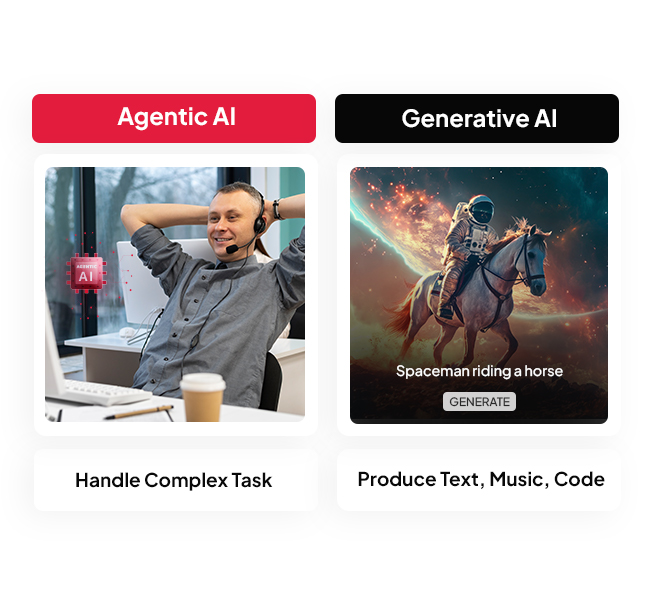


The AI landscape is evolving faster than most businesses can keep up with. Just when organisations started getting comfortable with generative AI and its ability to create content, a new paradigm has emerged: agentic AI. But what exactly sets these two AI solutions apart, and why should business leaders care about the distinction between agentic AI vs generative AI?
If you have been following AI trends, you have probably noticed that the conversation has shifted from basic generative AI tools to more sophisticated AI agents. According to Gartner, agentic AI is now positioned as one of the most important strategic technologies for 2025 and beyond. This is not just another buzzword. It represents a fundamental shift in how AI systems interact with the world around them, moving beyond the capabilities of traditional gen AI models.
What is Generative AI?
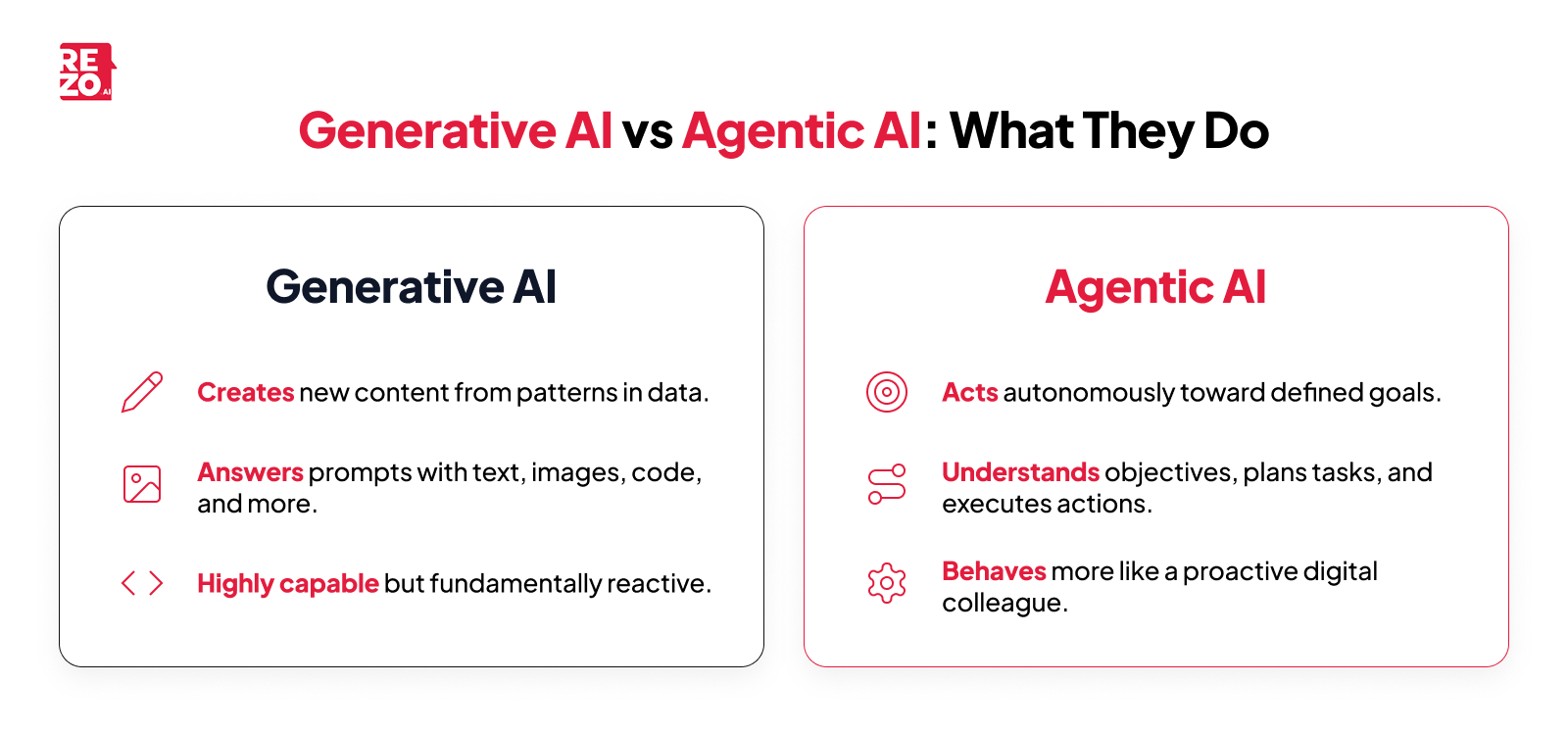
Before we dive into the differences, let us establish what we mean by Generative AI. At its core, gen AI refers to artificial intelligence systems that can create new content through deep learning and neural networks. These AI models are trained on massive training data and can produce text, images, software code, music, and more based on the learned patterns they have absorbed.
Many generative AI models, including large language models (LLMs) and diffusion models like Stable Diffusion, leverage foundation models built on deep learning architectures. These generative models utilize neural networks and, in some cases, generative adversarial networks to produce realistic outputs across multiple domains. The technology has proven particularly effective for content creation, code generation, image generation, and even generating synthetic data for machine learning applications.
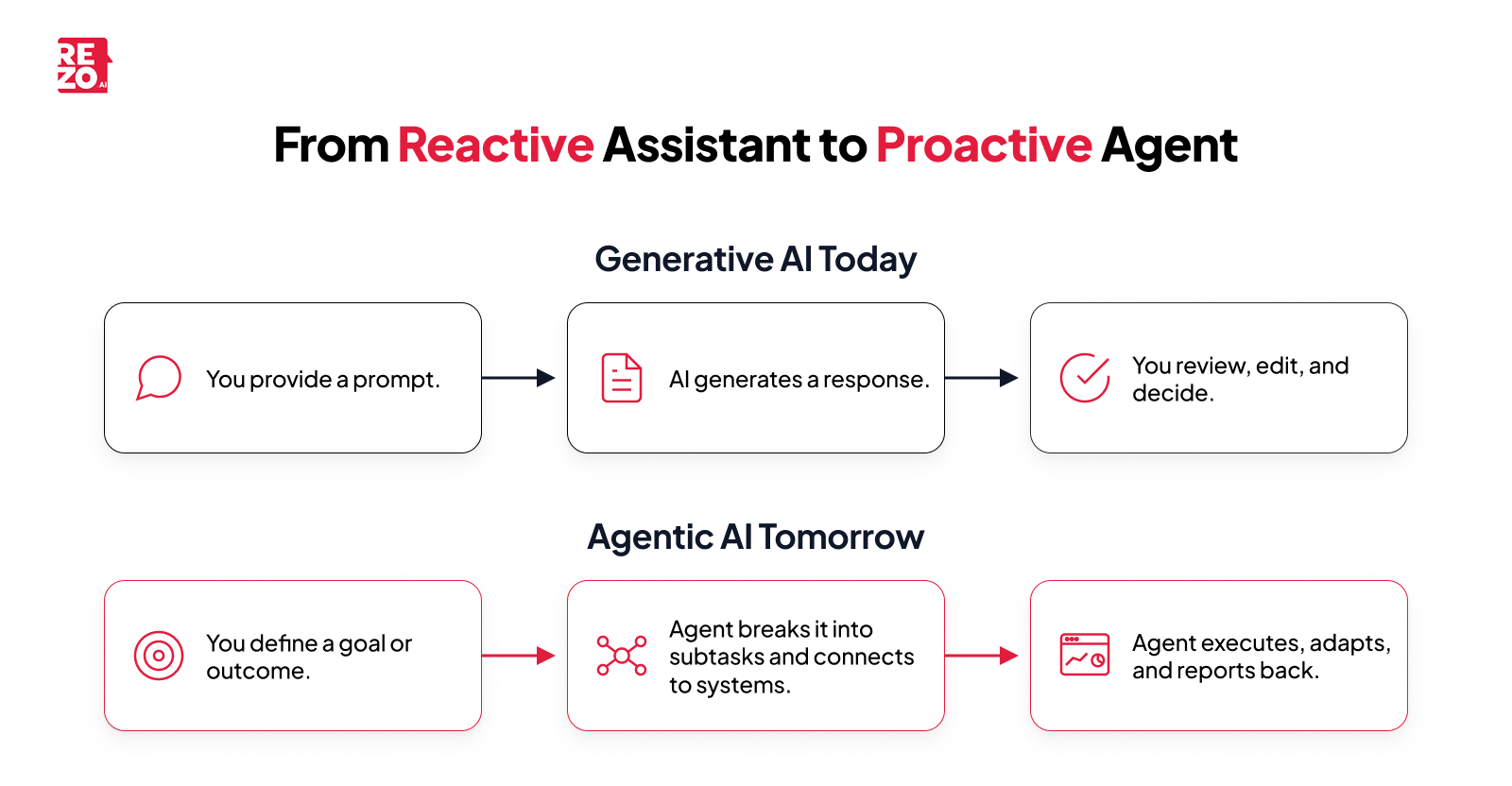
The key characteristic of generative AI is that it responds to prompts with minimal human input. You ask a question, and it generates an answer. You describe an image, and it creates one through its image generation capabilities. Generative AI operates in a fundamentally reactive manner, waiting for human input before taking action. The generative AI outputs depend entirely on the quality of prompts and the training data these AI models were built upon.
According to Salesforce’s State of IT report, 86% of IT leaders expect gen AI to soon play a prominent role at their organisations, with 67% prioritising these AI tools within the next 18 months. The technology has already proven its worth in content creation, coding assistance, natural language processing, and customer communications across various AI applications.
Deloitte’s State of Generative AI in the Enterprise report found that gen ai has boosted productivity by 20 to 30 percent for junior employees and 10 to 15 percent for senior staff in consulting and professional services. These are meaningful gains from generative AI capabilities, but they still require significant human oversight to direct and review the generated content.
What is Agentic AI?
Here is where things get interesting. Agentic AI represents the next evolution in artificial intelligence and AI technology. Unlike generative AI, which waits for instructions to perform specific tasks, agentic AI systems can act independently within defined boundaries, handling complex tasks without constant supervision.
Agentic AI is defined as AI systems that exhibit autonomy, goal-driven behaviour, and adaptability. The term “agentic” refers to these AI agents’ agency, or their capacity to act independently and purposefully. Rather than just responding to prompts like traditional gen ai tools, these AI agents can understand goals, break them into subtasks, interact with both humans and external tools, execute actions, and adapt in real-time using retrieval augmented generation and real time data.
Think of it this way: if generative AI is like a highly skilled assistant who waits for your instructions for specific tasks, agentic AI is more like a capable colleague who understands your objectives and takes initiative to achieve them. AI agents can access relevant data and applications, make decisions about complex processes, and produce outcomes with minimal human intervention. These agentic AI systems leverage foundation models and machine learning to handle complex workflows that would typically require multiple steps of human oversight.
McKinsey’s research on agentic AI highlight that AI agents mark a major evolution in enterprise AI applications, extending gen ai from reactive content generation to autonomous, goal-driven execution. These agentic AI systems have the potential to automate complex business processes by combining autonomy, planning, memory, and integration capabilities. Unlike generative ai models that simply produce outputs, AI agents can engage with external tools and make data driven decision making across complex workflows.
The Core Differences That Matter
Understanding the distinction between these two AI paradigms is crucial for making informed technology investments. Let us break down the key differences in this agentic AI and generative comparison.
Real-World Impact and ROI
The business implications of this shift from gen ai to AI agents are substantial. McKinsey estimates that implementing agentic AI has the potential to generate $450 billion to $650 billion in additional annual revenue by 2030 in advanced industries alone. Cost savings could range from 30 to 50 percent, driven by the ability to automate repetitive tasks and streamlined operations through AI agents handling complex tasks.
Early adopters of agentic AI systems are already seeing impressive results from these AI solutions. According to McKinsey’s research, one global bank cut its IT modernisation timelines by over 50 percent by deploying AI agents to assist engineering teams with software development and code generation. A financial institution restructured its credit memo process using agentic AI and achieved a 60 percent productivity gain for analysts analyzing market data. Another firm used multiagent systems multiple AI agents working together to clean up and interpret complex market data through natural language processing, unlocking $3 million in projected annual savings.
Gartner predicts that at least 15 percent of day-to-day work decisions will be made autonomously through agentic AI systems by 2028, up from zero percent in 2024. Additionally, 33 percent of enterprise software applications will include AI agents by 2028, compared to less than 1 percent in 2024. This represents a massive shift from traditional gen ai tools to more sophisticated AI agents.

Current Adoption Landscape
So where do organisations stand today with implementing agentic AI? The adoption picture for these AI solutions is rapidly evolving.
According to a January 2025 poll by Gartner of over 3,400 webinar attendees, 19 percent said their organisation had made significant investments in agentic AI systems, while 42 percent had made conservative investments in AI agents and related AI technology. Only 8 percent reported no investments, with the remaining 31 percent taking a wait-and-see approach.
Deloitte’s findings show that among emerging AI applications related to gen ai innovations, agentic AI captures the most attention. More than one in four leaders (26 percent) say their organisations are already exploring AI agents to a large or very large extent, moving beyond basic generative AI applications.
Challenges and Considerations
It would be unfair to discuss implementing agentic AI without acknowledging the challenges of these AI solutions. Gartner also predicts that over 40 percent of agentic AI projects will be cancelled by the end of 2027 due to escalating costs, unclear business value, or inadequate risk controls for AI agents.
IBM’s Institute for Business Value warns that some agentic AI systems can become self-reinforcing, escalating behaviours in unintended directions. Because these AI agents are often composed of multiple autonomous agents working together leveraging foundation models and machine learning there are opportunities for failure, including traffic jams, bottlenecks, and resource conflicts that can cascade through complex processes.
There is also the issue of “agent washing,” as Gartner calls it. Many vendors are rebranding existing products like AI assistants, robotic process automation, and chatbots as agentic AI without adding substantial agentic capabilities or true AI agents functionality. Business leaders need to rigorously differentiate genuine AI agents from marketing hype, understanding the real capabilities of these AI systems versus traditional gen ai tools.
Making the Right Choice for Your Organisation
So which approach is right for your business:- generative AI or agentic AI systems? The honest answer is that it depends on your specific needs, maturity level with AI technology, and whether you need AI solutions for straightforward content generation or complex workflows.
Generative AI remains incredibly valuable for content creation, coding assistance through code generation, data analysis, and customer communications. If your organisation is still in the early stages of adopting AI tools, focusing on gen ai applications can deliver meaningful productivity gains with relatively lower complexity. These generative AI tools excel at specific tasks like generating content, natural language processing, and producing generative ai outputs from well-defined prompts.
Agentic AI systems make sense when you need to automate complex, multi-step processes that currently require significant coordination across business processes. Customer service operations integrated with customer relationship management systems, for example, are prime candidates. An agentic AI system for customer service powered by AI agents can handle inquiries end-to-end, making decisions about routing, responses, and escalation based on user preferences and learned patterns without constant supervision.
The reality is that these AI technologies are not mutually exclusive in modern AI applications. Most enterprise AI strategies will incorporate both generative AI capabilities and agentic AI systems, leveraging the strengths of both gen ai and AI agents. The key is understanding when each approach adds the most value whether you need the generated content and creative outputs of generative AI models, or the autonomous decision making and complex problem-solving of AI agents working with foundation models and external tools.
Looking Ahead
The transition from Gen AI to AI agents represents a significant leap in what artificial intelligence can accomplish for business processes. PwC predicts that AI agents could double knowledge workforce capacity by automating routine decisions and repetitive tasks in sales and support, thereby accelerating time-to-market and enhancing customer interactions through more sophisticated AI applications.
McKinsey describes this moment as the emergence of “the agentic organisation,” representing a new paradigm for the AI era. Organisations that successfully integrate autonomous agentic AI systems while preserving human creativity and human oversight where it matters most will likely gain significant competitive advantages through these AI solutions.
The bottom line in this agentic AI vs generative AI comparison? Generative AI taught machines to create content and generate outputs. Agentic AI is teaching AI agents to act independently, handle complex tasks, and make decisions across complex processes. Understanding this distinction, and knowing when to apply each AI technology, will be essential for business leaders navigating the next phase of the AI revolution and implementing AI systems that deliver real value.
The question is no longer whether AI will transform your business. It is whether you will lead that transformation with the right AI solutions whether gen ai, AI agents, or both or scramble to catch up.
Frequently Asked Questions
What is the difference between AI and Generative AI?
Artificial Intelligence (AI) is a technology that enables machines to perform tasks that typically require human intelligence, such as learning, problem-solving, and decision-making, by processing large amounts of data. Generative AI, on the other hand, is a category of AI that focuses on creating new and original content such as text, images, and videos by learning patterns from existing datasets.
What is the difference between LLM and Agentic AI?
Large Language Models (LLMs) are trained on massive text datasets to understand, generate, and predict human language. Agentic AI uses LLMs to interpret prompts, retain context, and execute various multi-step tasks.
Frequently Asked Questions (FAQs)


Take the leap towards innovation with Rezo.ai
Get started now