Customer Retention: The AI-Powered Guide to Keeping Your Best Customers
Customer Retention: The AI-Powered Guide to Keeping Your Best Customers



Customer acquisition costs have risen 40% since 2023, making customer retention more critical than ever for sustainable business growth. Yet many organizations still prioritize acquisition over retention, despite research from Industry Giants showing that a mere 5% increase in customer retention can boost profits by 25% to 95%.
The economics are clear: acquiring new customers costs 5-7 times more than keeping existing customers. And with artificial intelligence transforming how businesses engage customers, organizations that master customer retention automation are building a significant competitive advantage.
This guide explores how agentic AI is revolutionizing customer retention, from predictive churn prevention to proactive multi-channel engagement, and provides a practical roadmap for implementation.
What is Customer Retention?
Customer retention measures a business’s ability to keep its customers over a specific period. It reflects how well you deliver value, build customer relationships, and create reasons for customers to stay.
The basic retention rate formula is straightforward:
Key related metrics include:
- Churn Rate: The percentage of customers who leave during a period
- Customer Lifetime Value (CLTV): Total revenue expected from a customer over their relationship with you
- Net Promoter Score (NPS): How likely customers are to recommend you
While acquisition focuses on bringing in new customers and loyalty programs reward repeat purchases, successful customer retention encompasses the entire customer journey that keeps customers from leaving in the first place. A strong customer retention strategy ensures customers feel valued throughout every interaction.
The AI Transformation in Customer Retention
Customer retention is shifting from reactive firefighting to proactive, anticipatory engagement. Traditional approaches relied on surveys, manual analysis, and generic retention campaigns launched only after customers showed signs of leaving. Artificial intelligence changes everything.
According to Cisco’s research, 68% of customer experience interactions will be handled by agentic AI by 2028. This represents the largest transformation in customer engagement since the internet era.
What makes AI different for retention?
- Predictive capabilities: Agentic AI analyzes hundreds of data points to identify at-risk customers 30-90 days before they churn, allowing customer success teams to intervene early
- Real-time personalization: Dynamic content and offers tailored to individual customer behavior and preference
- Autonomous action: AI agent systems can proactively reach out, resolve issues, and orchestrate retention workflows without human input
- Multi-channel coordination: Seamlessly engage customers across voice, chat, email, and WhatsApp with consistent, personalized messaging
McKinsey research shows AI-powered customer experience can enhance customer satisfaction by 15-20%, increase revenue by 5-8%, and reduce cost to serve by 20-30%. These improvements drive revenue and accelerate business growth for organizations that invest in the right.

List of AI-Powered Retention Strategies for Customer Success
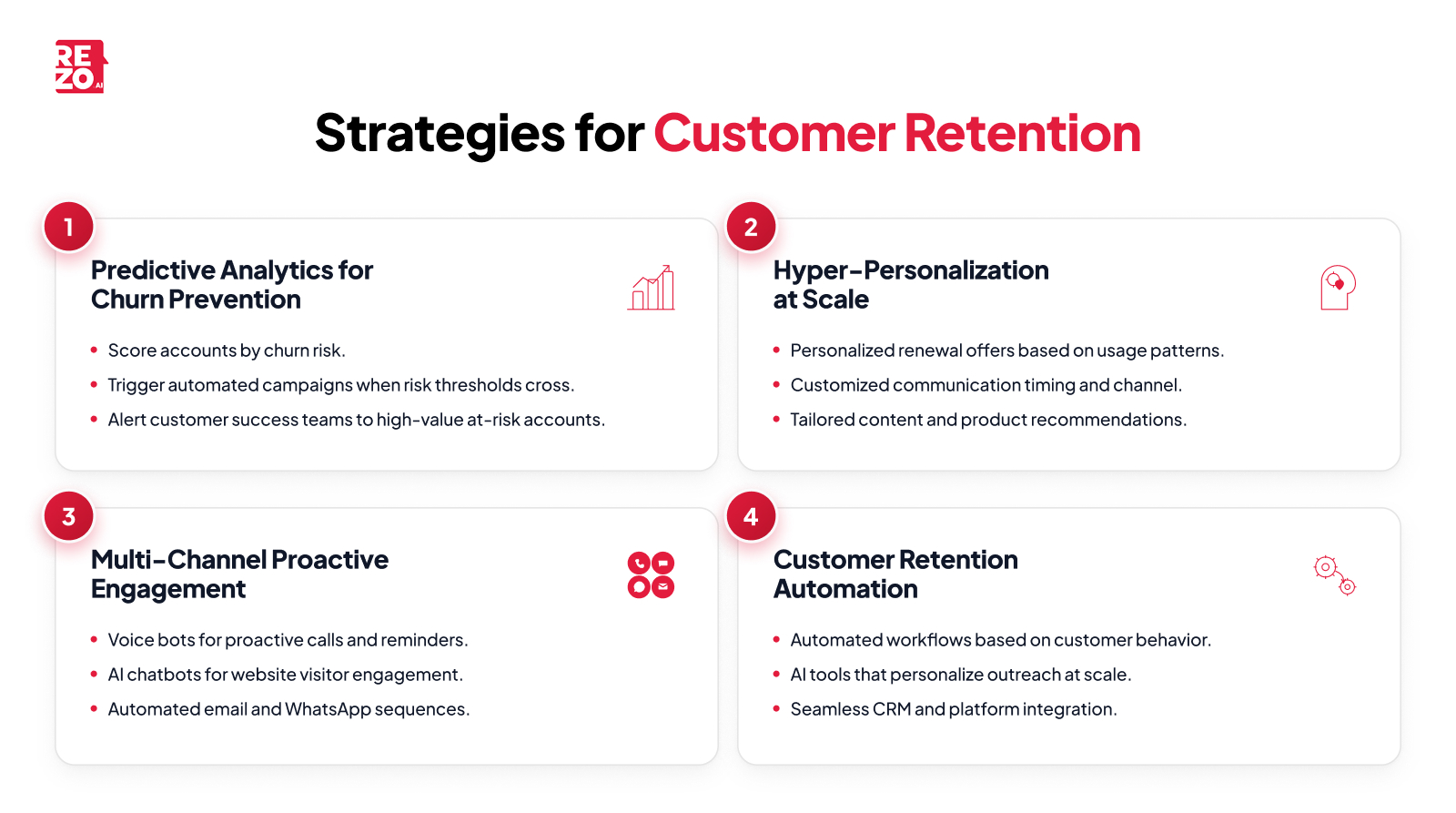
Predictive Analytics for Churn Prevention
Predictive analytics is the foundation of modern customer retention efforts. By analyzing behavioral patterns, transaction history, engagement metrics, and customer sentiment signals, AI models can predict churn and identify customers likely to leave with remarkable accuracy.
Organizations using predictive analytics for churn prevention report up to 30% reduction in churn rate. The key is acting early: agentic AI gives you the window to intervene before customers make the decision to leave. Customer health scores provide customer success teams with clear visibility into which accounts need immediate attention.
Practical applications include:
- Scoring accounts by churn risk to prioritize outreach
- Triggering automated retention campaigns when risk thresholds are crossed
- Alerting customer success teams to high-value accounts showing warning signs
- Monitoring customer health to identify patterns that signal dissatisfaction
Hyper-Personalization at Scale
Generic retention strategies no longer work. A Salesforce research shows that 84% of customers say being treated like a person, not a number, is key to winning their business. Customers expect personalized experiences that demonstrate you understand their customer needs.
AI driven personalization enables hyper-personalization by analyzing each customer’s unique customer journey, preferences, and customer behavior to deliver tailored experiences. Businesses that integrate AI-driven personalization into their customer success strategies are reportedly seeing higher conversion rates.
This means:
- Personalized renewal offers based on usage patterns and price sensitivity, with reminders sent before the renewal date
- Customized communication timing and channel based on individual preferences
- Tailored content and product recommendations that demonstrate you understand their needs and delight customers
When customers feel that you truly understand them, they develop customers trust and become loyal customers who advocate for your brand.
Multi-Channel Proactive Engagement
The shift from reactive to proactive engagement is where agentic AI truly shines. Instead of waiting for customers to reach out with problems, AI agent technology anticipates customer needs and initiates meaningful touchpoints throughout the customer journey.
Conversational AI and chatbots can handle up to 80% of routine tasks, freeing support teams for complex relationship-building while ensuring customers get immediate assistance 24/7. By automating routine tasks, your team’s time is freed to focus on building stronger relationships with customers.
Effective multi-channel retention strategies include:
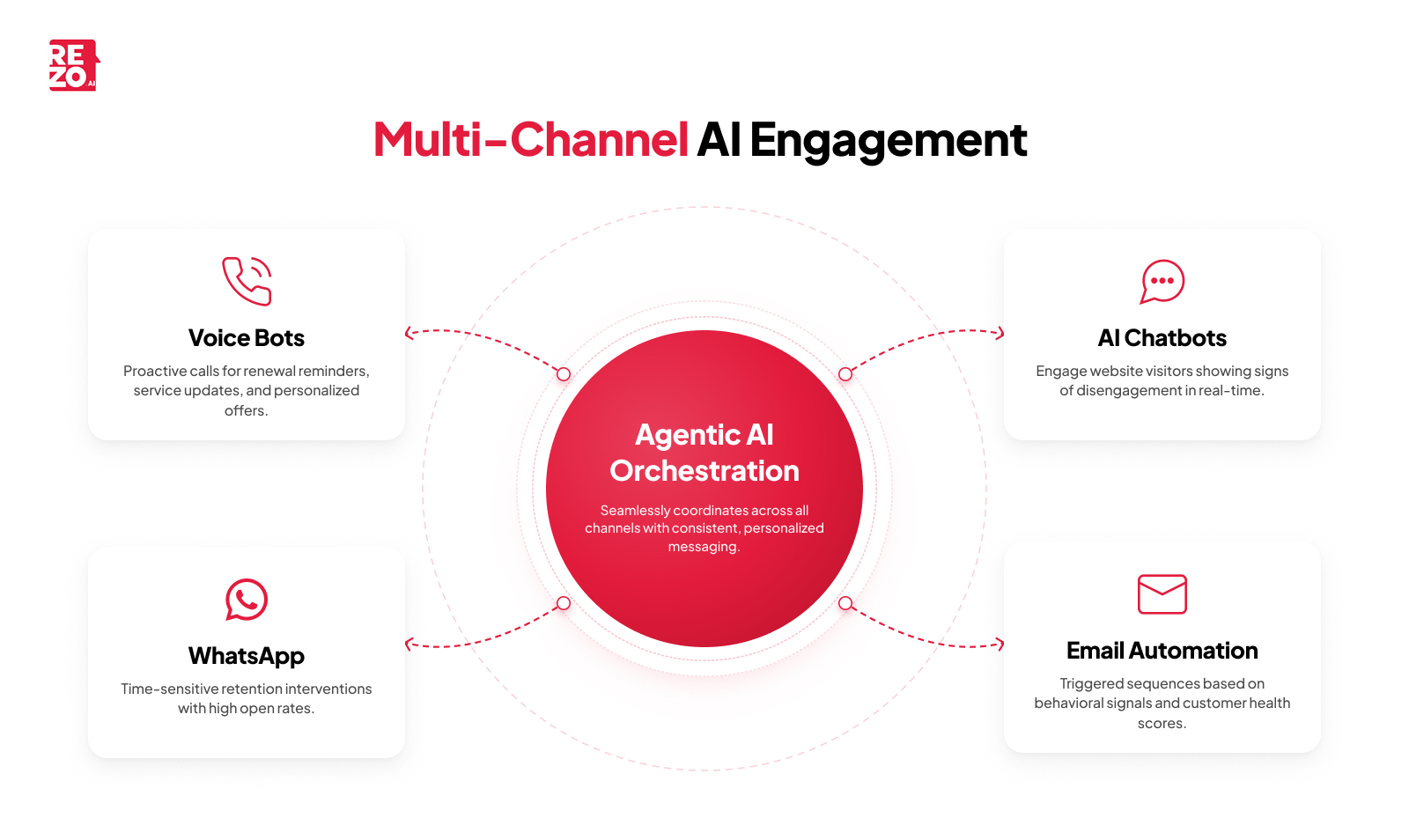
- Voice bots that proactively call customers with renewal reminders, service updates, or personalized offers
- AI agent chatbots that engage website visitors showing signs of disengagement
- Automated email sequences triggered by behavioral signals
- WhatsApp messages for time-sensitive retention interventions
Customer Retention Automation for Scale
Customer retention automation enables organizations to execute retention strategies across their entire customer base without overwhelming support teams. This is where agentic AI capabilities truly transform business processes.
Key features of customer retention automation include:
- Automated workflows that trigger based on customer behavior and customer health scores
- AI tools that personalize outreach at scale while maintaining authenticity
- Automation tools that handle repetitive tasks so customer success teams can focus on strategic customer interactions
- Seamless integration with existing CRM and customer success platforms
Here are a few examples: when customer health scores drop below a threshold, agentic AI can automatically schedule a check-in call, send a personalized email, or alert a customer success manager. This level of customer retention automation ensures no at-risk customers slip through the cracks.
How to Implement AI for Customer Retention?
Building Your Data Foundation
Agentic AI is only as good as the customer data powering it. Before implementing retention AI, organizations need to address limited visibility issues by:
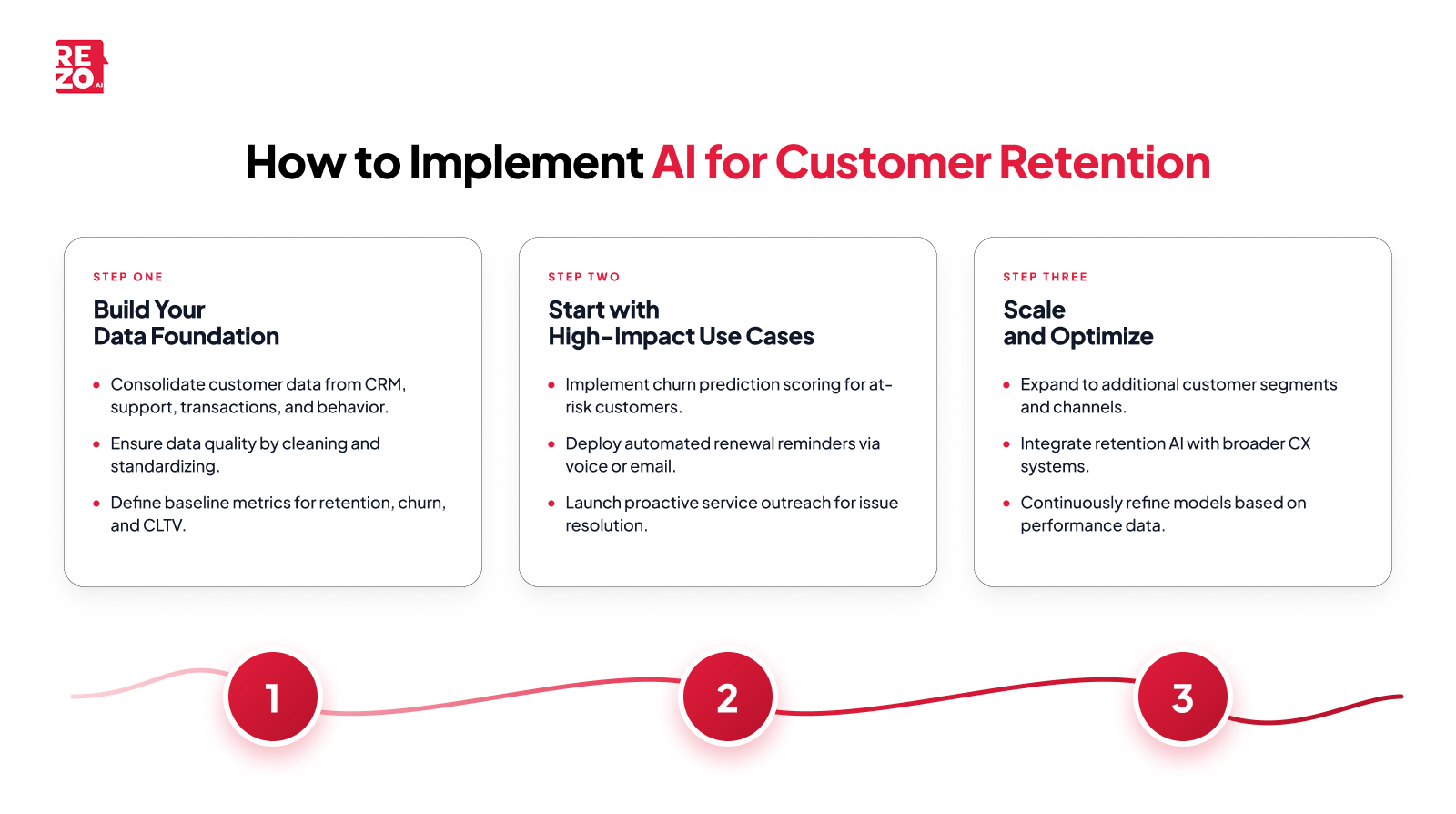
- Consolidate customer data: Integrate touchpoints across CRM, support tickets, transaction history, website behavior, and communication logs into a unified view. Without this foundation, you’ll have limited visibility into the complete customer journey.
- Ensure data quality: Clean and standardize data to eliminate inconsistencies that undermine AI model accuracy. According to McKinsey, data quality issues remain one of the primary barriers to AI adoption.
- Define clear metrics: Establish baseline customer retention rate, churn rate, and customer lifetime value before implementation to measure customer retention impact accurately.
Starting with High-Impact Use Cases
Begin with focused pilots where ROI is most measurable. Tech companies and enterprises alike should prioritize retention efforts that deliver quick wins:
- Churn prediction: Implement AI scoring for at-risk customers and high churn risk accounts, starting with your highest-value segments
- Automated renewal reminders: Deploy voice bots or email automation for subscription renewals to reduce churn
- Proactive service outreach: Use agentic AI to identify and reach customers experiencing service issues before they complain
These retention efforts help improve customer retention while demonstrating AI value to stakeholders.
Scaling and Optimizing
Once pilots demonstrate value:
- Expand to additional customer segments and channels to grow your number of customers retained
- Integrate retention AI with broader customer experience systems
- Continuously refine models based on performance data and customer behavior patterns
- Use generative AI to create personalized content at scale
Customer success teams should track customer health continuously and adjust their customer success strategy based on what the data reveals. This iterative approach helps improve retention over time and builds lasting customer relationships.
The Human-AI Balance in Retention
Despite AI capabilities, human connection remains essential. Research shows that 89% of customers emphasize the need to combine human connection with AI efficiency. Customers expect both speed and empathy.
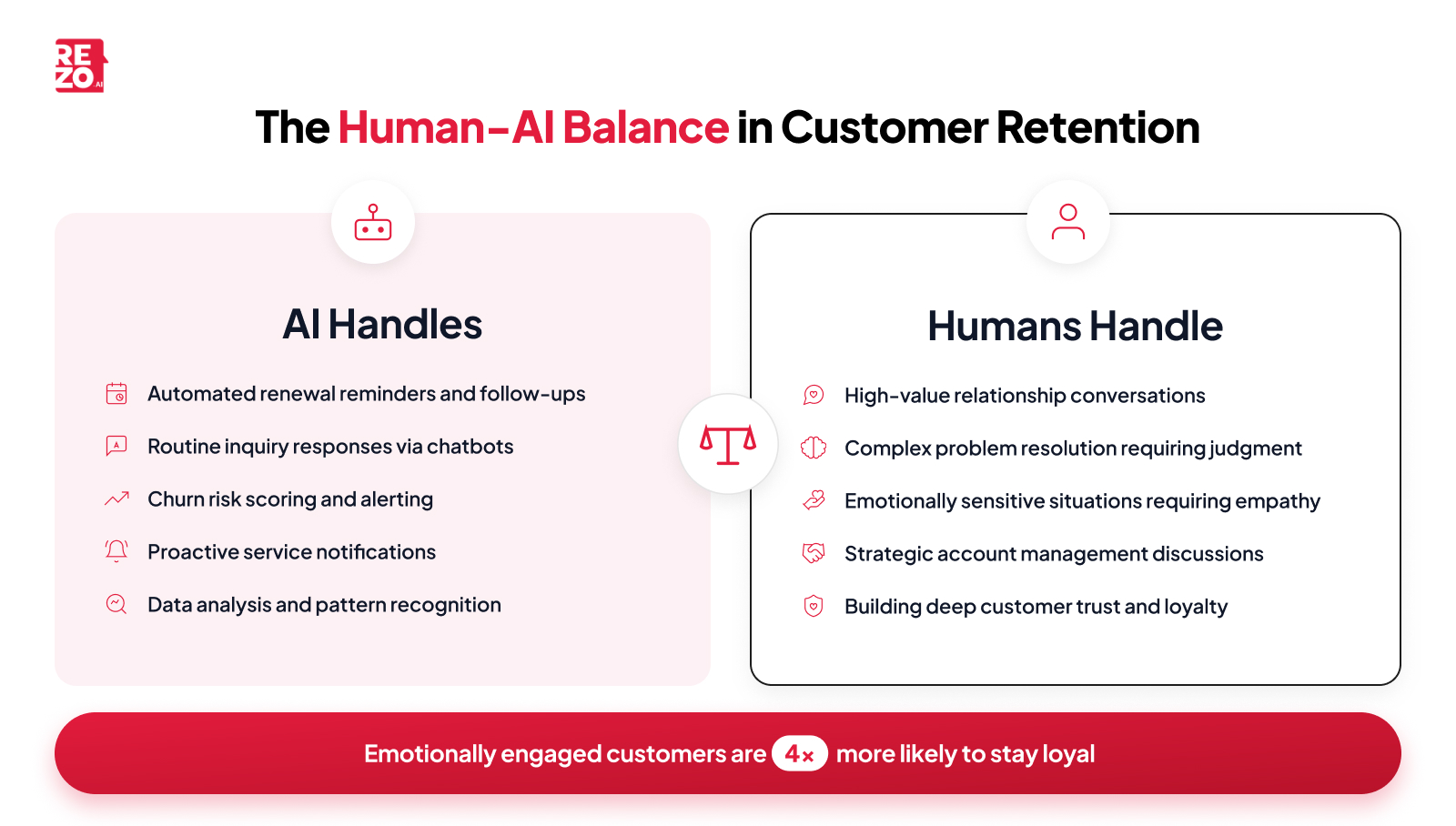
The optimal model uses agentic AI to automate repetitive tasks (up to 70% in many cases) while reserving human agents for:
- High-value relationship conversations that deepen customer relationships
- Complex problem resolution requiring judgment
- Emotionally sensitive situations requiring empathy where customers feel vulnerable
- Strategic account management discussions with key customers
This approach maximizes efficiency while preserving the personal touch that builds customer loyalty. Studies show emotionally engaged customers are four times more likely to stay loyal. When customers feel valued through genuine human connection, they become advocates who help drive revenue through referrals.
Managing customer relationships effectively requires knowing when AI agent automation enhances the experience and when human touch is essential. The right customers deserve the right level of attention, and customer success teams must balance efficiency with personalization to deepen customer relationships.
Measuring Success: Key Retention Metrics
Track these metrics to measure customer retention program effectiveness:
- Customer Retention Rate (CRR): Percentage of customers retained over a period—the foundational metric for any customer retention strategy
- Customer Lifetime Value (CLTV): Engaged customers have 30% higher customer lifetime value according to Bain & Company
- Net Promoter Score (NPS): Measures customer satisfaction and likelihood to recommend, a leading indicator of retention rates
- Customer Effort Score (CES): How easy it is for customers to do business with you
- Churn Rate: The inverse of retention, tracking customers lost
- Customer Health Scores: Aggregated indicators showing which customers are thriving versus at churn risk
Set benchmarks based on industry standards, then measure improvement after AI implementation. Increasing customer retention even marginally can dramatically boost customer lifetime value and drive revenue growth.

Conclusion
Customer retention is no longer about reacting to churn signals. It is about proactively building customer relationships that make leaving unthinkable. Agentic AI, with its ability to anticipate customer needs, personalize at scale, and act autonomously, gives organizations the AI tools to transform retention from a cost center into a growth engine.
The businesses winning at customer retention are those combining AI efficiency with human empathy, using predictive analytics to intervene early, and orchestrating seamless engagement across every channel. These organizations understand that retaining customers and building customer loyalty requires both technological innovation and genuine care for customers.
With retention improvements driving 25-95% profit growth and significant business growth potential, the ROI case is clear. Successful customer retention powered by agentic AI doesn’t just reduce churn, it creates loyal customers who fuel sustainable growth. The question is not whether to invest in AI-powered customer retention automation and customer success. It is how quickly you can begin to boost customer retention and transform your existing customers into lifelong advocates.
Frequently Asked Questions
What is a good customer retention rate?
A good retention rate varies by industry. SaaS and tech companies typically aim for 90%+ annual retention, while e-commerce averages 30-40%. BFSI and telecom often target 85-95%. Compare against your industry benchmark and focus on continuous improvement in your retention strategies.
What is the difference between customer retention and customer loyalty?
Customer retention measures whether customers stay with you over time. Customer loyalty goes deeper, reflecting emotional commitment, repeat purchases, and advocacy. Retained customers may stay out of convenience; loyal customers actively choose you and recommend you to others because they feel genuine connection to your brand.
How long does it take to see results from AI retention programs?
Most organizations see measurable impact within 3-6 months of AI implementation. Quick wins like automated renewal reminders show results within weeks. Predictive churn models and customer health scores typically need 2-3 months of data refinement before optimal accuracy. Customer success teams often report improved efficiency immediately after implementing customer retention automation.
How does agentic AI differ from traditional AI in customer retention?
Agentic AI goes beyond analysis to take autonomous action. Traditional AI might identify churn risk; agentic AI identifies the risk, determines the best intervention, and executes it, whether that’s sending a personalized offer, scheduling a customer success call, or adjusting service parameters. This autonomous capability makes agentic AI particularly powerful for customer retention automation at scale.
Frequently Asked Questions (FAQs)


Take the leap towards innovation with Rezo.ai
Get started now