AI for Scaling in Contact Center: The Complete Enterprise Guide

AI for Scaling in Contact Center: The Complete Enterprise Guide


Contact center leaders face an impossible equation. Customer interactions are surging across voice and digital channels including chat, email, and WhatsApp. Yet the traditional solution of adding more customer service reps creates a linear cost spiral that most enterprises cannot sustain. The math simply does not work when every new hire means weeks of training, infrastructure costs, and ongoing salaries. High volume contact centers need a better approach.
AI for scaling in contact center operations offers a fundamentally different approach. Rather than matching headcount to volume, enterprises can now leverage intelligent systems that handle more customer interactions without proportional cost increases. According to Gartner, agentic AI in contact centers will autonomously resolve 80% of common customer service issues by 2029, reducing operational costs by 30%. This is not incremental improvement. This is transformation through contact center automation.
What is AI-Powered Scaling in Contact Centers?
AI-powered scaling refers to using artificial intelligence to handle increasing interaction volumes while maintaining or improving service quality, without proportionally increasing headcount. This is distinct from simple automation, which follows rigid rules and breaks when faced with unexpected scenarios. Modern contact center AI solutions deliver the operational efficiency that traditional approaches cannot match.
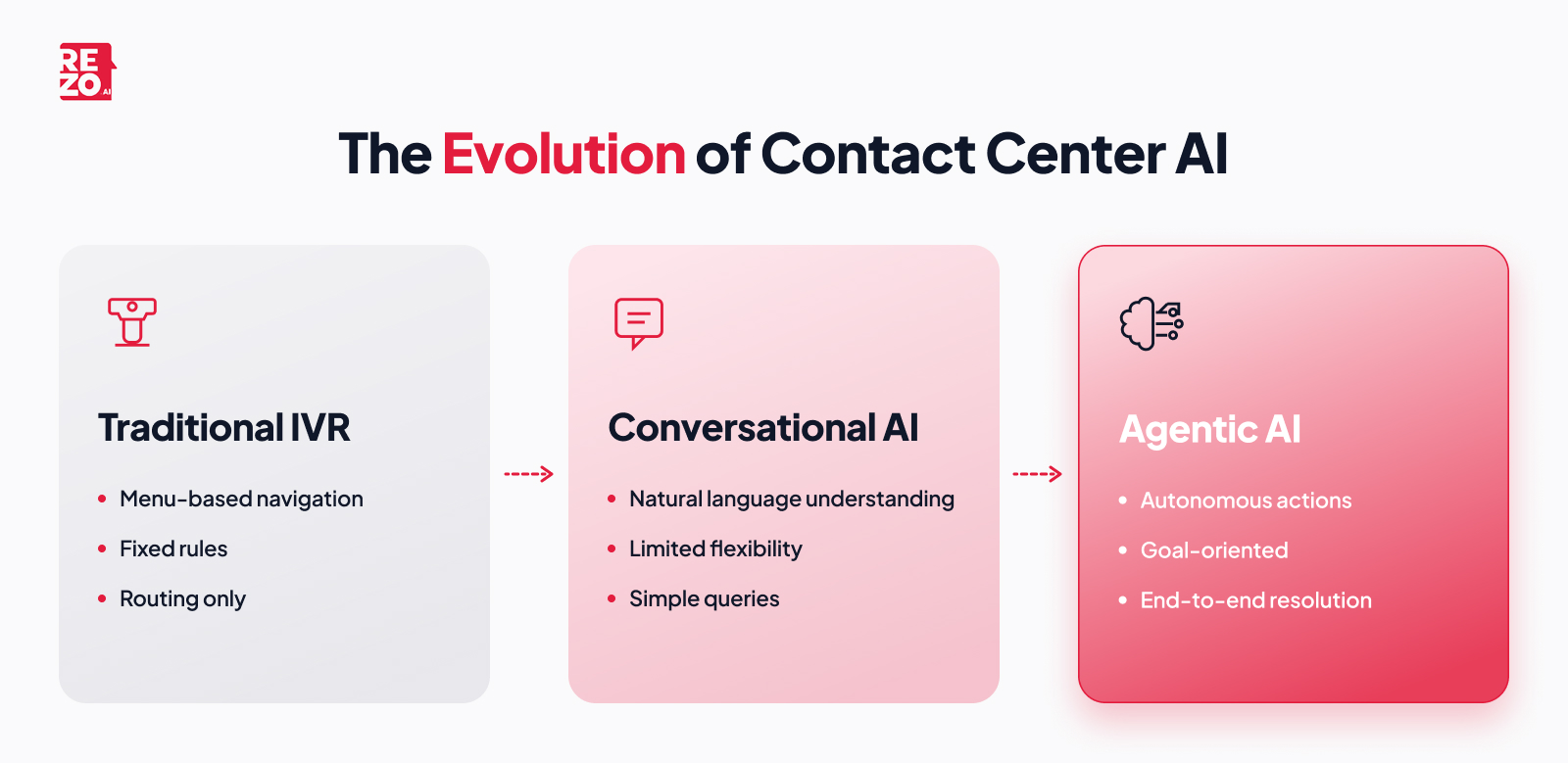
The evolution has happened in three waves. First came Interactive Voice Response (IVR) systems, which used menu trees for call routing. Then conversational AI emerged, using natural language processing to understand customer intent. Now we are entering the era of agentic AI, which represents a fundamental shift in capability for contact centers worldwide.
From Chatbots to Agentic AI: Understanding the Evolution
Traditional chatbots follow predefined rules. Ask something outside their script, and they fail. Conversational AI improved on this by understanding natural language, but still operated within narrow boundaries. These early self service tools could only handle simple customer queries.
Agentic AI is different. These AI agents understand context, make decisions, and take autonomous actions to achieve specific goals. They do not just respond to prompts. They complete tasks end-to-end. An AI agent can process a refund, schedule a callback, update a customer record using customer data, and send a confirmation, all without human involvement. This level of contact center automation transforms how contact centers operate.
Virtual agents powered by generative AI can now handle complex customer requests while analyzing customer sentiment in real time. These AI agents work alongside virtual assistants to deliver a satisfying customer experience across every customer interaction. The integration of machine learning enables continuous improvement in how AI contact center solutions understand and respond to customer inquiries.
Key Capabilities That Enable AI Scaling
Modern contact center AI platforms deliver scaling through several interconnected capabilities that work together to handle volume efficiently. These AI solutions address rising customer expectations while improving business outcomes.
- Autonomous Issue Resolution is the primary driver. When AI agents can fully resolve customer inquiries without human intervention, your customer service reps focus only on complex or sensitive issues. Early adopters report 45-80% of issues resolved autonomously, with each interaction saving an average of 280 seconds. This first contact resolution capability dramatically improves operational efficiency.
- Real-time Agent Assistance amplifies human productivity. Contact center AI listens to conversations and surfaces relevant information, suggested responses, and compliance reminders through real time guidance. Customer service reps handle customer calls faster and with greater accuracy. This real time agent assistance improves agent performance while reducing customer effort.
- Intelligent Routing moves beyond simple skill-based call routing. AI analyzes customer intent, customer sentiment, customer history, and even likelihood of positive outcome to route each contact to the optimal resource, whether that is an AI agent, a specific customer service rep, or an automated workflow. Sentiment analysis ensures that frustrated customers reach human agents quickly.
- Omnichannel Orchestration unifies voice and digital channels under one intelligent layer. Customers move seamlessly between channels while maintaining context. A conversation that starts on WhatsApp can escalate to voice without customers repeating themselves. The contact center AI platform maintains customer history across all touchpoints for personalized service.
- Predictive Analytics enables proactive outreach. AI identifies customers likely to churn through customer behavior analysis, products likely to fail, or issues likely to escalate, allowing preemptive action that reduces inbound call volume. This ai driven approach to customer engagement improves customer loyalty and reduces customer demand on contact centers.
- Self Service Portals powered by generative AI give customers the tools to resolve issues independently. These self service options handle everything from order tracking to account changes, reducing the burden on contact centers while improving customer experience. Virtual assistants within self service portals provide personalized support based on customer data and customer history.
- Quality Assurance systems powered by AI monitor every customer interaction for compliance and quality. Automated quality assurance tools analyze customer sentiment, track agent performance metrics, and identify coaching opportunities through real time coaching. This data driven insights approach replaces manual quality assurance sampling with comprehensive coverage.

The ROI of AI-Powered Contact Center Scaling
The business case for AI scaling is compelling. According to PwC, enterprises adopting agentic AI workflows can achieve 70-80% cost reduction over five years through AI workflows coupled with workforce augmentation. Contact center automation delivers measurable business value.
Here are the key metrics driving ROI:
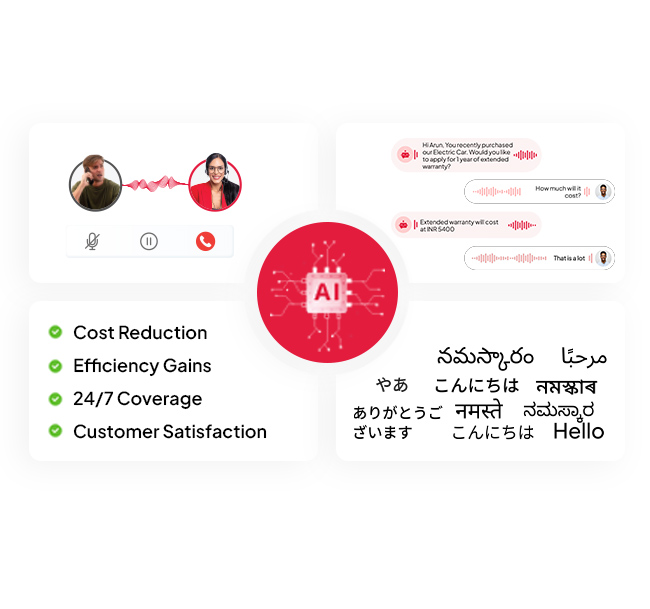
- Cost Reduction: Gartner predicts conversational AI will reduce contact center agent labor costs by $80 billion globally by 2026
- Efficiency Gains: Deloitte research shows AI driven contact centers reduce call handling time by up to 33%
- Customer Satisfaction: Same Deloitte study reports 25% improvement in customer satisfaction scores
- Scale Without Headcount: Handle seasonal spikes and growth without proportional hiring
- 24/7 Coverage: Customers calling at 2 AM receive the same service quality as those calling at noon
- Improved Agent Productivity: Customer service reps handle complex cases while AI agents manage routine tasks
- Enhanced Customer Experience: Faster contact resolution and personalized service improve customer loyalty
- Better First Contact Resolution: AI contact center solutions resolve more customer queries on the first try
Contact centers that implement AI solutions see improvements across multiple business outcomes. The combination of self service capabilities, AI agents, and empowered customer service reps creates efficient service delivery that meets customer expectations.
Implementation Roadmap: A Phased Approach
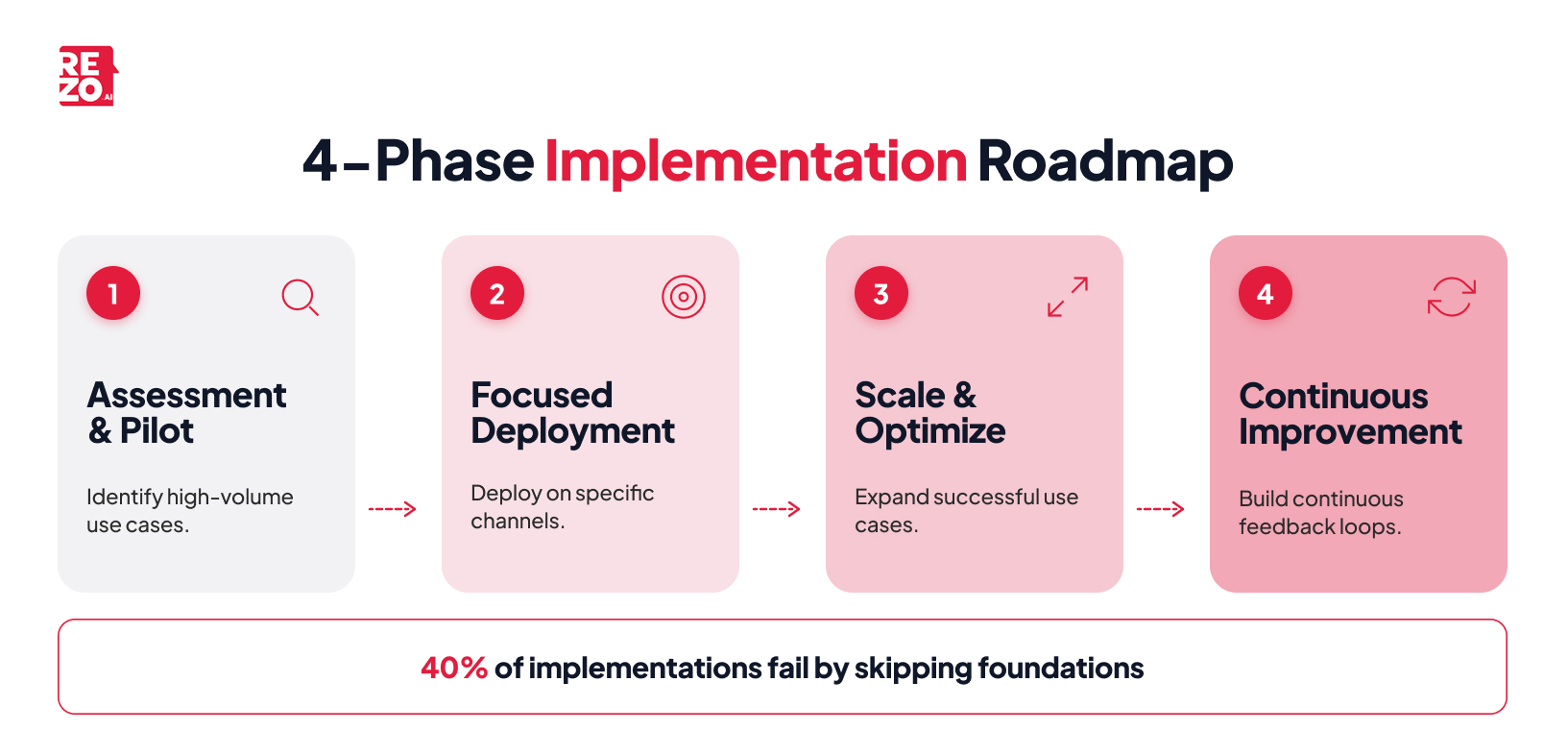
Successful AI-powered customer service scaling requires a structured implementation approach. Gartner warns that 40% of agentic AI implementations fail because organizations skip foundational steps or try to automate everything immediately. Contact center automation must be approached strategically.
Phase 1: Assessment and Pilot (Start Small)
Identify high-volume, repetitive tasks with clear success metrics. Order status inquiries, appointment scheduling, and password resets are common starting points. Run pilot programs with measurable goals before expanding your contact center AI deployment.
During this phase, assess your current contact center operations and identify where AI agents can deliver the most business value. Analyze customer interactions to understand common customer requests and customer queries. This data driven insights approach ensures you focus on use cases with the highest impact.
Phase 2: Focused Deployment
Based on pilot learnings, deploy contact center AI solutions across specific channels or processes. Integrate with existing CRM and backend systems to leverage customer data and customer history. Establish escalation paths to human agents for complex or sensitive issues.
Implement self service options for straightforward customer requests. Configure virtual agents to handle repetitive tasks while routing complex customer inquiries to customer service reps. Begin automating routine tasks that consume agent time without requiring human judgment.
Phase 3: Scale and Optimize
Expand successful use cases across voice and digital channels and customer segments. Implement advanced capabilities like predictive analytics, proactive outreach, and sentiment analysis. Deploy real time coaching to improve agent performance continuously.
At this stage, contact centers should implement automated quality assurance to monitor ai performance across all customer interactions. Use customer feedback and customer behavior data to refine AI agent responses. Focus on improving first contact resolution and reducing customer effort.
Phase 4: Continuous Improvement
Build feedback loops that capture agent and customer feedback. Use analytics to identify new contact center automation opportunities. Stay current with AI capability advancements including generative AI enhancements.
Monitor AI performance regularly through quality assurance processes. Track key metrics including customer satisfaction, contact resolution rates, and agent productivity. Adjust self service tools based on customer feedback and evolving customer expectations.
Common Pitfalls to Avoid
Organizations fail when they attempt to automate everything at once without proving business value incrementally. Neglecting change management leaves customer service reps feeling threatened rather than empowered. Poor integration with existing systems creates data silos that undermine contact center AI effectiveness. Skipping governance exposes the organization to compliance and brand risks.
Other common mistakes in contact center automation include:
- Failing to leverage customer data for personalized support
- Not establishing clear escalation paths for complex or sensitive issues
- Ignoring customer sentiment signals that indicate frustration
- Underinvesting in real time agent assistance for customer service reps
- Not monitoring ai performance to identify improvement opportunities
- Overlooking the customer journey when designing self service experiences
Balancing AI Automation with Human Touch
AI scaling does not mean eliminating human agents. The most successful contact center implementations use AI agents to augment humans, not replace them. Industry experts emphasizes finding the right mix of human agents and AI as a critical success factor for contact centers.
American Airlines provides an instructive example. They achieved 50% automation but focused on transforming customer service rep roles rather than reducing headcount. Customer service reps now handle complex, high-value customer interactions while AI agents manage routine tasks. This approach improved both customer experience and agent productivity.

Design clear escalation paths for situations requiring human judgment. Emotional distress, complex disputes, and high-value transactions often need human empathy and decision-making authority. Train customer service reps to work alongside AI agents, reviewing AI suggestions and providing feedback that improves the system.
Real time agent assistance helps customer service reps handle difficult customer interactions more effectively. When AI provides real time guidance and surfaces relevant customer history, agents can deliver personalized service that builds customer loyalty. This collaboration between human agents and AI solutions creates a superior customer service experience.
Contact centers should also consider:
- Implementing real time coaching to improve agent performance during calls
- Using sentiment analysis to identify when customers need human empathy
- Providing customer service reps with customer behavior insights for personalized support
- Building escalation triggers for complex or sensitive issues
- Enabling seamless handoffs from AI agents to human agents
Industry-Specific Considerations
Different industries have unique scaling requirements for their contact centers.
BFSI (Banking, Financial Services, Insurance)
Compliance is paramount. Contact center AI must operate within regulatory guardrails while automating collections, loan inquiries, and account servicing. AI agents excel at fraud detection and prevention through pattern recognition across high volumes of customer interactions.
Contact centers in BFSI should leverage customer data carefully while maintaining security. Virtual agents can handle routine customer requests while customer service reps focus on complex financial matters. Quality assurance requirements in this sector make automated quality assurance particularly valuable.
Automotive and OEMs
Dealer network coordination, service appointment scheduling, and customer feedback collection benefit from contact center automation. Peak periods around new model launches or recall notifications require elastic AI contact center capacity that scales with customer demand.
Self service portals allow customers to schedule service appointments and track vehicle status without contacting customer service reps. AI agents can handle parts inquiries and warranty questions while routing complex or sensitive issues to human agents.
E-commerce and Marketplaces
Order tracking, returns processing, and delivery inquiries represent high-volume customer interactions ideal for AI agents. Seasonal peaks during sales events require rapid scaling capability from contact center AI solutions.
Self service options are essential for e-commerce contact centers. Virtual assistants can guide customers through returns, track shipments, and answer product questions. Generative AI enables personalized support recommendations based on customer history and customer behavior applying machine learning to improve suggestions.
Telecom
Technical support, plan recommendations, and churn prevention are AI-suitable use cases for telecom contact centers. The industry’s high customer interaction volumes make contact center automation particularly impactful for operational efficiency.
AI contact center platforms can analyze customer data to identify customers at risk of churning. Proactive outreach based on customer behavior can address issues before customers contact support. Self service tools handle routine tasks like plan changes and bill payments.

Future-Proofing Your Contact Center
The trajectory is clear. Gartner predicts that by 2026, 20% of inbound customer service contact volume will come from machine customers, meaning AI systems contacting your contact center on behalf of consumers. Preparing for machine-to-machine interactions requires API-first infrastructure and adaptive AI solutions.
Build flexibility into your technology choices. Choose contact center AI platforms that integrate with existing systems while providing a path to more advanced capabilities. Prioritize vendors that demonstrate continuous innovation and can scale with your growth. Look for generative AI capabilities that enable ai driven improvements over time.
Contact centers should prepare for:
- Increased customer expectations for instant, personalized service
- Greater use of virtual agents across all voice and digital channels
- Machine learning improvements that enhance AI agent capabilities
- Deeper integration of customer data across the customer journey
- Advanced sentiment analysis for better customer experience management
- Expanded self service options through self service portals and virtual assistants
Conclusion: Taking the First Step
AI for scaling in contact center operations is no longer experimental. Leading enterprises are already handling millions of customer interactions daily with dramatically improved operational efficiency and customer satisfaction. The question is not whether to adopt contact center AI, but how quickly and effectively you can implement it.
Start with assessment. Identify your highest-volume repetitive tasks. Pilot AI solutions with clear success metrics. Scale what works while building organizational capability for continuous improvement. Focus on delivering efficient service that meets customer expectations.
Contact centers that invest in AI agents, self service capabilities, and real time agent assistance will build competitive advantages that late adopters cannot easily replicate. The combination of contact center automation and empowered customer service reps delivers both business value and improved customer experience.
The technology is ready. Contact center AI solutions can transform your customer service experience. The question is: are you ready to transform your contact center?
Frequently Asked Questions
How long does it take to implement AI scaling in a contact center?
Most enterprises see initial results within 8-12 weeks for pilot deployments. Full-scale contact center automation across all voice and digital channels typically takes 6-12 months, depending on complexity, integration requirements, and organizational readiness. Starting with focused use cases accelerates time-to-value. Contact centers should plan for iterative improvement as AI agents learn from customer interactions.
Will AI replace human agents in contact centers?
AI agents augment rather than replace customer service reps. While routine tasks shift to AI, human agents focus on complex, high-value customer interactions requiring empathy and judgment. Most successful contact center implementations transform agent roles toward relationship-building and problem-solving rather than reducing headcount. Customer service reps become experts in handling complex or sensitive issues while AI handles repetitive tasks.
What percentage of customer inquiries can AI handle autonomously?
Early adopters report 45-80% autonomous contact resolution rates depending on industry and use case complexity. Routine customer requests like order status, password resets, and appointment scheduling achieve higher automation rates through self service and AI agents, while complex financial or technical issues require human agents. First contact resolution rates improve as contact center AI solutions learn from customer data.
How does AI scaling affect customer satisfaction scores?
Research shows ai driven contact centers improve customer satisfaction by 20-25% through faster response times, 24/7 availability, and consistent service quality. The key is ensuring seamless escalation to human agents when needed, preventing customer frustration with AI limitations. Contact centers that balance self service options with personalized support from customer service reps achieve the best customer experience outcomes. Monitoring customer sentiment helps contact centers continuously improve their AI solutions.
What role does customer data play in AI contact center success?
Customer data is essential for personalized service and effective contact center automation. AI agents use customer history and customer behavior patterns to provide relevant responses and recommendations. Contact center AI platforms analyze customer interactions to improve quality assurance and agent performance. However, contact centers must handle customer data responsibly and maintain security throughout the customer journey.
How do self service options improve contact center efficiency?
Self service portals and virtual assistants handle routine customer requests without involving customer service reps. This reduces call volume while giving customers the immediate responses they expect. Effective self service tools include knowledge bases, chatbots, and self service portals for account management. Contact centers that implement comprehensive self service options see significant improvements in operational efficiency and customer effort scores.
Frequently Asked Questions (FAQs)


Take the leap towards innovation with Rezo.ai
Get started now