How Rezo AI Turns Every Customer Interaction Into Feedback You Can Act On

How Rezo AI Turns Every Customer Interaction Into Feedback You Can Act On


Your customers tell you exactly what they think every single day. Not just in the customer feedback surveys they rarely fill out, but in every call, chat, email, and WhatsApp message. The problem is not a shortage of feedback. It is that most of it never reaches the people who can do anything about it. And the stakes keep climbing: Salesforce found that 90% of customers say the experience a company provides is as important as its products and services. Understanding how Rezo AI turns every customer interaction into feedback you can act on starts with a simple shift: stop treating feedback as something you collect once in a while, and start treating every conversation as a live signal worth acting on.
Why Most Customer Feedback Insights Never Becomes Action?
Here is the uncomfortable truth. Surveys capture only what you think to ask, from the small slice of customers who bother to respond. Survey fatigue means fewer and fewer of them do. Everything else, the honest, unprompted commentary that happens mid-conversation, usually goes unheard. Surveys are still foundational tools for collecting customer feedback, but on their own they leave most of the story untold.
The numbers back this up. Most contact centers manually review only 2 to 5% of their interactions for quality. That means 95% or more of what customers say is never analyzed by anyone. The valuable customer insights that could prevent churn or fix a broken process sit untouched in call recordings and chat logs, and the customer feedback analysis that would surface those actionable insights never happens. Nobody stops to analyze customer feedback at the scale it actually arrives.
Even when feedback is captured, it tends to get stuck. Sales sees one version of the customer, support sees another, and marketing sees a third. Nobody owns the full picture, and this scattered feedback rarely turns into data driven decisions. As Forbes contributors point out, feedback only drives change when it is translated into clear priorities tied to revenue and retention, with ownership assigned across teams. Structured feedback reporting is what improves that kind of cross-functional alignment. Without it, valuable insights stay as noise.
The cost is real. When you cannot hear the early warning signs of frustration, customers leave quietly. Effective feedback analysis is what identifies those product gaps before churn, not after. Industry leaders also note that conversation analytics platforms exist precisely because leaders need to surface these signals from voice and text interactions before they turn into lost accounts.

What "Feedback You Can Act On" Actually Means
There is a big difference between raw feedback and feedback you can act on. Raw feedback is a pile of comments. Actionable feedback is specific, prioritized, and handed to a team that can actually change something. Turning customer feedback into actionable steps is the whole point.
Think of it as the gap between hearing and acting. Hearing is knowing a customer was annoyed. Acting is knowing that billing confusion drove 40% of last week's negative calls, that it maps to a specific step in your payment flow, and that the product team already has it on their sprint. That is what it means to move from customer concerns to clear insights.
Every interaction carries three kinds of signal:
- What customers say: the literal words, requests, and complaints that reveal real customer needs and frustrations
- What customers feel: the sentiment and emotion behind those words
- What customers intend: whether they are about to churn, buy, or escalate
Feedback becomes actionable only when all three are captured, connected, and routed to someone who can respond. That is the standard Rezo AI is built around, and it is how customer feedback insights turn into a competitive advantage rather than a quarterly slide. It is the same principle behind a strong voice of customer program, taken from occasional survey to every live conversation.
.jpg)
Why Every Interaction Is Your Richest Feedback Source
Surveys are structured but shallow. Interactions are messy but rich. When a customer speaks or types freely, they reveal context you would never think to ask for, and they expose the pain points a rating scale never captures.
Consider the volume. In a single five-minute call, thousands of words are exchanged. Multiply that across voice, chat, email, WhatsApp, support tickets, review sites, and social media comments, and you have the largest, most honest source of customer truth your business owns. Those social media posts and support tickets are unprompted, they are current, and they are piling up whether you analyze them or not. Collecting feedback from these multiple channels is what uncovers the hidden issues a single set of survey responses will always miss.
The catch is that these signals arrive across different channels and usually stay siloed. A frustration voiced on a call never gets connected to the same customer's angry WhatsApp message an hour later, and neither gets tied to their comment on social media. Unifying them is what turns scattered comments into a coherent story, and it is exactly what a true omnichannel customer support setup is meant to deliver.
This is where AI earns its place. Good customer feedback analysis combines qualitative and quantitative methods: qualitative analysis explores customer behavior hidden in unstructured data and surfaces the customer needs behind the words, while quantitative feedback analysis measures customer satisfaction using structured data and metrics like Net Promoter Score and CSAT. Done well, that feedback analysis uncovers patterns no manual review could. Research indicates that AI-driven customer interactions can lift customer satisfaction by 10 to 20%, largely because AI can listen to everything and respond faster than any manual process. The richness was always there. AI-powered analysis is what finally makes it usable.
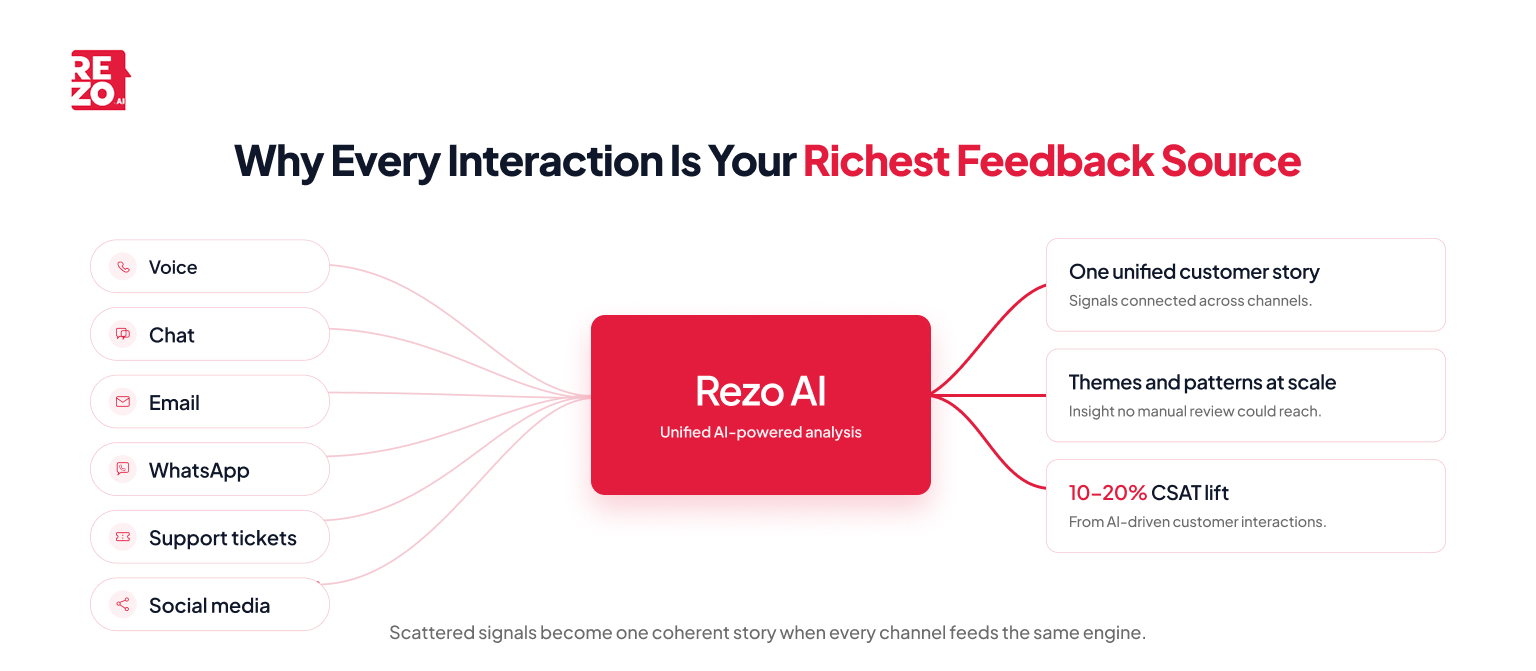
How Rezo AI Turns Interactions Into Feedback You Can Act On
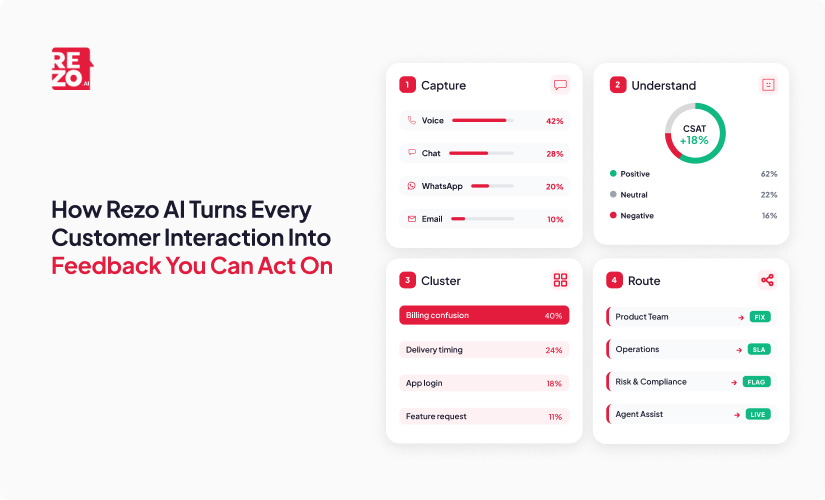
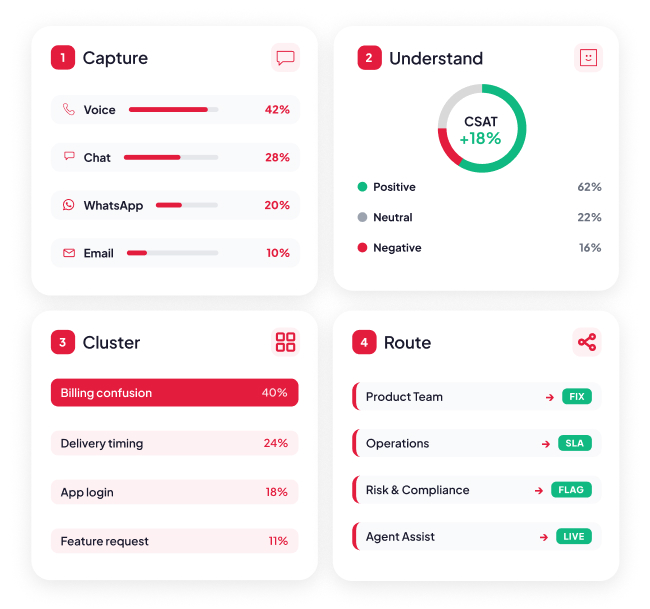
So how does the shift from raw conversation to acted-on insight actually happen? Rezo AI runs it as a continuous pipeline across four stages, so that analyzing customer feedback becomes an ongoing process rather than a one-time project.
Capture Every Conversation, Across Every Channel
It starts with coverage. Rezo AI captures interactions across voice, chat, email, and WhatsApp on one unified platform, so nothing lives in a separate tool that nobody checks. Instead of sampling 2 to 5% of calls, the platform works with 100% of customer interactions. Every conversation becomes a data point, and no complaint slips through because a manager did not happen to listen to that recording. When you centralize data this way, inconsistent formats stop getting in the way of a clean analysis process.
Understand What Customers Mean, Not Just What They Say
Capturing words is not enough. Rezo AI applies natural language processing, sentiment analysis, and intent detection to understand meaning. Sentiment analysis classifies each piece of feedback as positive, negative, or neutral, so you can track how customers feel at scale rather than guessing. Modern speech analytics picks up when a customer says "fine" but clearly is not, flags rising frustration in real time, and detects the emerging issue that is starting to appear across dozens of conversations. Because this real-time feedback happens live, in minutes rather than weeks, a supervisor can step into a call that is going sideways instead of reading about it later. The nuance still needs human judgment, but the machine does the listening no team could do manually.
Turn Signals Into Themes and Priorities
A million individual signals are useless without structure. Rezo AI automatically tags and clusters interactions into themes, grouping feedback instead of reacting to individual requests, so you can see that "delivery timing" is driving complaints in one region while "app login" is spiking in another. It uncovers patterns a human reviewer would never spot across that volume. It then ranks these themes by volume and business impact, so your service teams focus on the customer issues that affect the most customers rather than the loudest single voice. This is the practical heart of call center analytics, and it is where raw data becomes clear insights.
Route Insights to the Teams Who Can Act
This is the stage most tools skip, and it is the one that matters most. An insight is only actionable if it reaches the right owner. Rezo AI routes product feedback to product teams so they can prioritize necessary features and fixes, service issues to operations, and compliance flags to risk teams. On the front line, real-time agent assist surfaces the next best action mid-conversation, and supervisors get alerted the moment intervention is needed. Feedback stops being a quarterly report and becomes a direct line into daily business decisions.

How to Put Customer Feedback Analysis to Work: An Implementation Path
You do not need to transform everything at once. The enterprises that succeed start focused and expand as they prove value. Here is a practical path for effective feedback analysis, and for the common challenges that trip teams up.
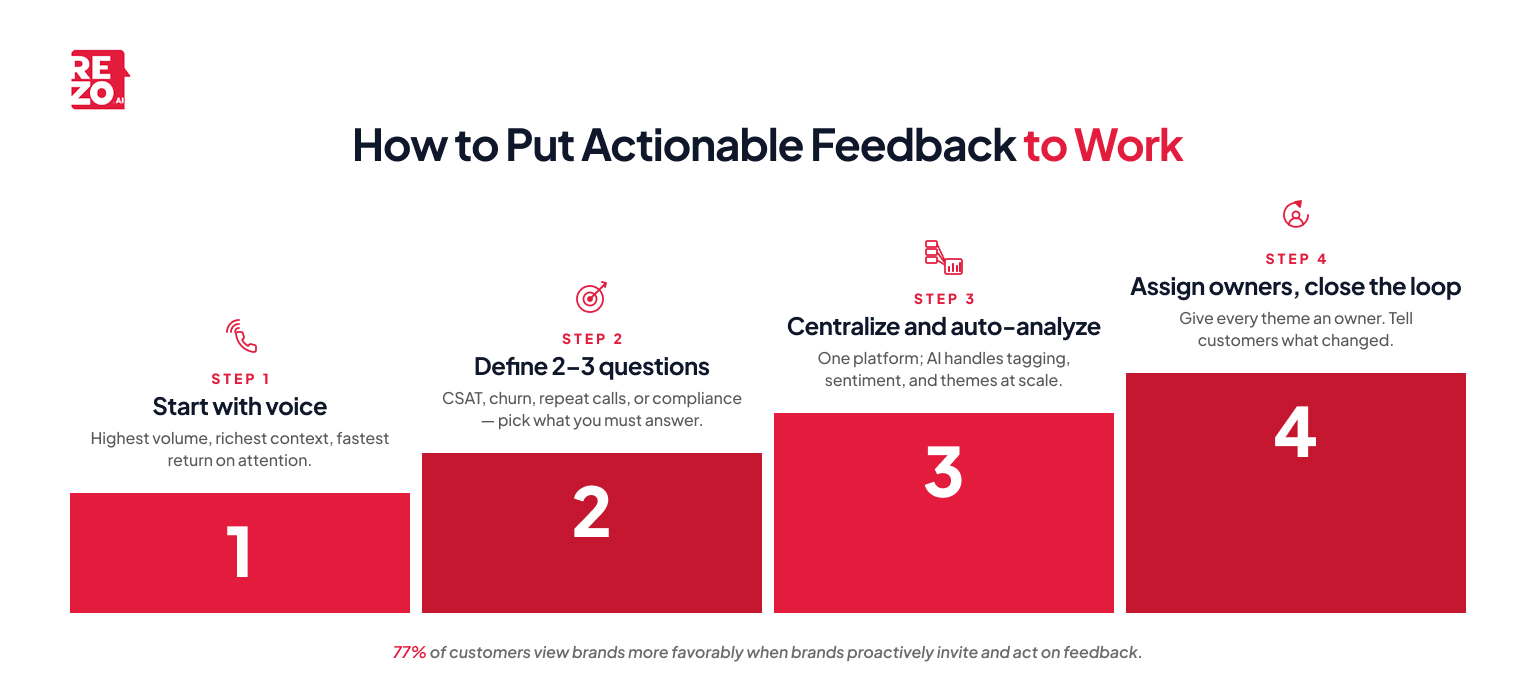
Start with your highest-volume channel for customer insights
For most contact centers, that is voice. It carries the most customer interactions and the richest context, so it delivers the fastest return on attention. Get one channel right before you widen the net.
Define the two or three questions you need answered.
Are you trying to improve customer satisfaction? Cut churn? Reduce repeat calls? Catch compliance gaps? Clear questions keep the program from drowning in dashboards nobody reads. Build your first feedback analysis around those specific questions and the key metrics that answer them.
Centralize and auto-analyze.
Consolidate interactions into one platform and let AI handle tagging, sentiment, and theme detection at scale. Analyzing support tickets alongside calls, chats, and social media reveals recurring problems fast, and consistent categorization across channels is what lets you compare signals, identify patterns, and spot trends you would otherwise miss. This is where ongoing customer feedback analysis pays off: feedback should be analyzed regularly so you can track those trends over time rather than reading a single snapshot of survey responses. A unified conversational AI for customer service engine keeps the context with the customer as they move between channels.
Assign ownership and close the loop.
This is the step that separates programs that work from programs that stall. Actively asking for feedback and acting on it builds trust and loyalty; in fact, around 74% of consumers say brand loyalty is about feeling valued and understood, not discounts. While 77% of customers view brands more favorably when those brands proactively invite and act on feedback. So give every recurring theme an owner, and tell customers when their input led to a change. A quick follow-up or a release note is enough to show them the feedback loop is closed. That is what turns a one-time complaint into stronger customer relationships and lasting loyalty.
What Changes When You Act on Every Actionable Insights?
When feedback flows all the way from conversation to action, the results compound quietly and drive continuous improvement.
First-contact resolution improves, because agents get real-time guidance and recurring issues get fixed at the root instead of being handled one ticket at a time. Repeat calls drop as a result, and the customer experience gets measurably smoother. Analyzing feedback this way helps increase customer satisfaction and improve retention. Churn signals get caught while there is still time to save the relationship, not after the customer has already gone. And your product and process decisions start resting on what customers actually said, on real customer insights and actionable insights, not on what a small survey sample of customers guessed at. That is how customer feedback analysis prevents wasted development efforts and points teams toward genuine growth opportunities.
This is not theoretical at scale. Rezo AI handles more than 1.5cr+ calls daily with 2x connect rates compared with traditional call centers, powering CX for over 22 leading enterprises. That volume only works because every customer interaction feeds back into the system as usable intelligence rather than being lost.
Conclusion
The businesses that win on customer experience are not the ones that collect the most feedback. They are the ones that hear their customers clearly, turn raw comments into customer insights, and act fast on them. Every call, chat, and message is already telling you what to fix, what to build, and who is about to leave. The only question is whether that signal reaches someone who can do something with it.
Rezo AI closes that gap by turning every interaction into feedback you can act on, across every channel, in real time. That is how a stream of conversations becomes durable customer insights and a better customer experience. If you are ready to stop sampling and start listening to all of it, explore how the Rezo unified CX platform can help.
Frequently Asked Questions
What is a customer feedback survey loop?
A customer feedback loop is the ongoing process of collecting customer feedback, analyzing it, acting on it, and telling customers what changed. Closing the loop signals that their input mattered, which builds trust and encourages them to keep sharing.
What is the difference between conversation analytics and speech analytics?
Speech analytics focuses on spoken voice calls. Conversation analytics is broader, analyzing voice plus text channels like chat, email, and messaging. It surfaces sentiment, intent, and themes across every interaction rather than voice alone.
What is the analysis process to measure customer feedback?
Common measures include Net Promoter Score, Customer Satisfaction score, and Customer Effort Score. AI-based analysis adds continuous sentiment and theme tracking across every interaction, so you measure real behavior rather than only survey responses.
Frequently Asked Questions (FAQs)


Take the leap towards innovation with Rezo.ai
Get started now