How Speech Analytics is transforming the Insurance industry? : Complete Guide

How Speech Analytics is transforming the Insurance industry? : Complete Guide


Here is a number that should make every insurance CX leader pause: only 12% of insurers currently use speech analytics to monitor customer interactions. That means the vast majority of insurance contact centers are letting millions of voice calls, each one packed with valuable insights about fraud risk, compliance gaps, customer frustration, and churn signals, go completely unanalyzed. Without speech analytics software in place, just 1 in 20 customer calls receives any form of quality monitoring.
Think about the scale of what is being missed. Every day, insurance contact centers field thousands of customer conversations around claims, renewals, policy inquiries, and complaints. Each of those customer interactions is a data point. And collectively, they paint a picture of what your customer experience actually looks like, what your contact center agents struggle with, and where your contact center operations break down.
The global speech analytics market is already valued at $4.94 billion in 2025 and is projected to reach $13.34 billion by 2032. Insurers are under pressure from regulators, rising customer expectations, and aggressive competitors. Yet most are still flying blind on what is actually happening across their most important customer touchpoints, missing actionable insights that could improve customer satisfaction and operational efficiency at scale.
This guide breaks down what speech analytics is, why speech analytics important for the insurance industry, the biggest problems it solves, and how to actually implement a speech analytics solution without getting stuck in a multi-year IT project.
Why Speech Analytics Is Important for Insurance?
Before diving into the mechanics, it is worth understanding why speech analytics has become essential for highly regulated industries like insurance. Contact centers remain the primary channel where policyholders voice customer concerns, file claims, and make purchasing decisions. Every phone call is a window into customer sentiment, customer needs, and service quality. Yet without the right speech analytics tools, this valuable intelligence stays locked inside recorded calls and disappears.
Using speech analytics, insurers can analyze spoken conversations at scale, turning spoken words into structured, actionable data. The technology does not just transcribe. It interprets. It detects customer emotions, flags compliance risks, and surfaces patterns that no human team could identify manually across thousands of voice calls. For insurance leaders focused on improving customer satisfaction, the return on investment is both measurable and significant.
What makes speech analytics important for contact centers is that it bridges the gap between what executives think is happening on the front lines and what is actually happening. It provides performance visibility that traditional quality assurance programs, built on manual sampling, simply cannot match. In an industry where every customer interaction carries regulatory weight and retention value, speech analytics important to leadership because it delivers the insights needed to act decisively.
What Is Speech Analytics and How Does It Work in Insurance?
Speech analytics is the use of artificial intelligence, natural language processing NLP, and machine learning to automatically transcribe, analyze, and extract insights from voice conversations. It goes far beyond basic call recordings or simple keyword spotting. Modern speech analytics software solutions understand context, detect emotion, and identify patterns across thousands of customer conversations simultaneously.
How does speech analytics work at a technical level? The core technology stack includes automatic speech recognition (ASR) and automated speech recognition engines for transcription, natural language processing NLP models for intent and topic detection, sentiment analysis for gauging customer sentiment, and machine learning for pattern recognition and anomaly detection. These key features allow the speech analytics solution to process spoken words and convert human speech into structured data that contact center agents and managers can act on. Speech recognition accuracy now exceeds 97% for modern solutions, making the technology reliable at enterprise scale.
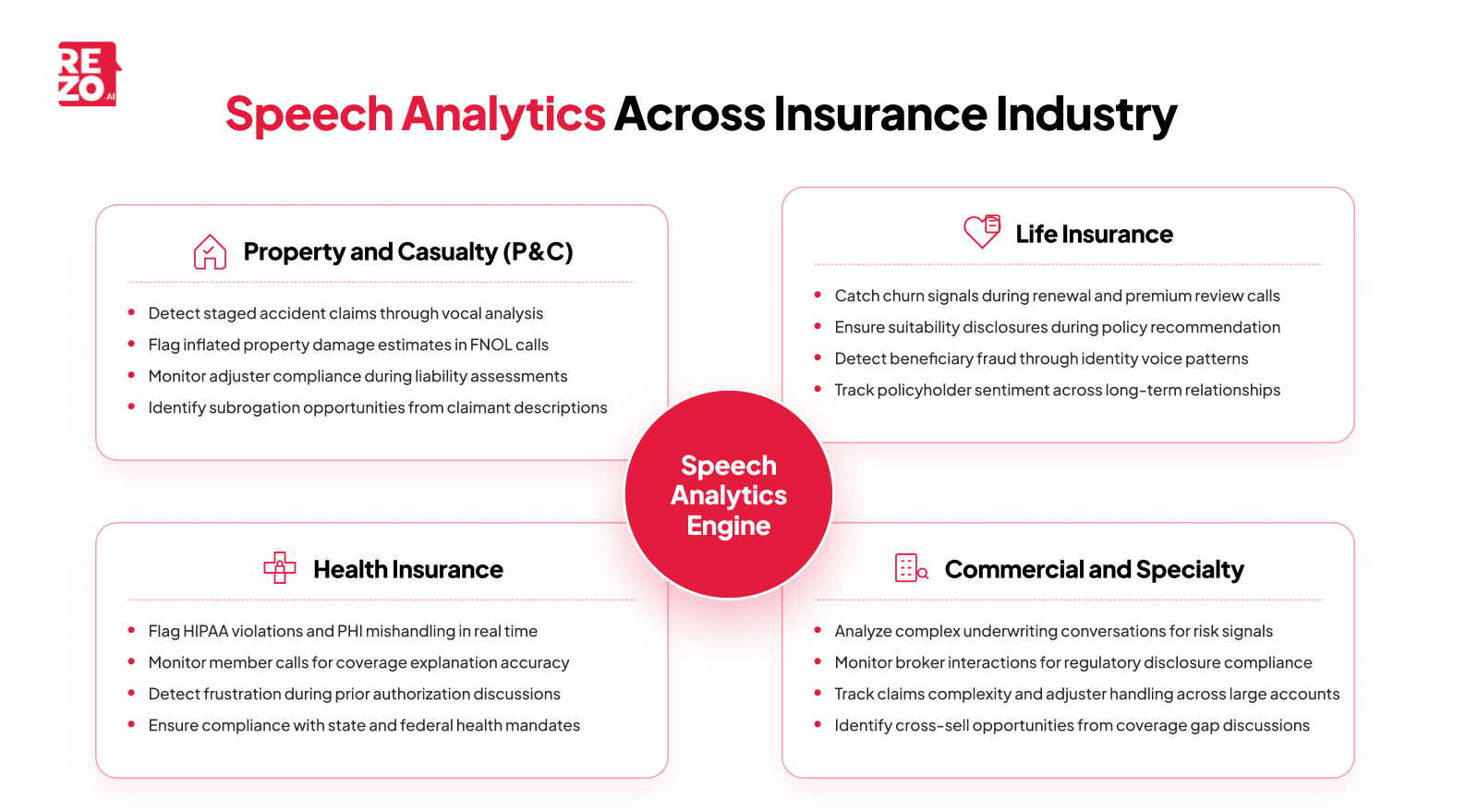
In insurance specifically, speech analytics tools are applied to claims calls, underwriting conversations, renewal discussions, complaint handling, and compliance-sensitive customer interactions. Whether a policyholder is reporting a fender bender or a claims adjuster is walking through a complex liability case, the technology captures and performs speech analysis on what is said, how it is said, and what it means for the business. This covers both the content of customer calls and the vocal cues, including tone, pace, and stress, that reveal underlying customer sentiment.
It is worth noting the distinction between real time speech analytics, which delivers insights during the live call, and post call analytics, which processes call recordings in batch for trends and audits. Both play a role in a comprehensive speech analytics solution, and we will get into when each matters most later in this article.
How Speech Analytics Solves the Biggest Challenges in Insurance?
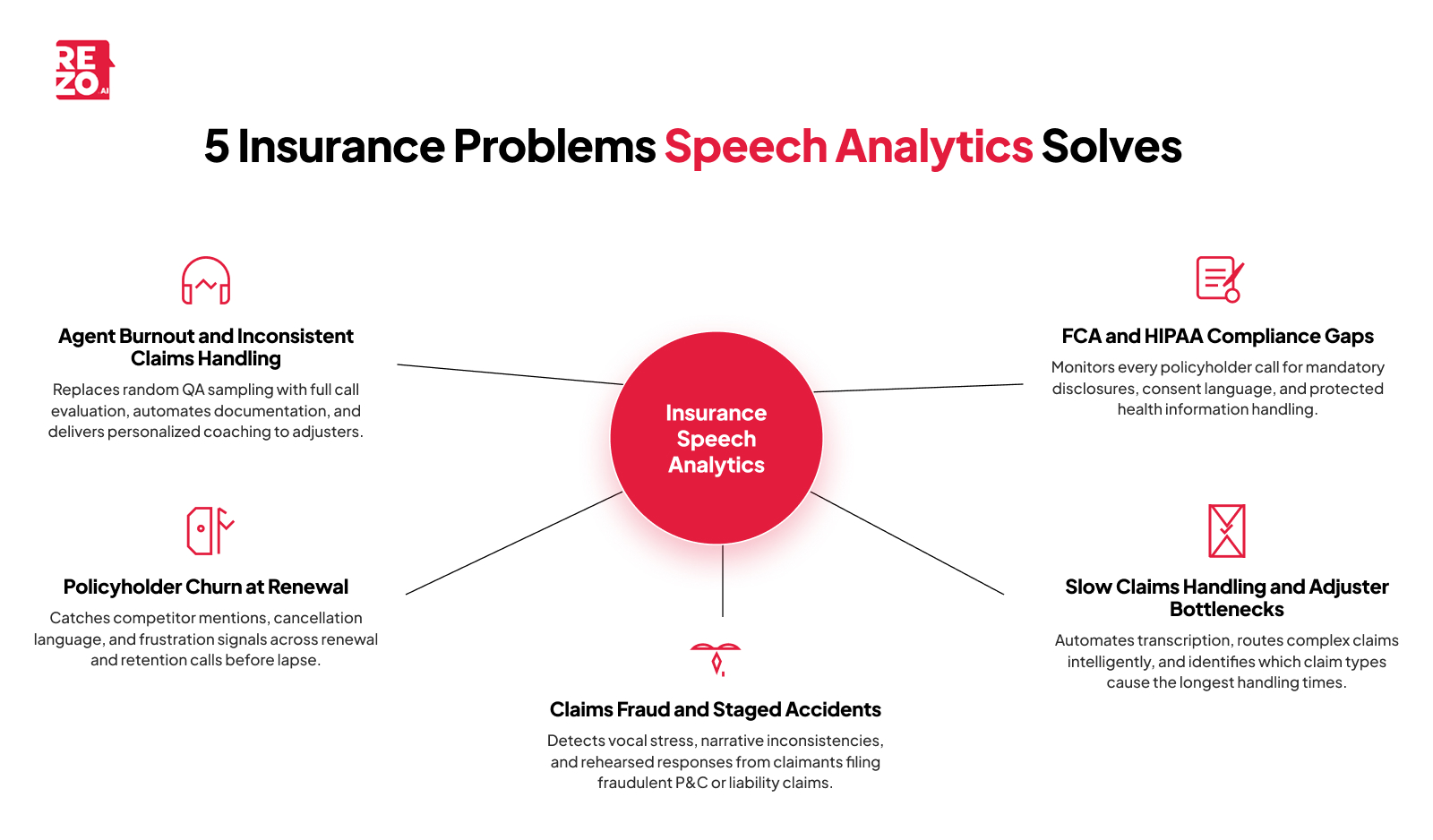
Conversation analytics in insurance is not a solution looking for a problem. Insurers face a specific set of operational and regulatory challenges that speech analytics is uniquely positioned to address. Using speech analytics across your contact centers unlocks improvements in five areas where the impact on customer experience and operational efficiency is most significant.
Keeping Up with Compliance and Regulatory Requirements
Insurance compliance monitoring is one of the most labor-intensive challenges in highly regulated industries. Traditional quality assurance relies on manual sampling, typically reviewing just 1 in 20 customer service calls. That leaves 95% of customer interactions unmonitored for regulatory adherence.
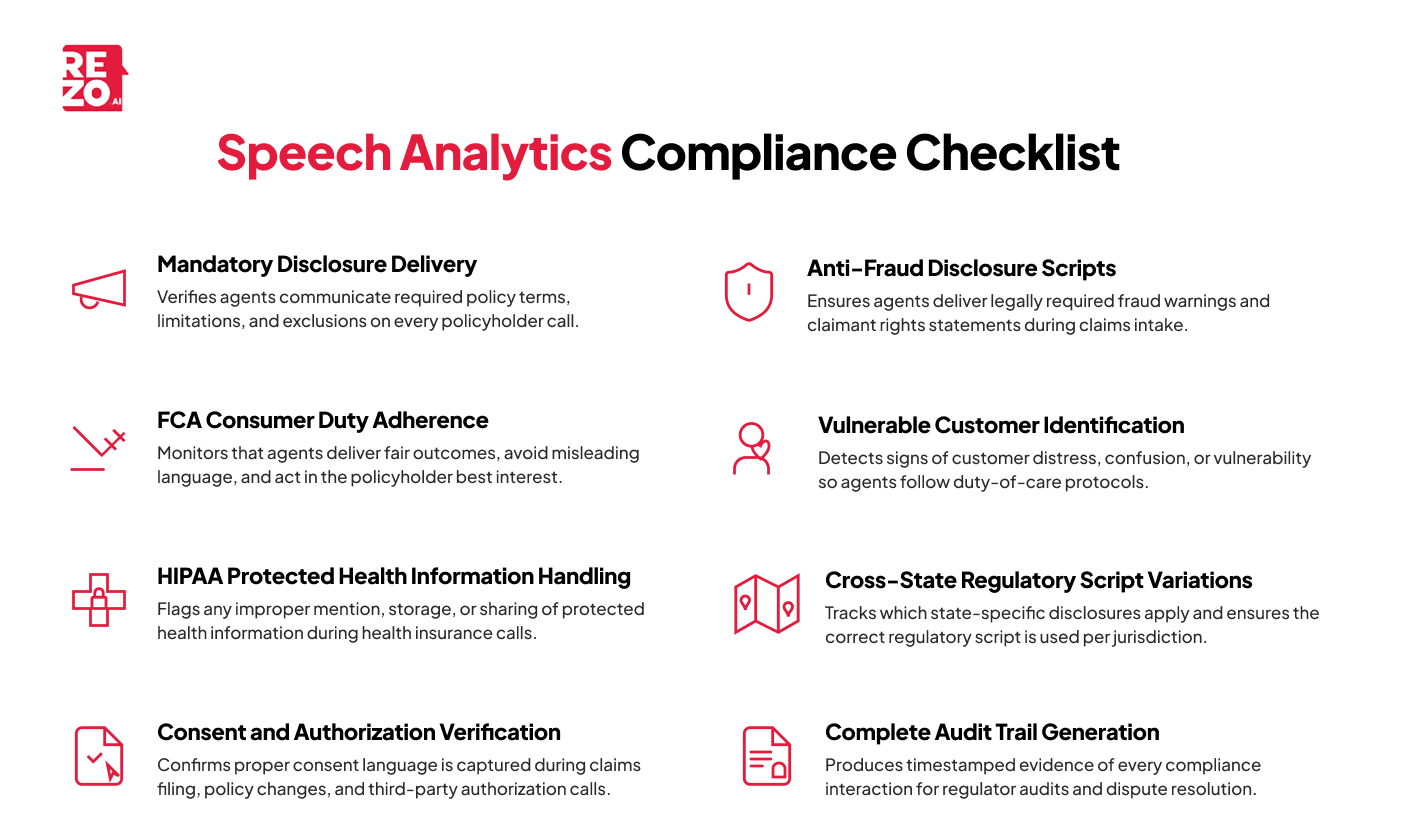
Speech analytics enables 100% call monitoring, automatically detecting whether contact center agents deliver mandatory disclosures, follow regulatory scripts, and obtain proper consent. For insurers operating under the FCA Consumer Duty framework, this is particularly critical. Regulators expect insurers to demonstrate they are delivering good outcomes for customers, and a speech analytics solution provides the evidence trail to prove it.
For health insurance operations, HIPAA considerations around sensitive information and protected health information add another layer of complexity. Speech analytics tools can flag potential mishandling of sensitive information in real time. And with real-time compliance alerts, supervisors can intervene before a violation is complete rather than discovering it weeks later during an audit. This level of monitoring across contact centers is impossible to achieve without speech analytics software working across every customer interaction.
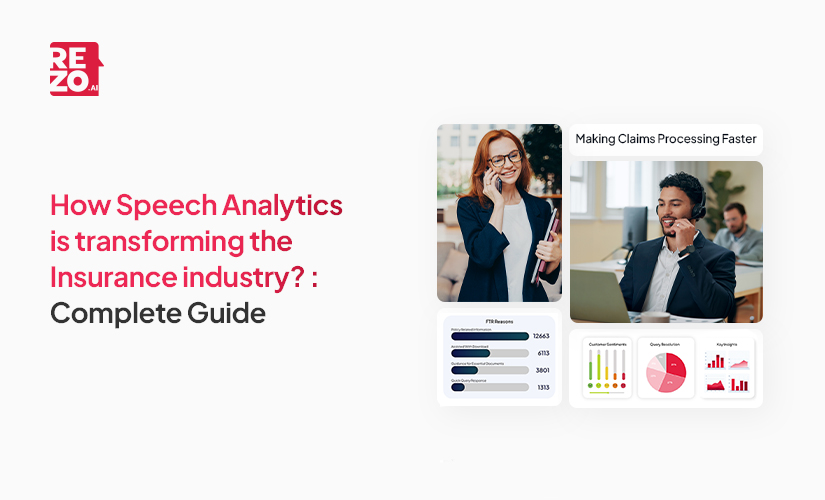
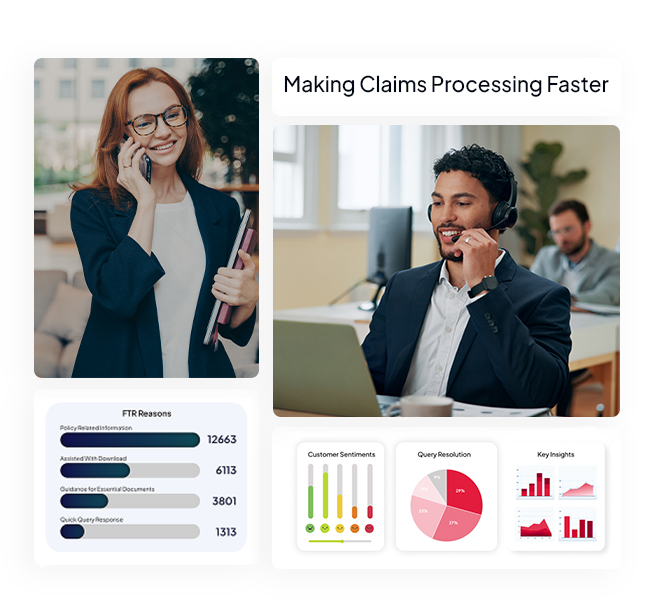
Making Claims Processing Faster and Smarter
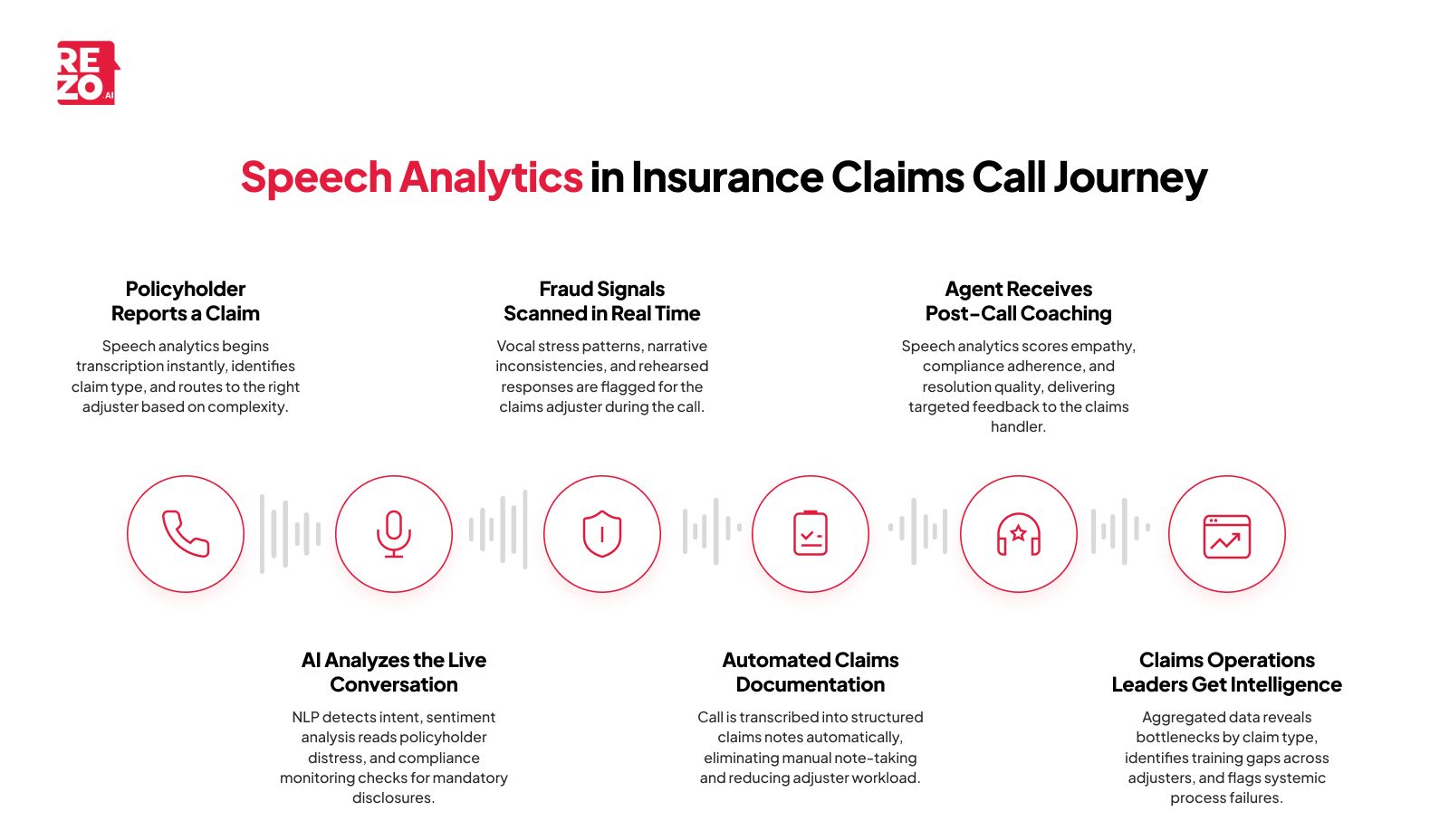
The claims lifecycle is the operational heart of any insurance company, and it is where speech analytics delivers some of the most measurable results in process efficiency. McKinsey reports up to a 30% reduction in claims handling time when voice analytics is applied across contact centers to streamline the process.
Real-time transcription eliminates the manual note-taking that slows down customer calls, freeing adjusters to focus entirely on the claimant. Sentiment analysis in insurance calls enables intelligent routing: distressed or vulnerable claimants are automatically prioritized or connected to experienced handlers who can manage customer concerns with empathy. Using speech analytics in the claims workflow directly impacts both policyholder satisfaction and first call resolution rates.
On the back end, speech analysis of recorded calls identifies bottlenecks and recurring issues in the claims workflow. If a particular type of claim consistently generates longer phone calls and higher frustration, the data surfaces it so operations leaders can fix the root cause rather than treating symptoms. This ability to derive actionable insights from every interaction is what separates modern contact centers from legacy approaches and drives meaningful improvements in efficiency.
Detecting and Preventing Fraud Before It Costs You
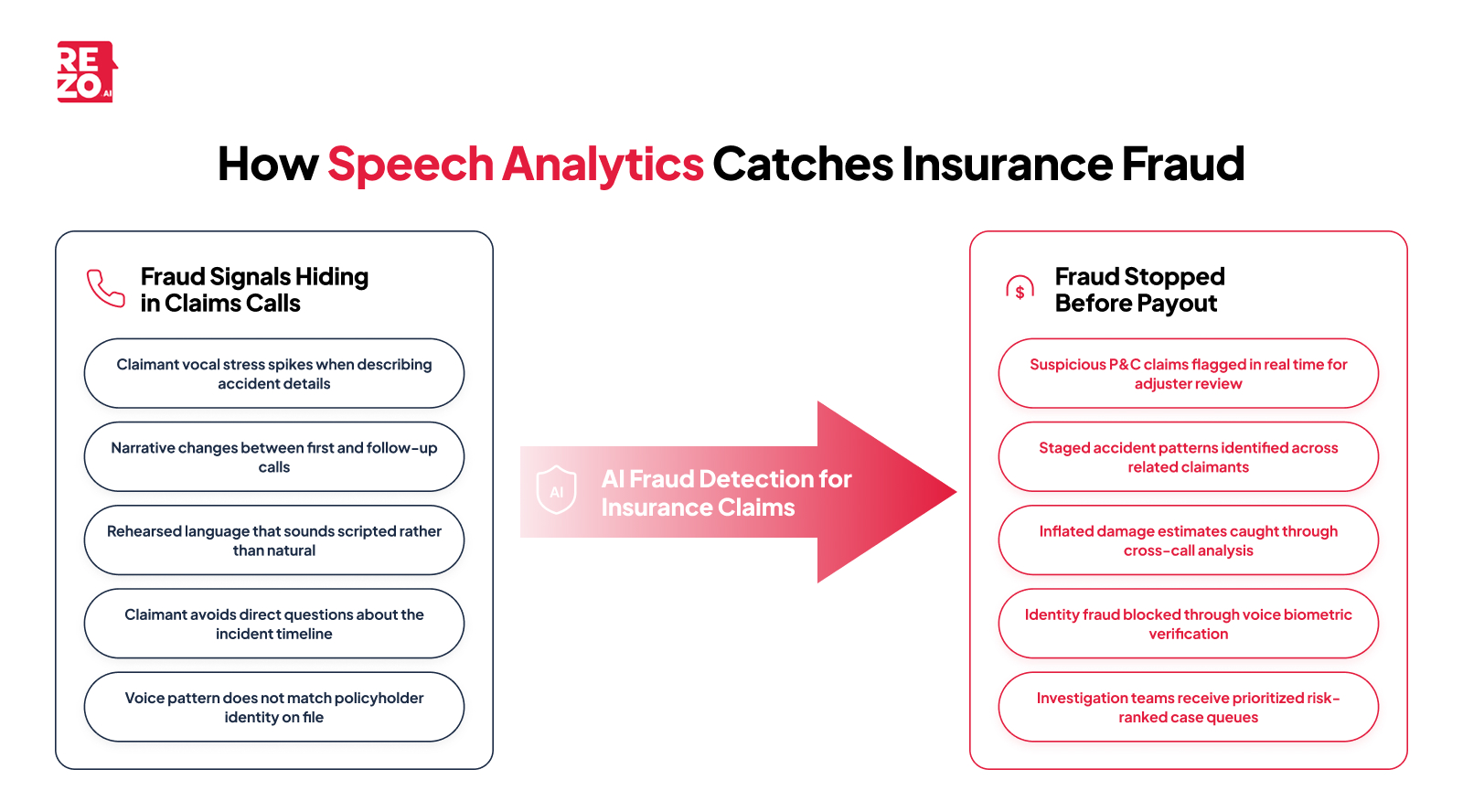
Insurance fraud is not a small problem. The fraud detection market alone is valued at $5.58 billion in 2024 and is projected to reach $40.09 billion by 2033, growing at a 22.7% CAGR. Speech analytics for insurance fraud detection works by running speech analysis on vocal stress patterns, inconsistencies in claimant narratives, and behavioral cues that suggest deception during customer calls.
Rather than relying on manual red-flag checklists, artificial intelligence flags suspicious phone calls in real time, allowing claims adjusters and investigators to prioritize their reviews. For P&C insurers, this means catching staged accidents, inflated damage claims, and identity fraud through voice pattern analysis before payouts are made. Industry reports indicate fraud rate reductions of up to 20% when speech analytics is deployed consistently across claims operations in contact centers. Using speech analytics to identify keywords and phrases associated with known fraud schemes turns every voice call into an early warning system.
Coaching Agents and Elevating Performance
This is the angle that often gets overlooked, but it matters enormously for customer experience and the people on the front lines. Speech analytics is not just about monitoring. It is about helping the people who do the work every day to improve agent performance.
Real-time agent assist surfaces suggested responses, compliance prompts, and next-best-action guidance during live customer calls. Instead of hoping a contact center agent remembers every disclosure requirement, the speech analytics solution prompts them in the moment. Automated quality assurance replaces random sampling with 100% call evaluation, giving every agent fair and data-driven feedback on agent performance rather than being judged on a handful of cherry-picked interactions.
Targeted coaching becomes possible because speech analytics pinpoints specific skill gaps affecting agent performance. One agent might need help with empathy during claims calls; another might struggle with handling objections during renewals. Speech analytics makes the difference visible, and it helps improve agent performance while reducing agent burnout by automating tedious documentation and manual compliance checks. When agents are supported with the right speech analytics software, both agent performance and service quality improve together. The result is better customer service performance across contact center operations, with training programs built on real data rather than anecdotal observation.
Reducing Customer Churn and Improving Retention
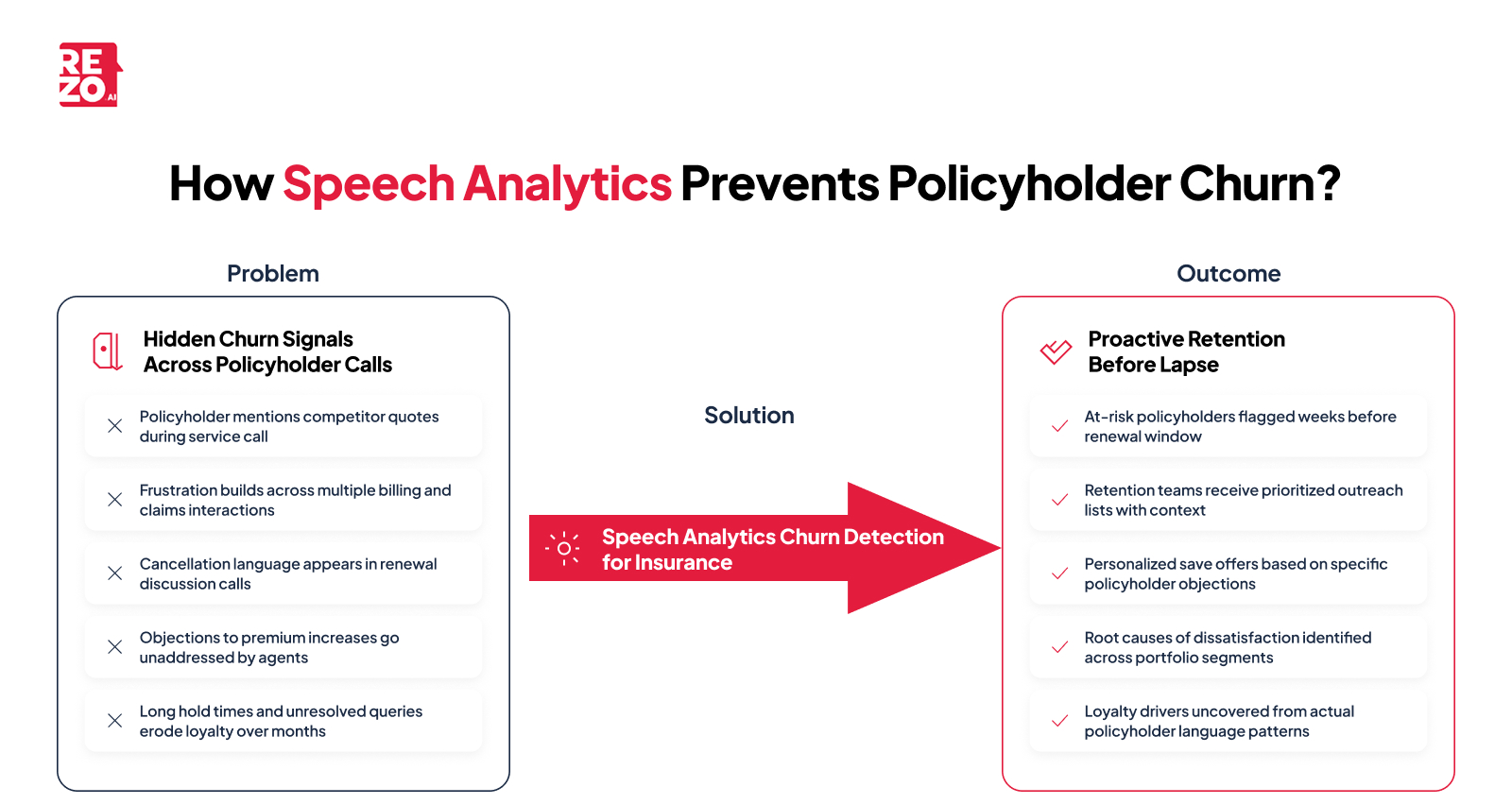
Customer churn prediction in insurance is an area where speech analytics adds a layer of intelligence that surveys and NPS scores simply cannot match. The technology detects churn signals in real time: frustration, competitor mentions, cancellation language, customer objections, and patterns of dissatisfaction that build over multiple customer interactions.
This is especially relevant for life insurance renewals, where long-term customer relationships are the core business model. Rather than waiting for a policyholder to lapse, speech analytics flags at-risk customers for proactive follow-up based on customer sentiment detected across their voice calls. At a portfolio level, customer insights from conversation analytics reveal what drives customer loyalty and what triggers defection, giving retention teams a strategic playbook grounded in actual customer language rather than assumptions.
Understanding customer preferences and what policyholders need through their own spoken words is the most direct path to improving customer satisfaction and reducing churn. When you can track customer behavior across every call and understand customer emotions in real time, you move from reactive damage control to proactive relationship management. Voice analytics applied to retention calls helps reduce customer churn at a portfolio level while simultaneously elevating the overall customer experience.
Real-Time vs. Post-Call Analytics: What Should Insurers Prioritize?
This is a distinction that matters more than most vendors let on, and it directly affects where you should start with your speech analytics solution.
Real time speech analytics solutions deliver insights during the live call. This is where you get in-the-moment agent coaching, compliance alerts before a violation happens, fraud flagging while the claimant is still on the line, and sentiment-based routing for distressed customers. It is operationally powerful but requires tighter integration with your telephony stack and contact center operations. The key features of real time speech analytics make it invaluable for contact centers handling high-stakes calls where immediate intervention can change outcomes.
Post call analytics processes recorded calls after the fact. This is where trend analysis, compliance audits, process optimization, root cause analysis, and training programs design live. It is less technically demanding to deploy and delivers the strategic insights that shape long-term decisions about how contact centers perform.
Most mature insurance contact centers use both: real time speech analytics for operational agility, batch analysis for strategic intelligence. But if you are just getting started using speech analytics, the practical recommendation is to begin with analyzing your existing voice calls. Establish your baselines, extract valuable insights from your customer conversations, identify quick wins, and build organizational confidence in the data. Then layer in real-time capabilities as the program matures and your team is ready to address customer needs at the point of interaction.
How to Implement Speech Analytics in Your Insurance Contact Center?
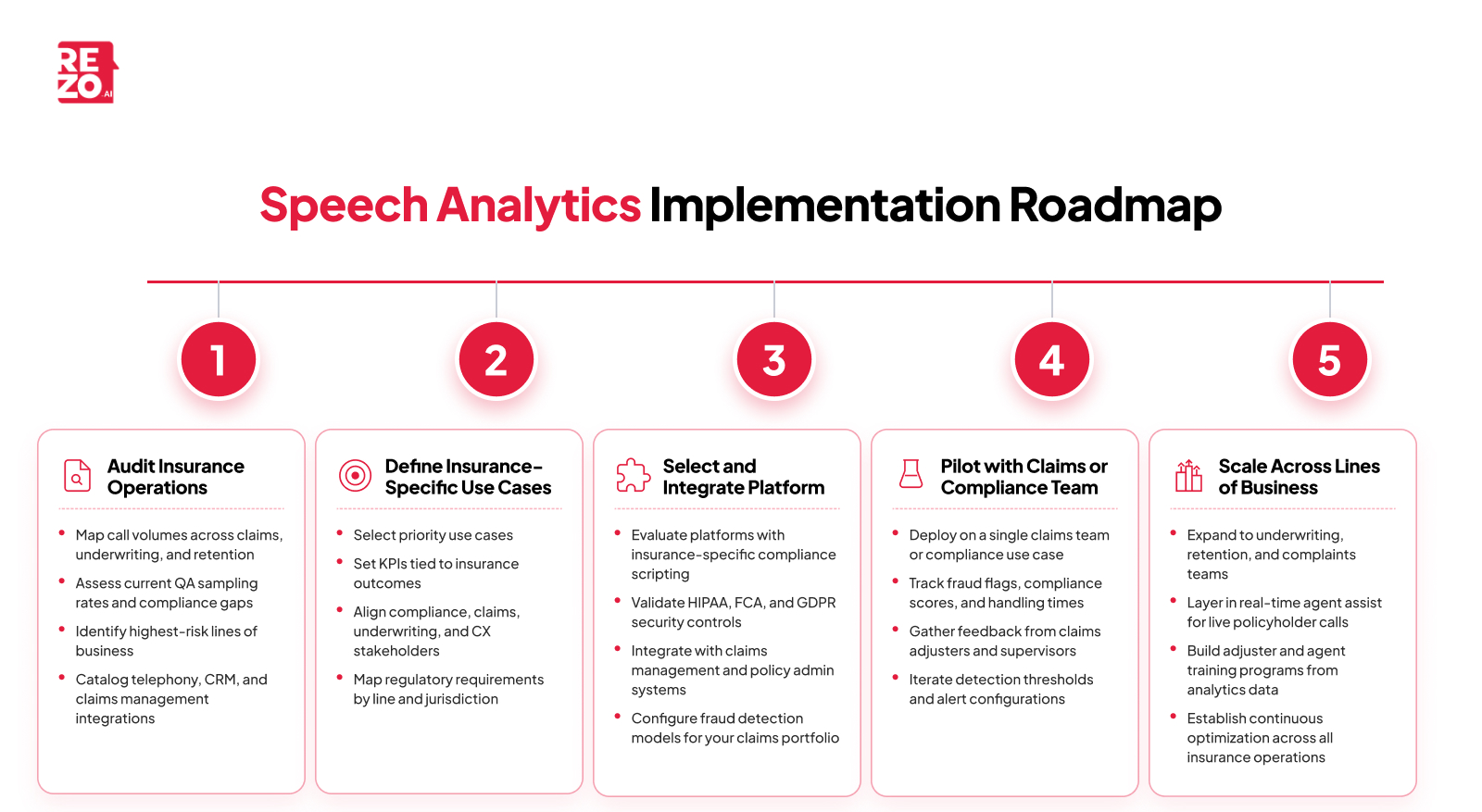
No top-ranking article on this topic provides a structured implementation roadmap, which is surprising given how many insurance leaders want to know not just "why" but "how." Here is a phased approach that works for mid-market and large insurance enterprises looking to deploy a speech analytics solution across their contact centers.
Step 1: Audit Your Current State
Start by assessing your existing call volume, quality assurance processes, and pain points across your contact centers. Identify which lines of business, whether claims, underwriting, retention, or complaints, will benefit most from using speech analytics. Map your technology landscape, including your CRM, telephony platform, compliance tools, and data storage, so you understand what you are integrating with. Catalog the types of voice calls and customer interactions that represent your highest volume and highest risk.
Step 2: Define Clear Objectives and Use Cases
Resist the urge to solve everything at once. Start with two to three high-impact use cases and align them with measurable key performance indicators: compliance adherence rate, fraud detection rate, average handling time, customer satisfaction scores, or agent performance metrics. This is also the stage to get buy-in from stakeholders across customer experience, compliance, operations, and IT. Cross-functional alignment early on prevents friction later. Be specific about what customer feedback and behavioral patterns you want the speech analytics software to surface.
Step 3: Choose the Right Speech Analytics Platform
Look for insurance-specific capabilities: compliance scripting, claims workflow integration, and multi-channel support across voice calls, chat, email, and digital channels. Evaluate how the speech analytics software integrates with your existing telephony and CRM systems to ensure you can act on insights without switching between tools. For health insurers, enterprise-grade security and data privacy controls (HIPAA, GDPR) are non-negotiable. Contact center AI for insurance is not one-size-fits-all, so prioritize speech analytics solutions built for your regulatory environment. The best platforms also support multiple languages, which is essential for insurers serving diverse markets.
Step 4: Prepare Your Data and Your People
Clean and consolidate your data sources to ensure the speech analytics tools have reliable input from voice calls and other customer interactions. And just as importantly, train your agents on how ai speech analytics will support them, not surveil them. Position it as a coaching and development tool designed to improve agent performance and help agents better understand customer queries. Designate internal champions in your quality assurance and operations teams to drive adoption and address concerns early. People readiness is just as critical as technology readiness in any contact center environment.
Step 5: Pilot, Measure, and Scale
Run a controlled pilot with a single team or use case for 60 to 90 days. Track outcomes against the key performance indicators you defined in Step 2, including customer satisfaction, operational efficiency, agent performance, and first call resolution. Iterate based on customer feedback from agents, supervisors, and compliance teams. Then scale to additional use cases and business lines based on proven results. Deloitte reports that organizations following a phased approach typically see meaningful improvements in contact centers within year one of implementation. Each phase should deliver measurable results that justify the next stage of expansion.
What Is Next for Speech Analytics in Insurance?
The technology is evolving fast, and the next wave will reshape how insurers use conversational data from their contact centers.
Generative AI and large language models are transforming speech analytics from basic keyword spotting to true contextual understanding of customer conversations. Tomorrow's speech analytics solution will not just identify keywords in spoken words. It will interpret meaning, understand customer needs, and surface insights that rigid rule-based systems would miss entirely. This represents a fundamental shift in how speech analytics work gets done, moving from pattern matching to genuine comprehension of intent.
Predictive analytics is pushing the field from reactive to proactive. Instead of analyzing what happened on yesterday's customer calls, insurers will predict fraud risk and churn probability before they happen. This ability to anticipate future interactions based on speech analysis patterns will transform contact centers from reactive service hubs into proactive customer experience engines. Using speech analytics predictively means insurers can address issues before they become complaints.
Omnichannel integration is expanding speech analytics beyond voice calls and phone calls to include chat, email, messaging, and social media in a unified view of interactions. This is the natural evolution for insurers running multi-channel customer experience operations across contact centers. Speech analytics platforms will ingest data from all channels and voice calls alike, giving insurers a complete picture of customer sentiment across every touchpoint.
With 77% of insurance brands expected to implement artificial intelligence within core business functions, speech analytics is moving from a "nice to have" to an operational standard. The convergence of voice biometrics, emotion AI, and agentic AI will create insurance interactions that are more secure, more empathetic, and more efficient, ultimately improving customer satisfaction and driving operational efficiency across the entire organization.
The Bottom Line
Insurance companies that treat every customer conversation as a source of valuable intelligence will outperform those that let those conversations disappear into silence. Using speech analytics across contact centers transforms voice calls and phone calls from fleeting moments into actionable data that drives customer experience improvements, strengthens compliance, and boosts agent performance.
The technology is mature, the business case is proven, and the regulatory environment increasingly demands it. Whether you are looking to understand customer sentiment, improve satisfaction, or drive operational efficiency, the right speech analytics solution delivers measurable results. Speech analytics tools give insurers the ability to listen at scale, act in real time, and continuously elevate the way agents serve policyholders. The question is no longer whether to adopt speech analytics for insurance, but how quickly you can start listening.
Frequently Asked Questions
How much does speech analytics software cost for insurance companies?
Pricing varies based on call volume, key features, and deployment model. Most platforms use per-agent or per-minute pricing structures. Enterprise speech analytics solutions typically offer custom quotes, so it is best to request a tailored proposal that factors in your specific call volumes and integration requirements. The investment typically pays for itself through improved workflow efficiency, reduced fraud losses, and higher customer satisfaction.
Can speech analytics handle multilingual insurance customer calls?
Yes. Modern speech analytics software supports transcription and speech analysis in dozens of languages, with some offering real-time translation across multiple languages and over 100 language variants. This is critical for insurers serving diverse regional markets where policyholders may switch between languages within a single conversation. The best platforms use advanced speech recognition to accurately process spoken words regardless of accent or dialect, ensuring no customer queries or insights are missed.
What is the difference between speech analytics and text analytics in insurance?
Speech analytics processes spoken customer conversations from voice calls and phone calls, using speech recognition to analyze human speech and detect vocal cues like tone, stress, and pace to gauge customer sentiment. Text analytics analyzes written interactions such as emails, chats, and surveys using keyword and sentiment analysis. Insurers increasingly combine both approaches in their speech analytics solution for a complete omnichannel view of the customer experience. This integrated approach allows contact centers to understand customer needs, track behavior across channels, and extract valuable insights from every interaction, whether spoken or written.
Frequently Asked Questions (FAQs)


Take the leap towards innovation with Rezo.ai
Get started now