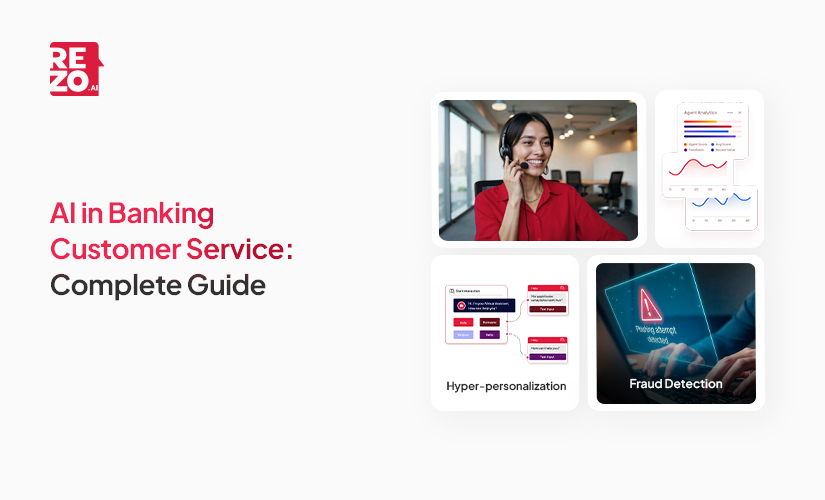
AI in Banking Customer Service: Complete Guide

AI in Banking Customer Service: Complete Guide



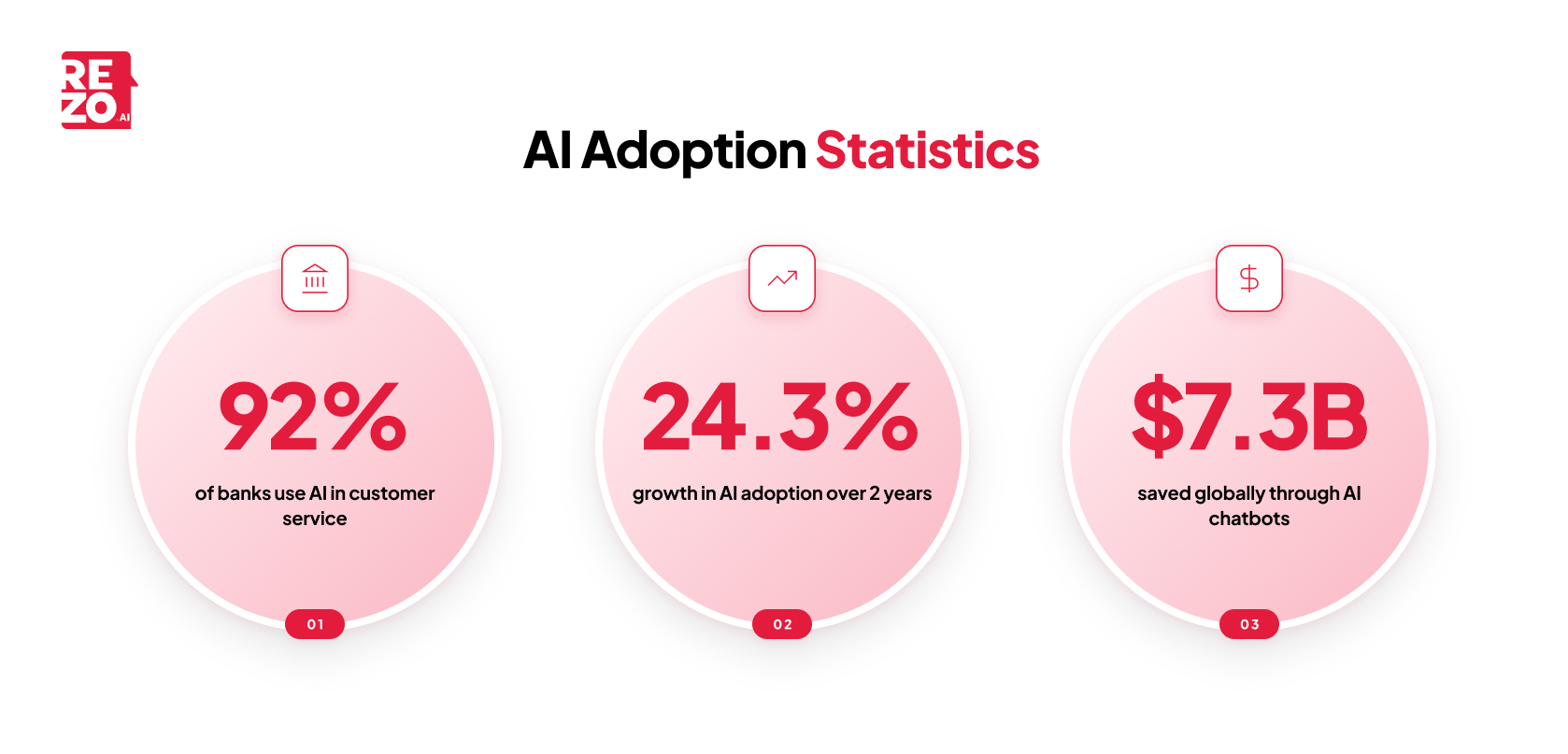
Banks saved $7.3 billion globally through AI-powered customer service in 2025 alone. That number is not a projection or an optimistic forecast. It reflects the real impact of intelligent automation on banking operations and on enhancing customer service today.
AI in banking customer service has moved beyond pilot programs and proof-of-concept stages. In 2026, financial institutions are scaling these solutions enterprise-wide, transforming how they handle millions of client interactions and customer data daily. For banks still evaluating their options, the question is no longer whether to adopt AI but how quickly they can implement it effectively.
This guide explores how AI technologies are reshaping banking customer engagement, the measurable benefits they delivers, and practical steps for implementation.
The Current State of AI in Banking Customer Service
The adoption of AI in banking customer service has reached a tipping point. According to industry research, 92% of banking and finance organizations now use AI models in their customer service operations. This represents a 24.3% growth in just two years, driven by the need for better fraud detection, faster response times, and personalized customer guidance.
Several factors are accelerating this shift. Rising call volumes continue to strain traditional contact centers. Customer expectations have evolved, with users demanding instant, accurate responses across multiple channels. Cost pressures force banks to find more efficient ways to serve growing customer bases without proportional increases in staffing.
The channels have expanded too. Customers now expect consistent service across voice calls, chat, email, and messaging platforms like WhatsApp. AI enables banks to deliver unified experiences across all these touchpoints without building separate teams for each channel.
Key Use Cases Transforming Customer Experience
AI in banking customer service covers a wide range of applications, from simple query handling to complex transaction support.
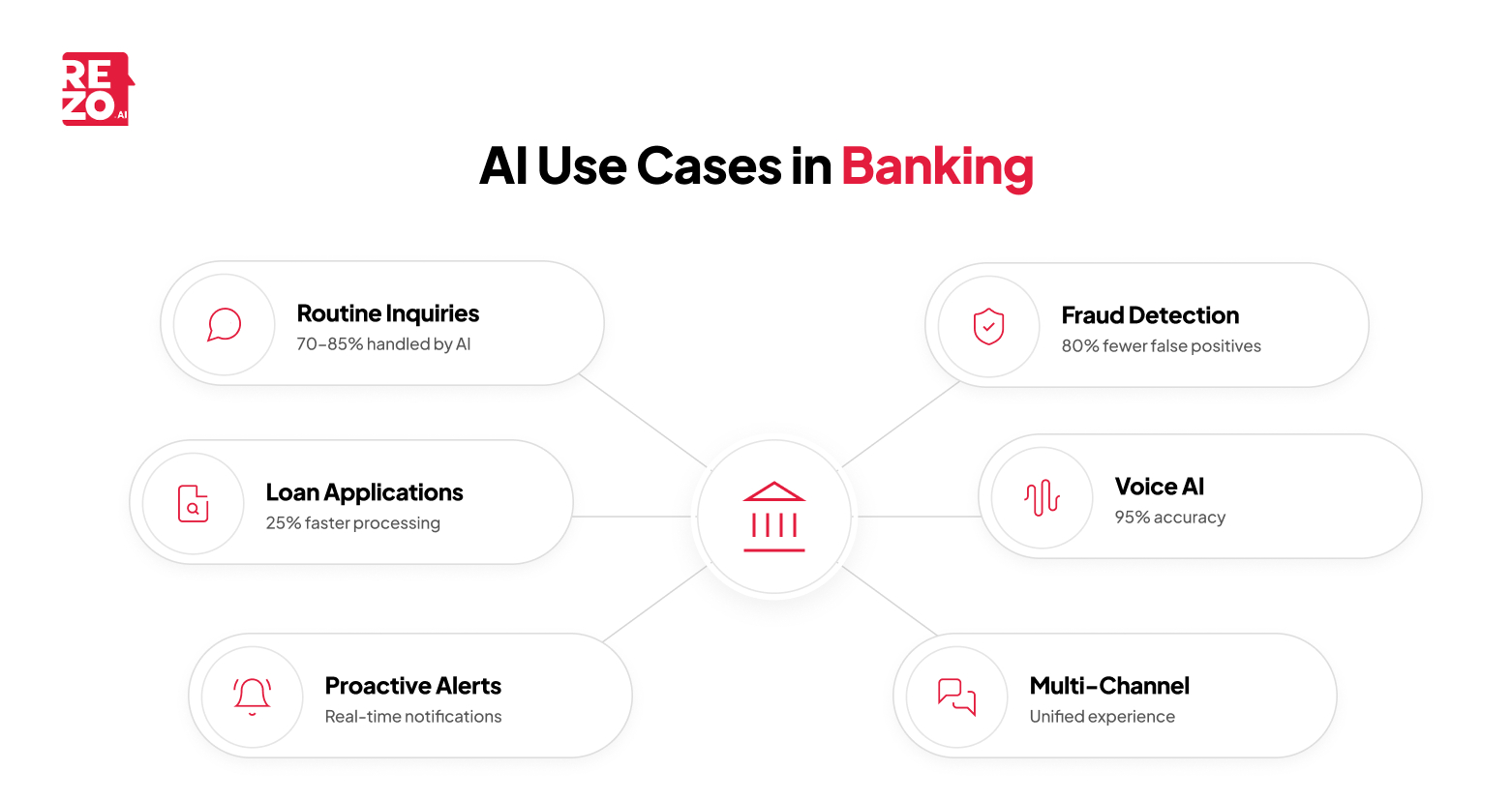
Conversational AI chatbots handle the bulk of routine inquiries and customer requests. Balance checks, transaction history, branch locations, customer onboarding, educate customers with financial products, real time support with financial services and basic account questions represent high-volume, repetitive tasks that AI powered automation can manage efficiently. Industry data shows that chatbots now handle 70-85% of customer inquiries with 91% accuracy, operating around the clock without fatigue.
Fraud detection, cyber threats and security represent another critical application. AI systems analyze customer behavior and transaction patterns in real-time, flagging suspicious activity before it causes harm. According to Deloitte, AI-powered fraud detection reduces false positives by up to 80%, balancing security with customer convenience.
Customer journey for loan applications have become significantly smoother with AI models using machine learning and predictive analytics. Chatbots guide customers through eligibility checks, document requirements, and application status updates. This automation has helped banks achieve faster loan processing times while reducing errors and maintaining service quality.
Voice AI Agents in Banking Sector
While text-based chatbots and virtual assistants receive most of the attention, voice AI is emerging as the next major frontier, providing personalized customer experiences. Customers can now complete transactions using voice commands with high accuracy rates. Voice Agents leverage AI to analyze customer data to deliver personalized services.
Voice AI integrates with existing telephony infrastructure, transforming traditional IVR systems into intelligent conversational interfaces making banking services for new customers more accessible. Instead of navigating frustrating menu trees, customers simply state their needs and receive immediate assistance.
Financial institutions are reporting that voice AI agents can be more efficient than human operators for routine tasks. This efficiency comes from parallel calling capabilities, consistent performance, providing personalized financial advice, and significantly lower operational costs.
Omnichannel Customer Journey in Banking Industry
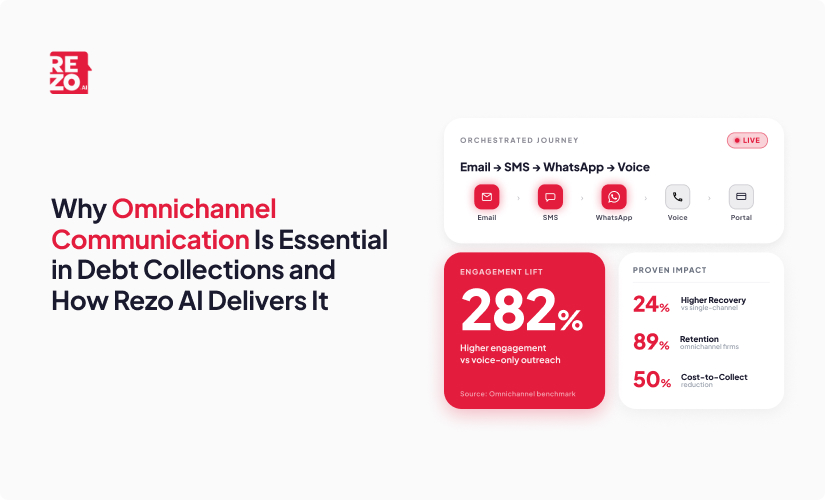
Customer queries do not stick to a single channel. They might start a conversation via chat, continue it through a phone call, and follow up via email. AI enables banks to maintain context across all these interactions, ensuring customers never have to repeat themselves.
This omnichannel customer orchestration creates a unified view of each customer, including past interactions and customer preferences, regardless of how they choose to engage. The result is a seamless experience that builds loyalty and reduces frustration and leads to significant cost savings.
Benefits and ROI of AI in Banking Customer Service
The financial case for AI in banking customer service is compelling. Organizations implementing AI for process optimization see a higher ROI within 18 months.
Cost reduction stands out as the most immediate benefit. Companies using AI in customer support reduce the average cost per interaction by 68%, dropping from $4.60 to just $1.45. For banks handling millions of interactions monthly, this translates to substantial savings.
Efficiency gains extend across operations. AI chatbots have contributed to a significant drop in call center volume, reducing staffing requirements while improving service availability. First response times have decreased by up to 74% in the first year of implementation.
The ability to provide 24/7 support without proportional staffing increases gives banks a significant competitive advantage. Customers expect service at any hour, and AI delivers this without the overhead of round-the-clock human coverage.
Customer satisfaction improves alongside efficiency. Capgemini reports that banks surveyed showed improved CSAT scores after implementing AI sentiment analysis tools. When routine queries are handled instantly, human agents can focus on complex issues requiring empathy and judgment.
Challenges and How to Overcome Them
Implementing AI in banking systems for customer service is not without obstacles. Understanding these challenges helps organizations prepare for successful deployment.
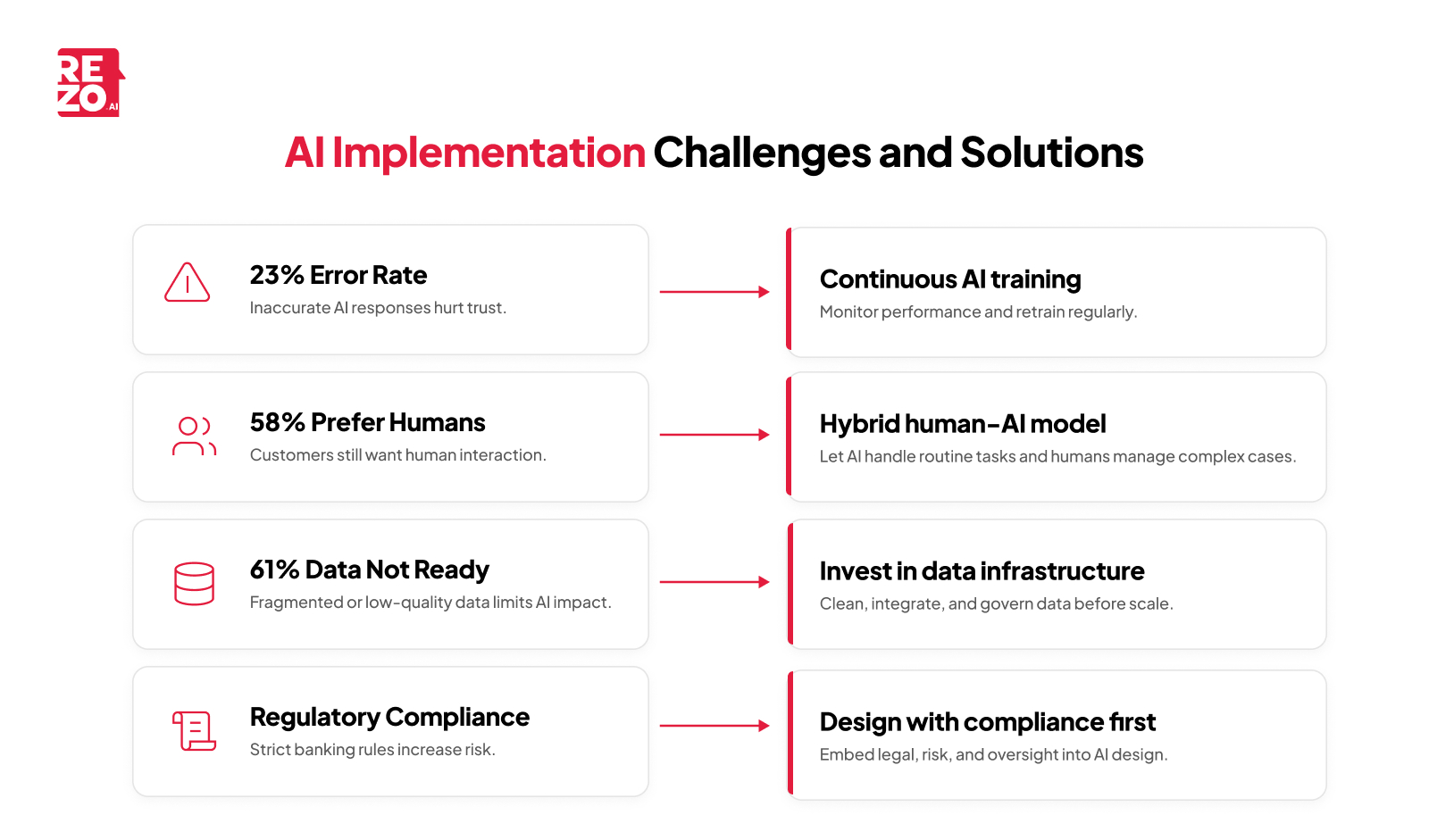
Accuracy remains a concern. Research indicates that AI chatbots often fail to understand the customer inquiries or user intent. Artificial Intelligence models can struggle with complex, context-specific queries that fall outside their training data. The solution lies in continuous training on real customer interactions and maintaining clear escalation paths to human agents.
Customer trust varies by demographic and complexity. Studies show that majority of customers still prefer human agents for complex issues. Rather than forcing AI on every interaction, successful banks implement hybrid models where AI handles routine tasks and seamlessly transfers complex cases to human agents.
Data integration presents a technical hurdle. Many banks operate on legacy IT systems that are not readily compatible with modern AI tools. Research indicates that 61% of companies are not fully data-ready for Generative AI. Their data is either inaccessible or not clean enough to power intelligent automation. Addressing this requires investment in data infrastructure alongside AI capabilities.
Regulatory compliance adds another layer of complexity. The Consumer Financial Protection Bureau has highlighted risks of chatbots providing inaccurate information or failing to recognize when customers invoke federal rights. Banks must ensure their AI systems are designed with compliance in mind from the start.
Implementing AI in Your Banking Customer Service
Successful AI implementation follows a structured approach that minimizes risk while maximizing learning.
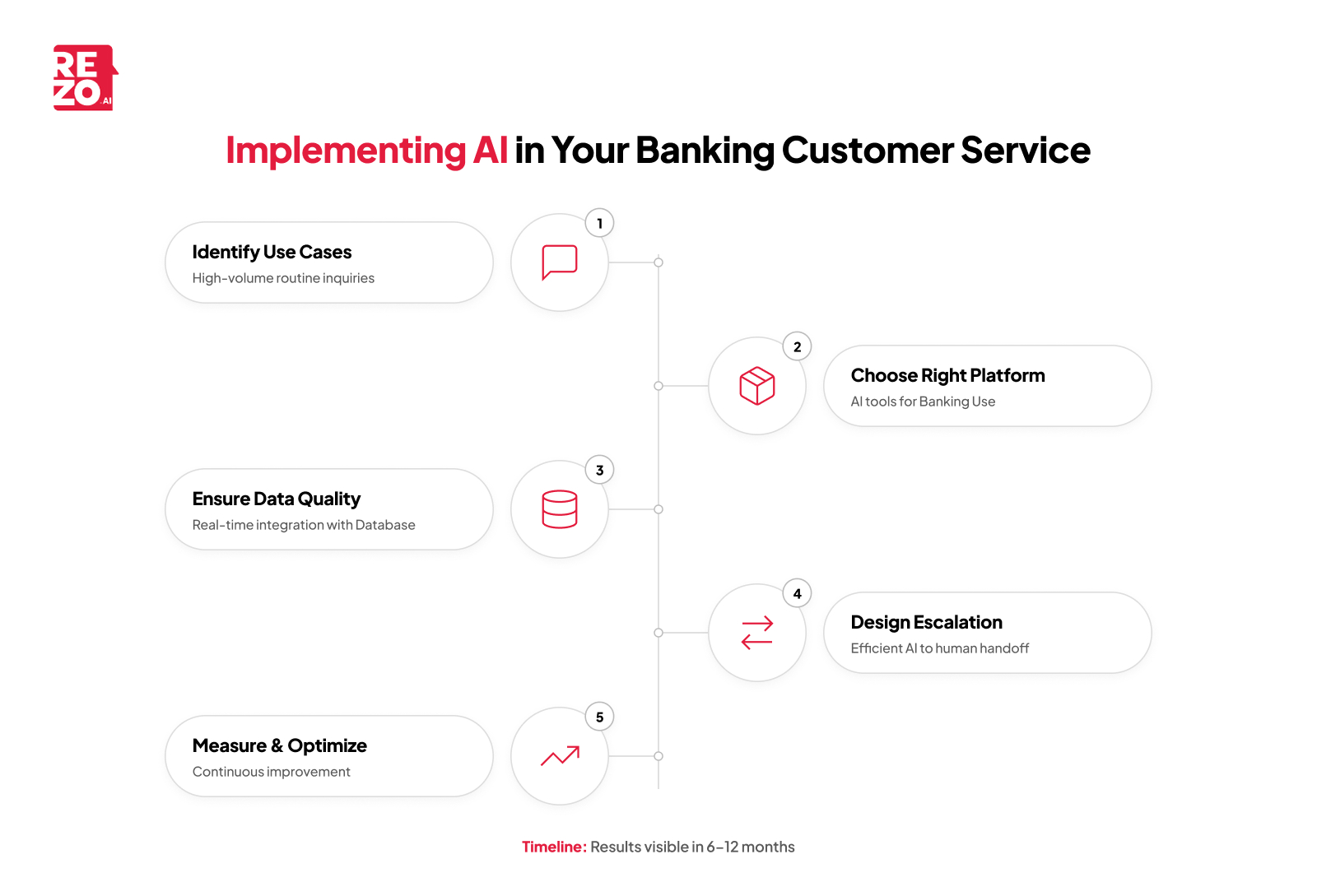
Start small with high-volume, routine inquiries. Balance checks, transaction status, and basic account questions make ideal starting points. These use cases offer quick wins while building organizational confidence in AI strategy.
Choose platforms designed specifically for banking rather than generic customer service tools. Banking-specific solutions understand financial terminology, compliance requirements, risk management, wealth management and the unique security needs of financial transactions. Leading institutions report significant improvements within 6-12 months when using purpose-built platforms.
Data quality and integration determine AI effectiveness. An AI assistant is only as smart as the data feeding it. If customer records are incomplete or updated only in batch processes, the AI will give wrong answers. Invest in real-time data integration before scaling AI capabilities.
Design intelligent escalation paths. When AI encounters questions beyond its capabilities or detects customer frustration, it should transfer seamlessly to human agents with full context. This hybrid approach combines AI efficiency with human empathy.
N26 demonstrates how quickly results can materialize. Using the right platform and approach, N26 deployed an AI assistant in just four weeks with full data control. Their team of data scientists, designers, and product managers worked closely with customer service to identify major use cases and ensure the AI handled complex conversations effectively.
Also Read: Agentic AI-Powered Dispute Resolution for Card and Transaction Complaints in Banks
Key Success Factors
Executive sponsorship ensures resources and organizational alignment. Clear objectives help teams measure progress and demonstrate value while keeping up with evolving customer expectations.
Cross-functional collaboration in the financial sector brings together IT, customer experience, and compliance perspectives. Each function contributes essential insights that shape effective implementation.
Phased rollout with continuous learning allows organizations to refine their AI systems based on real-world performance. What works in testing may need adjustment when facing target customers.
Conclusion
AI in banking customer service has evolved from an innovative experiment to a competitive necessity. With 92% of banking organizations already using AI, the question for remaining institutions in the financial services industry is not whether to adopt but how to catch up.
The benefits are documented and substantial: significant cost reduction per interaction, massive decrease in call center volume, and high ROI within 18 months. Banks like JPMorgan Chase, Bank of America, and DBS have demonstrated that intelligent automation delivers measurable results.
Success requires starting with clear use cases, choosing banking-specific platforms, ensuring data readiness, and maintaining human touchpoints for complex interactions. Organizations that approach implementation thoughtfully will find AI transforms their customer service from a cost center into a competitive advantage.
Frequently Asked Questions
What is AI's role in customer service in banking?
AI agents are widely used in customer service within the banking sector. They process vast amount of customer queries, automate repetitive tasks, perform data analysis, and assist customers with activities such as investment banking queries. These AI systems are powered by next-generation technologies, including Generative AI and Agentic AI.
Can AI chatbots and voice bots in banking handle sensitive account information securely?
Yes, banking AI chatbots and voice bots use encryption, multi-factor authentication, and tokenization to protect sensitive data. They operate within the bank's security infrastructure and comply with financial regulations like PCI-DSS to ensure customer information remains protected during interactions.
What happens when an AI chatbot cannot answer a customer's question?
Well-designed banking AI systems detect when they cannot resolve an issue and seamlessly transfer customers to human agents. The AI passes full conversation context so customers do not need to repeat information, ensuring a smooth handoff experience.
Frequently Asked Questions (FAQs)


Take the leap towards innovation with Rezo.ai
Get started now